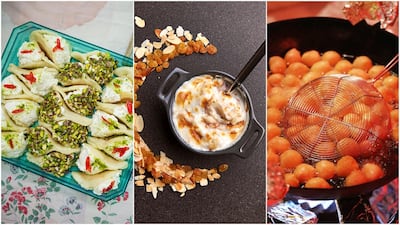
The holy month of Ramadan is on our doorsteps to grace us with myriad health and spiritual blessings. Along with it comes the gratified anticipation of beloved post-iftar treats.
What is the history behind the sumptuous desserts that punctuate the holy month and that shaped the childhood memories of many followers? The backstories have much to do with the fact the Arab world has been a melting pot for ages – a crossroads for civilisations, cultures and cuisines – all down to its strategic location connecting East and West, and influenced by empires such as the Romans, Persians and Ottomans.
All this is woven into the rich foodscape that exists today, and extends to the Middle East’s classic Ramadan’s treats.
Umm Ali – Arabic bread and butter pudding

Umm Ali – meaning "mother of Ali" – originated in Egypt. Think of it as a Middle Eastern bread and butter pudding with a history that dates back to the dynasty of the Mamluk sultans. The story goes that Shagaret El Dorr, queen of Egypt in the 1200s and wife of ruler Ezz El-Din Aybek, ordered the death of her husband. In revenge, Aybek's other wife, Umm Ali, successfully carried out Shagaret's assassination.
To celebrate her rival's death, Umm Ali requested her cooks to create the most delicious dessert and distribute it throughout Egypt.
This dessert is traditionally made of a filo-like pastry, milk, butter, cream and sugar, topped with nuts, raisins and coconut flakes. It has spread to the Arab world with minor variations, such as the addition of orange blossom or rose water.
Basbousa – Arabic vanilla cake

A simple semolina cake drenched in sugar syrup, this can be served plain, topped with nuts, or qashta (clotted cream), and is the epitome of comfort desserts. In some regions, coconut and saffron are added, and the sugar syrup is infused with rose water.
The taste and texture are akin to a vanilla cake that is crusty on the outside and spongy within. Basbousa is traditionally baked in large round trays, cut into squares or diamonds, and served in the same tray.
Its origins go back to the revani of Turkish cuisine, a classic cake from the Ottoman Empire. The Arabic name stems from the verb “bas”, meaning blend, as basbousa is prepared by blending the semolina flour with margarine.
Also known as harissah and namoura, basbousa is available in every corner of the Arab world from North Africa and the Levant to the Gulf.
Kunafah – Arabic string pastry

Sweet, rich, crunchy and creamy, kunafeh, kunafah or knafeh has it all. A mouth-watering and hearty dessert with numerous traditional variations, kunafah’s origins are purely Arabic, and not Turkish as many think.
It was first served in Ramadan during the Umayyad dynasty when the Caliph Muawiyah ordered his cook to prepare a rich dish to help him endure the fast.
Kunafah is made of thin, noodle-like dough, which is layered in a tray with a filling of either stretchy cheese such as Nabulsi, clotted cream, or just toasted nuts and raisins. The top and bottom are crunchy on the outside thanks to pan-frying or baking. Like typical Middle Eastern desserts, it is finished with a generous pour of sugar syrup.
The process of making Kunafah noodles is almost hyptonic. The kanafani – person who prepares kunafah – towers over a circular hot stove with a shower-head-like tool seeping with runny dough, skilfully drawing circular continuous spirals that are transformed instantly to hair-like noodles.
Qatayef – Arabic pancake
Qatayef is a strong contender on both iftar and suhoor tables. It is the most versatile Ramadan dessert, as it can also works as a savoury appetiser. It is said that qatayef has Fatimid Dynasty origins, and some books also linked it to the Abbasid Caliphate.

Think of qatayef as a fluffy pancake that can take the form of sweet or savoury dumplings. It can be filled with a mixture of nuts and sugar, qashta (clotted cream), and akkawi or ricotta cheese. It is fried until golden crispy then dipped in sugar syrup.
For the savoury version, the filling could be spiced minced meat, creamy feta cheese with dried mint or simply mozzarella and cheddar cheese, all of which make for a finger-licking appetiser.
Popular in the Levant, is the soft, uncooked qatayef assafiri, meaning bird-size qatayef. This version is smaller in size and folded into half circles with open pockets, which are filled with sweetened cheese or qashta, then sprinkled with ground pistachios, and drizzled with honey.
Luqaimat – Arabic dumplings

Luqaimat is an Emirati dessert that translates as “small bites". The airy golden dumplings are made of a saffron and cardamom-infused batter, deep-fried, then smothered in date syrup, and sprinkled with sesame seeds.
Luqaimat has many version and names that have spread across neighbouring countries, of which the Greek loukoumades are believed to be the oldest. Egypt has louqmet el qadi, which is coated with icing sugar after frying. A similar dessert called zalabia is common in Lebanon.

