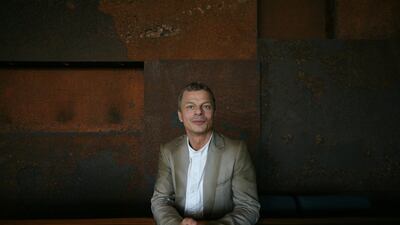
Zuma co-founder Rainer Becker launched his latest concept, Roka, in Dubai just as the pandemic forced restaurants to close. Amy Leang/The National

'It's important we adapt': What Roka's Rainer Becker has learnt from opening a restaurant in a pandemic


Janice Rodrigues
  • English
  • Arabic

Anyone who has ever opened a restaurant will be able to say, with abject certainty, that it is no quick nor easy job.

From creating a concept and menu from scratch to organising licensing and staffing, there’s a lot that goes on behind the scenes to create that perfect dining experience. But while opening a restaurant is in itself a Herculean task, launching one during a pandemic is an entirely different matter.

And, even those with years of experience in the industry, such as Rainer Becker, chef and co-founder of Dubai institution Zuma, are not immune to the challenges the scenario presents.

Becker launched his latest Dubai concept, Roka, earlier this year. Its soft opening took place on March 9 and it officially opened doors on March 18. Just three days later, the team was informed that they would have to operate at a limited capacity. By the end of the month, all restaurants in Dubai were closed to guests and only allowed to do deliveries.

“Opening a restaurant is tough at the best of times but this specific situation is unprecedented,” Becker says.

“There was little time for preparation; we needed to be agile, make quick decisions and, most importantly, ensure our staff and guests were kept as safe as possible. I can only commend our teams for their flexibility and hard work during this period – they have gone above and beyond.”

When news first broke of the coronavirus pandemic, and subsequent safety measures, Roka staff responded by closing the restaurant to evaluate the situation. However, by May, staff had adapted to offer deliveries – a service never before performed at any of Becker’s restaurants around the world.

If the past few months have taught the restaurant industry anything, then it's that you can go from 100 to 0 per cent overnight

“Even when restaurants were allowed to open, people were understandably still hesitant to dine out, so we tried to deliver the Roka experience to their homes," says Becker. "As restrictions were lifted during Ramadan, we developed an iftar and Eid menu, which we also made available for takeaway."

The restaurant has since opened to diners as restrictions have gradually been lifted, while accommodating social distancing measures. However, Roka will continue to offer takeaways for the foreseeable future.

According to Becker, it is this ability to adapt to the new normal that will make or break restaurants in the months to come.

“It has always been important that restaurants adapt – look at consumer trends, listen to customers, monitor industry movements, etc. However, if the past few months have taught the restaurant industry anything, then it’s that you can go from 100 to 0 per cent overnight," the chef says.

"Therefore, it is even more important, moving forward, that we watch all of these areas and the economy, and adapt accordingly.

Rainer Becker's Roka started delivering iftar during Ramadan. Courtesy Roka

“I think the repercussions of Covid-19 will be felt for a long time to come and if you are not agile, then there is a risk that your business will not succeed."

Becker admits that, had he foreseen how the year would unfold, he would have delayed Roka's opening, ideally to 2021. But, despite the challenges of launching a new concept and having to gain customers' trust during a pandemic, business has been going relatively well.

“It is not what we projected, of course, but considering the restrictions, we couldn’t ask for more," he says.

"Our general manager and head chef have worked incredibly hard to build a strong and cohesive team in very difficult circumstances and I believe that will go a long way to the long term success of Roka Dubai. We have also been very fortunate with our landlord who has been very accommodating; other businesses have not had that advantage.”

Going forward, Becker believes there’s no one-size-fits-all solution when it comes to the success of a restaurant.

“I think the main thing right now is to keep a very close eye on the figures and trends over the next six to nine months and, above all, adapt quickly.”


Ferrari 12Cilindri specs

Engine: naturally aspirated 6.5-liter V12

Power: 819hp

Torque: 678Nm at 7,250rpm

Price: From Dh1,700,000

Available: Now

How to wear a kandura

Dos

  • Wear the right fabric for the right season and occasion 
  • Always ask for the dress code if you don’t know
  • Wear a white kandura, white ghutra / shemagh (headwear) and black shoes for work 
  • Wear 100 per cent cotton under the kandura as most fabrics are polyester

Don’ts 

  • Wear hamdania for work, always wear a ghutra and agal 
  • Buy a kandura only based on how it feels; ask questions about the fabric and understand what you are buying
COMPANY PROFILE
Name: Kumulus Water
 
Started: 2021
 
Founders: Iheb Triki and Mohamed Ali Abid
 
Based: Tunisia 
 
Sector: Water technology 
 
Number of staff: 22 
 
Investment raised: $4 million 
Conflict, drought, famine

Estimates of the number of deaths caused by the famine range from 400,000 to 1 million, according to a document prepared for the UK House of Lords in 2024.
It has been claimed that the policies of the Ethiopian government, which took control after deposing Emperor Haile Selassie in a military-led revolution in 1974, contributed to the scale of the famine.
Dr Miriam Bradley, senior lecturer in humanitarian studies at the University of Manchester, has argued that, by the early 1980s, “several government policies combined to cause, rather than prevent, a famine which lasted from 1983 to 1985. Mengistu’s government imposed Stalinist-model agricultural policies involving forced collectivisation and villagisation [relocation of communities into planned villages].
The West became aware of the catastrophe through a series of BBC News reports by journalist Michael Buerk in October 1984 describing a “biblical famine” and containing graphic images of thousands of people, including children, facing starvation.

Band Aid

Bob Geldof, singer with the Irish rock group The Boomtown Rats, formed Band Aid in response to the horrific images shown in the news broadcasts.
With Midge Ure of the band Ultravox, he wrote the hit charity single Do They Know it’s Christmas in December 1984, featuring a string of high-profile musicians.
Following the single’s success, the idea to stage a rock concert evolved.
Live Aid was a series of simultaneous concerts that took place at Wembley Stadium in London, John F Kennedy Stadium in Philadelphia, the US, and at various other venues across the world.
The combined event was broadcast to an estimated worldwide audience of 1.5 billion.

The%20specs%20
%3Cp%3E%3Cstrong%3EEngine%3A%20%3C%2Fstrong%3E2.0-litre%204cyl%20turbo%0D%3Cbr%3E%3Cstrong%3EPower%3A%20%3C%2Fstrong%3E261hp%20at%205%2C500rpm%0D%3Cbr%3E%3Cstrong%3ETorque%3A%20%3C%2Fstrong%3E400Nm%20at%201%2C750-4%2C000rpm%0D%3Cbr%3E%3Cstrong%3ETransmission%3A%20%3C%2Fstrong%3E7-speed%20dual-clutch%20auto%0D%3Cbr%3E%3Cstrong%3EFuel%20consumption%3A%20%3C%2Fstrong%3E10.5L%2F100km%0D%3Cbr%3E%3Cstrong%3EOn%20sale%3A%20%3C%2Fstrong%3ENow%0D%3Cbr%3E%3Cstrong%3EPrice%3A%20%3C%2Fstrong%3EFrom%20Dh129%2C999%20(VX%20Luxury)%3B%20from%20Dh149%2C999%20(VX%20Black%20Gold)%3C%2Fp%3E%0A
MATCH INFO

Uefa Champions League, last-16 second leg
Paris Saint-Germain (1) v Borussia Dortmund (2)
Kick-off: Midnight, Thursday, March 12
Stadium: Parc des Princes
Live: On beIN Sports HD

What can victims do?

Always use only regulated platforms

Stop all transactions and communication on suspicion

Save all evidence (screenshots, chat logs, transaction IDs)

Report to local authorities

Warn others to prevent further harm

Courtesy: Crystal Intelligence

NYBL PROFILE

Company name: Nybl 

Date started: November 2018

Founder: Noor Alnahhas, Michael LeTan, Hafsa Yazdni, Sufyaan Abdul Haseeb, Waleed Rifaat, Mohammed Shono

Based: Dubai, UAE

Sector: Software Technology / Artificial Intelligence

Initial investment: $500,000

Funding round: Series B (raising $5m)

Partners/Incubators: Dubai Future Accelerators Cohort 4, Dubai Future Accelerators Cohort 6, AI Venture Labs Cohort 1, Microsoft Scale-up 

The specs: 2018 Nissan 370Z Nismo

The specs: 2018 Nissan 370Z Nismo
Price, base / as tested: Dh182,178
Engine: 3.7-litre V6
Power: 350hp @ 7,400rpm
Torque: 374Nm @ 5,200rpm
Transmission: Seven-speed automatic
​​​​​​​Fuel consumption, combined: 10.5L / 100km

Mercer, the investment consulting arm of US services company Marsh & McLennan, expects its wealth division to at least double its assets under management (AUM) in the Middle East as wealth in the region continues to grow despite economic headwinds, a company official said.

Mercer Wealth, which globally has $160 billion in AUM, plans to boost its AUM in the region to $2-$3bn in the next 2-3 years from the present $1bn, said Yasir AbuShaban, a Dubai-based principal with Mercer Wealth.

Within the next two to three years, we are looking at reaching $2 to $3 billion as a conservative estimate and we do see an opportunity to do so,” said Mr AbuShaban.

Mercer does not directly make investments, but allocates clients’ money they have discretion to, to professional asset managers. They also provide advice to clients.

“We have buying power. We can negotiate on their (client’s) behalf with asset managers to provide them lower fees than they otherwise would have to get on their own,” he added.

Mercer Wealth’s clients include sovereign wealth funds, family offices, and insurance companies among others.

From its office in Dubai, Mercer also looks after Africa, India and Turkey, where they also see opportunity for growth.

Wealth creation in Middle East and Africa (MEA) grew 8.5 per cent to $8.1 trillion last year from $7.5tn in 2015, higher than last year’s global average of 6 per cent and the second-highest growth in a region after Asia-Pacific which grew 9.9 per cent, according to consultancy Boston Consulting Group (BCG). In the region, where wealth grew just 1.9 per cent in 2015 compared with 2014, a pickup in oil prices has helped in wealth generation.

BCG is forecasting MEA wealth will rise to $12tn by 2021, growing at an annual average of 8 per cent.

Drivers of wealth generation in the region will be split evenly between new wealth creation and growth of performance of existing assets, according to BCG.

Another general trend in the region is clients’ looking for a comprehensive approach to investing, according to Mr AbuShaban.

“Institutional investors or some of the families are seeing a slowdown in the available capital they have to invest and in that sense they are looking at optimizing the way they manage their portfolios and making sure they are not investing haphazardly and different parts of their investment are working together,” said Mr AbuShaban.

Some clients also have a higher appetite for risk, given the low interest-rate environment that does not provide enough yield for some institutional investors. These clients are keen to invest in illiquid assets, such as private equity and infrastructure.

“What we have seen is a desire for higher returns in what has been a low-return environment specifically in various fixed income or bonds,” he said.

“In this environment, we have seen a de facto increase in the risk that clients are taking in things like illiquid investments, private equity investments, infrastructure and private debt, those kind of investments were higher illiquidity results in incrementally higher returns.”

The Abu Dhabi Investment Authority, one of the largest sovereign wealth funds, said in its 2016 report that has gradually increased its exposure in direct private equity and private credit transactions, mainly in Asian markets and especially in China and India. The authority’s private equity department focused on structured equities owing to “their defensive characteristics.”

Key products and UAE prices

iPhone XS
With a 5.8-inch screen, it will be an advance version of the iPhone X. It will be dual sim and comes with better battery life, a faster processor and better camera. A new gold colour will be available.
Price: Dh4,229

iPhone XS Max
It is expected to be a grander version of the iPhone X with a 6.5-inch screen; an inch bigger than the screen of the iPhone 8 Plus.
Price: Dh4,649

iPhone XR
A low-cost version of the iPhone X with a 6.1-inch screen, it is expected to attract mass attention. According to industry experts, it is likely to have aluminium edges instead of stainless steel.
Price: Dh3,179

Apple Watch Series 4
More comprehensive health device with edge-to-edge displays that are more than 30 per cent bigger than displays on current models.


Islamophobia definition

A widely accepted definition was made by the All Party Parliamentary Group on British Muslims in 2019: “Islamophobia is rooted in racism and is a type of racism that targets expressions of Muslimness or perceived Muslimness.” It further defines it as “inciting hatred or violence against Muslims”.