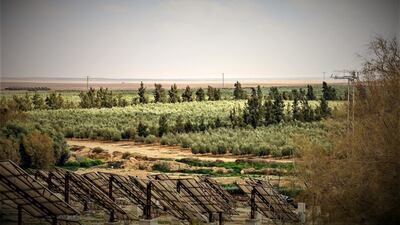
The farm has 155,000 olive trees and produces up to 100 tonnes of extra-virgin olive oil every year. Photo Diana Argueta Sinclair

Family-run olive oil estate in Jordan makes its mark on world culinary stage


  • English
  • Arabic

About two hours outside Amman, in the middle of a vast desert, sit 155,000 olive trees. They produce some of the Middle East’s highest quality olive oil, all extra-virgin. Their fruit goes through a high-tech Italian press, and the oil is the result of a decade of research and constant tweaking. The farm is the “fifth child” of Ziad Bilbeisi, former architect and founder of Al Maida. He works with his four “real” children to produce the oil that won a bronze medal at the London International Olive Oil Competition in April last year, where it was up against heavyweights from across the world.

Al Maida olive oil

Twenty years ago, after moving back to Amman from London where he’d been working, Ziad started to make oil with fruit from the 200 or so trees on his land. He realised there was a lack of high-quality extra-virgin olive oil in the Jordanian market, and curiosity and passion drove him to remedy that. Soon, he imported a small press from Italy and began to learn the technicalities that take olive oil from acceptable to extraordinary.

Al Maida olive oil, right, won the bronze medal at the London Olive Oil Awards. Photo Diana Argueta Sinclair

“The more you look into it, the more mysterious it is,” he says. “And the health benefits are enormous.” Olive oil is a key source of antioxidants and monounsaturated fats, which can help prevent heart disease, osteoporosis and type 2 diabetes; and are good for skin and hair. Extra-virgin olive oil has more of these antioxidants and good fats, plus fewer chemicals.

“Olive oil is a huge part of Jordanian culture and food history, but the value of premium extra-virgin olive oil simply isn’t there,” says Firas Bilbeisi, one of Ziad’s sons, who lives in London and works in the sales side of the business. “Most families in Jordan have a few trees, and they’ll go to the local mill and get a few containers for the family, but the quality is poor.”

Changing perceptions 

In an effort to change the perception around olive oil in the country, and also because he saw a market opportunity, Ziad purchased a plot of land outside the city about 10 years ago and imported Spanish olive trees. People told him he was crazy, and that he was wasting money.

“Even the Ministry of Agriculture said to me: ‘Do you really believe in this?’” he says. A decade later, he owns four plots of land and Al Maida is the largest family-run estate in Jordan, producing between 56 and 100 tonnes of oil each year, and supplying it to some of Ziad’s previous sceptics.

Amelia and Ziad Bilbeisi. Photo Rebecca Holland

The Bilbeisis grow Spanish Arbequina and Arbosana trees, Greek Koroneiki olives, and the local varieties Nabali and Baladi. Research led Ziad to a high-intensity growing system, which allows more trees to be planted in an area, and allows them to produce more oil, while also eliminating the gap year most farms have.

As the olives grow, Ziad and his team of about a dozen permanent workers (the number goes up during harvest season, and often includes Syrian refugees) moderate the moisture, wind, radiation and temperature through a weather station. The trees are all tilted at 355 degrees, towards the sun.

“A lot of people think: ‘Oh, I have some trees, I’ll just let them grow and make oil.’ It’s not like that. Not if you want great oil, anyway,” says Amelia, Ziad’s daughter, who works with him in Amman.

Traditional farms are susceptible to weather and irrigation, especially in the middle of the Jordanian desert. However, Ziad’s land sits above artesian wells, which are pumped into reservoirs throughout the farm by solar-powered pumps. He is still subject to daily extraction limits set by the government, but the water is always there and ready.

Quality control

The olives are harvested and pressed within the hour on-site, in a mill from Mori-Tem, a leading Italian manufacturer of olive mills. “Every hour [after harvesting] that they’re not pressed, they deteriorate. This reflects in the final product,” Ziad says. The mill is the same one used by many manufacturers in Europe and the US, and looking out over the trees and back at the machine, you could mistake Al Maida for somewhere in Tuscany.

“We look at what Europe does; that’s our default,” Firas says, explaining that the family stick to European standards rather than less stringent local regulations. The two benchmarks of the International Olive Council (a regulatory agency based in Madrid) are fatty acids and peroxide. In order to be classified as premium-grade olive oil, fatty acids have to be less than 0.8 per cent; Al Maida’s run at 0.2 per cent. Peroxide levels should be under 20; Al Maida’s are under 10. When the team entered the London International Olive Oil Competition, Ziad says it wasn’t so much about recognition as seeing where they stood, so “we know how we can improve”.

A man hired to work on the estate during harvest season. Photo Diana Argueta Sinclair

Chefs, too, are starting to take notice of Al Maida olive oil. It is currently sold white label to Michelin-starred restaurants in the UK, to restaurants across the Middle East, and to private clients. In the UAE, diners can find Al Maida on Andaz menus. Amelia hopes to expand to the US soon and sell to consumers under the brand’s own label.

Her hope is that discerning consumers will understand the difference between low and high-quality oil. “When you buy in a supermarket, you don’t always know what you’re getting,” Amelia says. “There are buzzwords like ‘cold-pressed’, which doesn’t mean anything because almost all extra-virgin olive oil is pressed cold, but there are numbers you can look for [high-quality olive oils will list their fatty acid and peroxide numbers]. And if consumers can learn to taste, they have the power.”  

I only wish I started when I was younger. When I see my people enjoying the oil, I feel very happy. It's lovely to have people appreciate something you've made.

When it comes to tasting, consumers can start with a few basics: the oil should have an element of tart fruitiness; should cleanse your palate, not stick to it; and should not scratch the back of your throat (that means it’s oxidised). One problem is that people are so used to consuming bad olive oil that sometimes when they do a taste test, that’s what they prefer. “It’s an outdated mentality where premium-grade olive oil is still held in the same regard as any base oil,” Amelia says.

Still, she and her father are hopeful things can change, and they’re continuing to improve their product and educate those who are interested. Changing public perception, learning in-depth technical skills from scratch, producing olive oil in a desert, and working to be among the world’s best producers – it’s a big task, especially for someone approaching 80. But Ziad doesn’t regret going down this path.

“I only wish I started when I was younger,” he says, looking over the trees. “When I see my people enjoying the oil, I feel very happy. It’s lovely to have people appreciate something you’ve made.”


Ten tax points to be aware of in 2026

1. Domestic VAT refund amendments: request your refund within five years

If a business does not apply for the refund on time, they lose their credit.

2. E-invoicing in the UAE

Businesses should continue preparing for the implementation of e-invoicing in the UAE, with 2026 a preparation and transition period ahead of phased mandatory adoption. 

3. More tax audits

Tax authorities are increasingly using data already available across multiple filings to identify audit risks. 

4. More beneficial VAT and excise tax penalty regime

Tax disputes are expected to become more frequent and more structured, with clearer administrative objection and appeal processes. The UAE has adopted a new penalty regime for VAT and excise disputes, which now mirrors the penalty regime for corporate tax.

5. Greater emphasis on statutory audit

There is a greater need for the accuracy of financial statements. The International Financial Reporting Standards standards need to be strictly adhered to and, as a result, the quality of the audits will need to increase.

6. Further transfer pricing enforcement

Transfer pricing enforcement, which refers to the practice of establishing prices for internal transactions between related entities, is expected to broaden in scope. The UAE will shortly open the possibility to negotiate advance pricing agreements, or essentially rulings for transfer pricing purposes. 

7. Limited time periods for audits

Recent amendments also introduce a default five-year limitation period for tax audits and assessments, subject to specific statutory exceptions. While the standard audit and assessment period is five years, this may be extended to up to 15 years in cases involving fraud or tax evasion. 

8. Pillar 2 implementation 

Many multinational groups will begin to feel the practical effect of the Domestic Minimum Top-Up Tax (DMTT), the UAE's implementation of the OECD’s global minimum tax under Pillar 2. While the rules apply for financial years starting on or after January 1, 2025, it is 2026 that marks the transition to an operational phase.

9. Reduced compliance obligations for imported goods and services

Businesses that apply the reverse-charge mechanism for VAT purposes in the UAE may benefit from reduced compliance obligations. 

10. Substance and CbC reporting focus

Tax authorities are expected to continue strengthening the enforcement of economic substance and Country-by-Country (CbC) reporting frameworks. In the UAE, these regimes are increasingly being used as risk-assessment tools, providing tax authorities with a comprehensive view of multinational groups’ global footprints and enabling them to assess whether profits are aligned with real economic activity. 

Contributed by Thomas Vanhee and Hend Rashwan, Aurifer

THE BIO:

Favourite holiday destination: Thailand. I go every year and I’m obsessed with the fitness camps there.

Favourite book: Born to Run by Christopher McDougall. It’s an amazing story about barefoot running.

Favourite film: A League of their Own. I used to love watching it in my granny’s house when I was seven.

Personal motto: Believe it and you can achieve it.

Results:

2.15pm: Handicap (PA) Dh60,000 1,200m.

Winner: AZ Dhabyan, Adam McLean (jockey), Saleha Al Ghurair (trainer).

2.45pm: Maiden (PA) Dh60,000 1,200m.

Winner: Ashton Tourettes, Sam Hitchcott, Ibrahim Aseel.

3.15pm: Conditions (PA) Dh60,000 2,000m.

Winner: Hareer Al Reef, Gerald Avranche, Abdallah Al Hammadi.

3.45pm: Maiden (PA) Dh60,000 1,700m.

Winner: Kenz Al Reef, Gerald Avranche, Abdallah Al Hammadi.

4.15pm: Sheikh Ahmed bin Rashid Al Maktoum Cup (TB) Dh 200,000 1,700m.

Winner: Mystique Moon, Sam Hitchcott, Doug Watson.

4.45pm: The Crown Prince Of Sharjah Cup Prestige (PA) Dh200,000 1,200m.

Winner: ES Ajeeb, Sam Hitchcott, Ibrahim Aseel.

RESULT

Wolves 1 (Traore 67')

Tottenham 2 (Moura 8', Vertonghen 90 1')

Man of the Match: Adama Traore (Wolves)

WHAT IS GRAPHENE?

It was discovered in 2004, when Russian-born Manchester scientists Andrei Geim and Kostya Novoselov were experimenting with sticky tape and graphite, the material used as lead in pencils.

Placing the tape on the graphite and peeling it, they managed to rip off thin flakes of carbon. In the beginning they got flakes consisting of many layers of graphene. But when they repeated the process many times, the flakes got thinner.

By separating the graphite fragments repeatedly, they managed to create flakes that were just one atom thick. Their experiment led to graphene being isolated for the very first time.

In 2010, Geim and Novoselov were awarded the Nobel Prize for Physics. 

The specs: 2019 Audi A7 Sportback

Price, base: Dh315,000

Engine: 3.0-litre V6

Transmission: Seven-speed automatic

Power: 335hp @ 5,000rpm

Torque: 500Nm @ 1,370rpm

Fuel economy 5.9L / 100km

Mercer, the investment consulting arm of US services company Marsh & McLennan, expects its wealth division to at least double its assets under management (AUM) in the Middle East as wealth in the region continues to grow despite economic headwinds, a company official said.

Mercer Wealth, which globally has $160 billion in AUM, plans to boost its AUM in the region to $2-$3bn in the next 2-3 years from the present $1bn, said Yasir AbuShaban, a Dubai-based principal with Mercer Wealth.

Within the next two to three years, we are looking at reaching $2 to $3 billion as a conservative estimate and we do see an opportunity to do so,” said Mr AbuShaban.

Mercer does not directly make investments, but allocates clients’ money they have discretion to, to professional asset managers. They also provide advice to clients.

“We have buying power. We can negotiate on their (client’s) behalf with asset managers to provide them lower fees than they otherwise would have to get on their own,” he added.

Mercer Wealth’s clients include sovereign wealth funds, family offices, and insurance companies among others.

From its office in Dubai, Mercer also looks after Africa, India and Turkey, where they also see opportunity for growth.

Wealth creation in Middle East and Africa (MEA) grew 8.5 per cent to $8.1 trillion last year from $7.5tn in 2015, higher than last year’s global average of 6 per cent and the second-highest growth in a region after Asia-Pacific which grew 9.9 per cent, according to consultancy Boston Consulting Group (BCG). In the region, where wealth grew just 1.9 per cent in 2015 compared with 2014, a pickup in oil prices has helped in wealth generation.

BCG is forecasting MEA wealth will rise to $12tn by 2021, growing at an annual average of 8 per cent.

Drivers of wealth generation in the region will be split evenly between new wealth creation and growth of performance of existing assets, according to BCG.

Another general trend in the region is clients’ looking for a comprehensive approach to investing, according to Mr AbuShaban.

“Institutional investors or some of the families are seeing a slowdown in the available capital they have to invest and in that sense they are looking at optimizing the way they manage their portfolios and making sure they are not investing haphazardly and different parts of their investment are working together,” said Mr AbuShaban.

Some clients also have a higher appetite for risk, given the low interest-rate environment that does not provide enough yield for some institutional investors. These clients are keen to invest in illiquid assets, such as private equity and infrastructure.

“What we have seen is a desire for higher returns in what has been a low-return environment specifically in various fixed income or bonds,” he said.

“In this environment, we have seen a de facto increase in the risk that clients are taking in things like illiquid investments, private equity investments, infrastructure and private debt, those kind of investments were higher illiquidity results in incrementally higher returns.”

The Abu Dhabi Investment Authority, one of the largest sovereign wealth funds, said in its 2016 report that has gradually increased its exposure in direct private equity and private credit transactions, mainly in Asian markets and especially in China and India. The authority’s private equity department focused on structured equities owing to “their defensive characteristics.”

UAE currency: the story behind the money in your pockets
Our legal consultant

Name: Dr Hassan Mohsen Elhais

Position: legal consultant with Al Rowaad Advocates and Legal Consultants.

Zakat definitions

Zakat: an Arabic word meaning ‘to cleanse’ or ‘purification’.

Nisab: the minimum amount that a Muslim must have before being obliged to pay zakat. Traditionally, the nisab threshold was 87.48 grams of gold, or 612.36 grams of silver. The monetary value of the nisab therefore varies by current prices and currencies.

Zakat Al Mal: the ‘cleansing’ of wealth, as one of the five pillars of Islam; a spiritual duty for all Muslims meeting the ‘nisab’ wealth criteria in a lunar year, to pay 2.5 per cent of their wealth in alms to the deserving and needy.

Zakat Al Fitr: a donation to charity given during Ramadan, before Eid Al Fitr, in the form of food. Every adult Muslim who possesses food in excess of the needs of themselves and their family must pay two qadahs (an old measure just over 2 kilograms) of flour, wheat, barley or rice from each person in a household, as a minimum.

Profile of Foodics

Founders: Ahmad AlZaini and Mosab AlOthmani

Based: Riyadh

Sector: Software

Employees: 150

Amount raised: $8m through seed and Series A - Series B raise ongoing

Funders: Raed Advanced Investment Co, Al-Riyadh Al Walid Investment Co, 500 Falcons, SWM Investment, AlShoaibah SPV, Faith Capital, Technology Investments Co, Savour Holding, Future Resources, Derayah Custody Co.

Men from Barca's class of 99

Crystal Palace - Frank de Boer

Everton - Ronald Koeman

Manchester City - Pep Guardiola

Manchester United - Jose Mourinho

Southampton - Mauricio Pellegrino

Stamp duty timeline

December 2014: Former UK finance minister George Osbourne reforms stamp duty, replacing the slab system with a blended rate scheme, with the top rate increasing to 12 per cent from 10 per cent:
Up to £125,000 - 0%; £125,000 to £250,000 – 2%; £250,000 to £925,000 – 5%; £925,000 to £1.5m: 10%; Over £1.5m – 12%

April 2016: New 3% surcharge applied to any buy-to-let properties or additional homes purchased.

July 2020: Rishi Sunak unveils SDLT holiday, with no tax to pay on the first £500,000, with buyers saving up to £15,000.

March 2021: Mr Sunak decides the fate of SDLT holiday at his March 3 budget, with expectations he will extend the perk unti June.

April 2021: 2% SDLT surcharge added to property transactions made by overseas buyers.

Wicked: For Good

Director: Jon M Chu

Starring: Ariana Grande, Cynthia Erivo, Jonathan Bailey, Jeff Goldblum, Michelle Yeoh, Ethan Slater

Rating: 4/5

Types of fraud

Phishing: Fraudsters send an unsolicited email that appears to be from a financial institution or online retailer. The hoax email requests that you provide sensitive information, often by clicking on to a link leading to a fake website.

Smishing: The SMS equivalent of phishing. Fraudsters falsify the telephone number through “text spoofing,” so that it appears to be a genuine text from the bank.

Vishing: The telephone equivalent of phishing and smishing. Fraudsters may pose as bank staff, police or government officials. They may persuade the consumer to transfer money or divulge personal information.

SIM swap: Fraudsters duplicate the SIM of your mobile number without your knowledge or authorisation, allowing them to conduct financial transactions with your bank.

Identity theft: Someone illegally obtains your confidential information, through various ways, such as theft of your wallet, bank and utility bill statements, computer intrusion and social networks.

Prize scams: Fraudsters claiming to be authorised representatives from well-known organisations (such as Etisalat, du, Dubai Shopping Festival, Expo2020, Lulu Hypermarket etc) contact victims to tell them they have won a cash prize and request them to share confidential banking details to transfer the prize money.

* Nada El Sawy