• Diana, Princess Of Wales, holds a baby at a shelter for abandoned children in Sao Paolo, Brazil, in 1991. Getty Images
    Diana, Princess Of Wales, holds a baby at a shelter for abandoned children in Sao Paolo, Brazil, in 1991. Getty Images
  • Diana, Princess of Wales, at a Dr Barnardo's Home in Auburn, New South Wales, Australia, January 1988. Getty Images
    Diana, Princess of Wales, at a Dr Barnardo's Home in Auburn, New South Wales, Australia, January 1988. Getty Images
  • Princess Diana visits a welfare centre in Noopur Shanan. Getty Images
    Princess Diana visits a welfare centre in Noopur Shanan. Getty Images
  • Diana, Princess of Wales, cradles a young cancer patient in her arms during a visit to Shaukat Khanum Hospital on February 22, 1996 in Lahore, Pakistan. Getty Images
    Diana, Princess of Wales, cradles a young cancer patient in her arms during a visit to Shaukat Khanum Hospital on February 22, 1996 in Lahore, Pakistan. Getty Images
  • Diana, Princess of Wales visits Tennant Creek in the Northern Territory of Australia, March 1983. Getty Images
    Diana, Princess of Wales visits Tennant Creek in the Northern Territory of Australia, March 1983. Getty Images
  • Princess Diana of Wales poses with Indian children as she visits the Agra chapter of the London-based Marie Stopes family planning clinic on February 11, 1992. AFP
    Princess Diana of Wales poses with Indian children as she visits the Agra chapter of the London-based Marie Stopes family planning clinic on February 11, 1992. AFP
  • The Prince And Princess Of Wales meet school children during a trip to Alice Springs. Getty Images
    The Prince And Princess Of Wales meet school children during a trip to Alice Springs. Getty Images
  • Diana, Princess Of Wales at the National Children's Hospital In Tokyo, Japan. Getty Images
    Diana, Princess Of Wales at the National Children's Hospital In Tokyo, Japan. Getty Images
  • Diana, Princess of Wales embraces a pupil at the Shri Swaminarayan Mandir in Neasden. Getty Images
    Diana, Princess of Wales embraces a pupil at the Shri Swaminarayan Mandir in Neasden. Getty Images
  • Diana, Princess Of Wales with children injured by mines at Neves Bendinha Orthopaedic Workshop In Luanda, Angola. Getty Images
    Diana, Princess Of Wales with children injured by mines at Neves Bendinha Orthopaedic Workshop In Luanda, Angola. Getty Images

The touching reason Princess Diana never wore hats on visits with children


Farah Andrews
  • English
  • Arabic

There is no doubt that royal fashion is carefully considered, with outfits curated for the occasion and rarely simply thrown together.

This was certainly true of Princess Diana, who had a specific rule for events with children, and that was that she could never wear hats.

She said: "You can't cuddle a child in a hat," Kensington Palace curator Claudia Acott Williams revealed.

Diana, Princess of Wales meeting children during her visit to the Hindu temple Neasden, north London on June 6, 1997. EPA

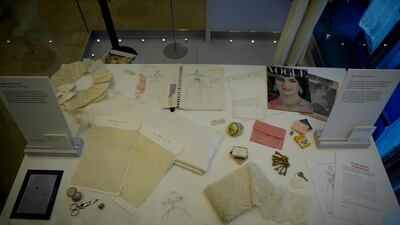
The Royal Style in the Making exhibition, which opened at Kensington Palace on June 3, features the sketch of a blue floral dress regularly worn by the Princess of Wales when she visited children or hospitals. The floral piece, by designer David Sassoon, became known as her "caring dress" because "she knew children loved the bright, floral pattern".

In the sketch, the model is wearing a hat, but the royal never paired a co-ordinating headpiece for events with children. However, Acott Williams says she did wear "big costume jewellery because she would pick children up and they would play with it".

A sketch of Princess Diana's blue 'caring dress' (right) on show at the Royal Style In The Making exhibition at Kensington Palace. Getty Images

"She understood how what you were wearing could really convey warmth ... it could reinforce hierarchy or it could undermine hierarchy and create more of a relationship," says Acott Williams.

"This brightly coloured floral was a really important piece in her working wardrobe."

Matthew Storey, curator at the Historic Royal Palaces, says that the example "really illustrates just how carefully she considered the people she would meet when selecting outfits for her many public engagements".

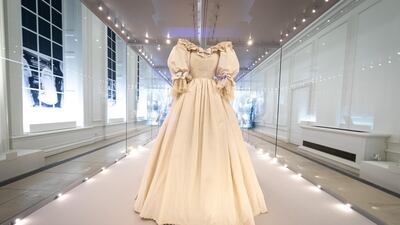
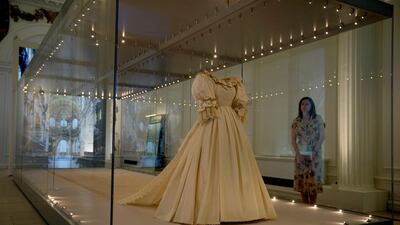
Also included in the exhibition is Princess Diana's wedding dress, which is on public display for the first time in more than 25 years.

The gown, which the late princess wore to marry Prince Charles at London's St Paul's Cathedral on July 29, 1981, was designed by David and Elizabeth Emanuel. It will be on display at Kensington Palace, London, until January 2.

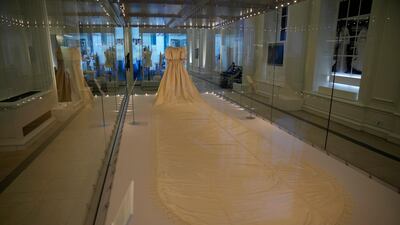
It is on view with the princess's 7.6-metre sequin-encrusted train, which is the longest in British royal history to date.

To include the dress, along with other personal items of the late royal, Historic Royal Palaces had to seek permission from her sons, Princes William and Harry.

Highlights from the Royal Style in the Making exhibition

  • The wedding dress of Britain's Princess Diana is going on display in London as part of the Royal Style in the Making exhibition. EPA
    The wedding dress of Britain's Princess Diana is going on display in London as part of the Royal Style in the Making exhibition. EPA
  • The gown, designed by David and Elizabeth Emanuel, will feature in the Royal Style in the Making exhibition at Kensington Palace in London, opening on June 3, running until January 2, 2022. AP Photo
    The gown, designed by David and Elizabeth Emanuel, will feature in the Royal Style in the Making exhibition at Kensington Palace in London, opening on June 3, running until January 2, 2022. AP Photo
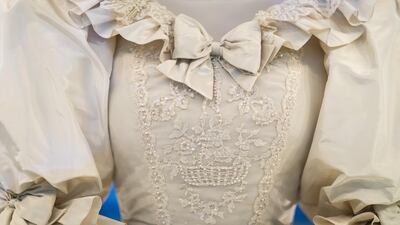
  • A detailed shot of the wedding dress, which then-Lady Diana Spencer wore to marry Prince Charles at St Paul's Cathedral, London, on July 29, 1981. Getty Images
    A detailed shot of the wedding dress, which then-Lady Diana Spencer wore to marry Prince Charles at St Paul's Cathedral, London, on July 29, 1981. Getty Images
  • The dress has a 7.6-metre sequin-encrusted train, which is the longest in British royal history to date. AP Photo
    The dress has a 7.6-metre sequin-encrusted train, which is the longest in British royal history to date. AP Photo
  • To include the dress in the exhibition, organisers had to seek permission from Princes Harry and William. Getty Images
    To include the dress in the exhibition, organisers had to seek permission from Princes Harry and William. Getty Images
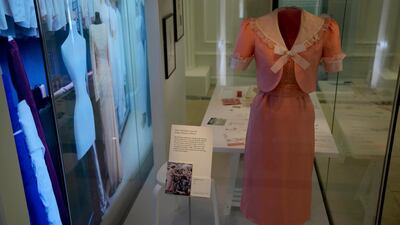
  • The dress and jacket that Princess Diana changed into on her wedding day made by designer David Sassoon is displayed in the Royal Style in the Making exhibition at Kensington Palace in London. AP Photo
    The dress and jacket that Princess Diana changed into on her wedding day made by designer David Sassoon is displayed in the Royal Style in the Making exhibition at Kensington Palace in London. AP Photo
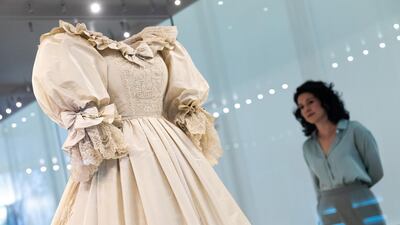
  • The gown, designed by David and Elizabeth Emanuel, will feature in the Royal Style in the Making exhibition at Kensington Palace in London, opening on June 3, running until January 2, 2022. AP Photo
    The gown, designed by David and Elizabeth Emanuel, will feature in the Royal Style in the Making exhibition at Kensington Palace in London, opening on June 3, running until January 2, 2022. AP Photo
  • An evening dress worn by Queen Elizabeth, The Queen Mother, is displayed in the Royal Style in the Making exhibition at Kensington Palace in London. Getty Images
    An evening dress worn by Queen Elizabeth, The Queen Mother, is displayed in the Royal Style in the Making exhibition at Kensington Palace in London. Getty Images
  • A Georgian-style dress worn by Princess Margaret, the sister of Britain's Queen Elizabeth II, to a charity costume ball in 1964 and created by theatre designer Oliver Messel is displayed in the Royal Style in the Making exhibition at Kensington Palace in London. AP Photo
    A Georgian-style dress worn by Princess Margaret, the sister of Britain's Queen Elizabeth II, to a charity costume ball in 1964 and created by theatre designer Oliver Messel is displayed in the Royal Style in the Making exhibition at Kensington Palace in London. AP Photo
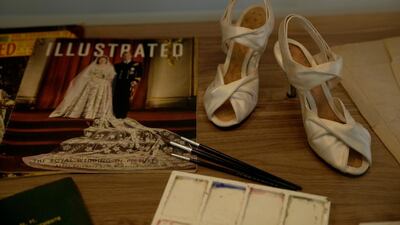
  • Prototype shoes for the ones Britain's Queen Elizabeth II wore at her wedding are displayed in the Royal Style in the Making exhibition at Kensington Palace in London. AP Photo
    Prototype shoes for the ones Britain's Queen Elizabeth II wore at her wedding are displayed in the Royal Style in the Making exhibition at Kensington Palace in London. AP Photo
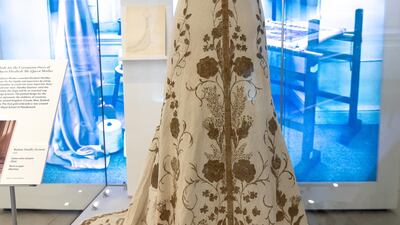
  • A rare surviving toile for the 1937 coronation gown of Queen Elizabeth The Queen Mother; consort of King George VI, is displayed in the Royal Style in the Making exhibition at Kensington Palace in London. Getty Images
    A rare surviving toile for the 1937 coronation gown of Queen Elizabeth The Queen Mother; consort of King George VI, is displayed in the Royal Style in the Making exhibition at Kensington Palace in London. Getty Images
  • Items from the design process of the wedding dress of Princess Diana created by David and Elizabeth Emanuel are also on display. AP Photo
    Items from the design process of the wedding dress of Princess Diana created by David and Elizabeth Emanuel are also on display. AP Photo

Also included in the exhibition are the pink Sassoon dress and jacket that Princess Diana changed into later on her wedding day, as well as artefacts detailing the creation of her wedding dress.

The exhibition features pieces worn by other British royals, including the surviving toile for the 1937 coronation dress of the Queen Mother and a Georgian-style dress worn by Princess Margaret, the sister of Queen Elizabeth II, to a 1964 charity costume ball.


Indoor cricket in a nutshell
Indoor Cricket World Cup - Sept 16-20, Insportz, Dubai

16 Indoor cricket matches are 16 overs per side
8 There are eight players per team
9 There have been nine Indoor Cricket World Cups for men. Australia have won every one.
5 Five runs are deducted from the score when a wickets falls
4 Batsmen bat in pairs, facing four overs per partnership

Scoring In indoor cricket, runs are scored by way of both physical and bonus runs. Physical runs are scored by both batsmen completing a run from one crease to the other. Bonus runs are scored when the ball hits a net in different zones, but only when at least one physical run is score.

Zones

A Front net, behind the striker and wicketkeeper: 0 runs
B Side nets, between the striker and halfway down the pitch: 1 run
C Side nets between halfway and the bowlers end: 2 runs
D Back net: 4 runs on the bounce, 6 runs on the full

Europe’s rearming plan
  • Suspend strict budget rules to allow member countries to step up defence spending
  • Create new "instrument" providing €150 billion of loans to member countries for defence investment
  • Use the existing EU budget to direct more funds towards defence-related investment
  • Engage the bloc's European Investment Bank to drop limits on lending to defence firms
  • Create a savings and investments union to help companies access capital

Mercer, the investment consulting arm of US services company Marsh & McLennan, expects its wealth division to at least double its assets under management (AUM) in the Middle East as wealth in the region continues to grow despite economic headwinds, a company official said.

Mercer Wealth, which globally has $160 billion in AUM, plans to boost its AUM in the region to $2-$3bn in the next 2-3 years from the present $1bn, said Yasir AbuShaban, a Dubai-based principal with Mercer Wealth.

Within the next two to three years, we are looking at reaching $2 to $3 billion as a conservative estimate and we do see an opportunity to do so,” said Mr AbuShaban.

Mercer does not directly make investments, but allocates clients’ money they have discretion to, to professional asset managers. They also provide advice to clients.

“We have buying power. We can negotiate on their (client’s) behalf with asset managers to provide them lower fees than they otherwise would have to get on their own,” he added.

Mercer Wealth’s clients include sovereign wealth funds, family offices, and insurance companies among others.

From its office in Dubai, Mercer also looks after Africa, India and Turkey, where they also see opportunity for growth.

Wealth creation in Middle East and Africa (MEA) grew 8.5 per cent to $8.1 trillion last year from $7.5tn in 2015, higher than last year’s global average of 6 per cent and the second-highest growth in a region after Asia-Pacific which grew 9.9 per cent, according to consultancy Boston Consulting Group (BCG). In the region, where wealth grew just 1.9 per cent in 2015 compared with 2014, a pickup in oil prices has helped in wealth generation.

BCG is forecasting MEA wealth will rise to $12tn by 2021, growing at an annual average of 8 per cent.

Drivers of wealth generation in the region will be split evenly between new wealth creation and growth of performance of existing assets, according to BCG.

Another general trend in the region is clients’ looking for a comprehensive approach to investing, according to Mr AbuShaban.

“Institutional investors or some of the families are seeing a slowdown in the available capital they have to invest and in that sense they are looking at optimizing the way they manage their portfolios and making sure they are not investing haphazardly and different parts of their investment are working together,” said Mr AbuShaban.

Some clients also have a higher appetite for risk, given the low interest-rate environment that does not provide enough yield for some institutional investors. These clients are keen to invest in illiquid assets, such as private equity and infrastructure.

“What we have seen is a desire for higher returns in what has been a low-return environment specifically in various fixed income or bonds,” he said.

“In this environment, we have seen a de facto increase in the risk that clients are taking in things like illiquid investments, private equity investments, infrastructure and private debt, those kind of investments were higher illiquidity results in incrementally higher returns.”

The Abu Dhabi Investment Authority, one of the largest sovereign wealth funds, said in its 2016 report that has gradually increased its exposure in direct private equity and private credit transactions, mainly in Asian markets and especially in China and India. The authority’s private equity department focused on structured equities owing to “their defensive characteristics.”

Tips from the expert

Dobromir Radichkov, chief data officer at dubizzle and Bayut, offers a few tips for UAE residents looking to earn some cash from pre-loved items.

  1. Sellers should focus on providing high-quality used goods at attractive prices to buyers.
  2. It’s important to use clear and appealing photos, with catchy titles and detailed descriptions to capture the attention of prospective buyers.
  3. Try to advertise a realistic price to attract buyers looking for good deals, especially in the current environment where consumers are significantly more price-sensitive.
  4. Be creative and look around your home for valuable items that you no longer need but might be useful to others.
Emergency phone numbers in the UAE

Estijaba – 8001717 –  number to call to request coronavirus testing

Ministry of Health and Prevention – 80011111

Dubai Health Authority – 800342 – The number to book a free video or voice consultation with a doctor or connect to a local health centre

Emirates airline – 600555555

Etihad Airways – 600555666

Ambulance – 998

Knowledge and Human Development Authority – 8005432 ext. 4 for Covid-19 queries

The specs: 2017 Lotus Evora Sport 410

Price, base / as tested Dh395,000 / Dh420,000

Engine 3.5L V6

Transmission Six-speed manual

Power 410hp @ 7,000rpm

Torque 420Nm @ 3,500rpm

Fuel economy, combined 9.7L / 100km

Our legal consultant

Name: Dr Hassan Mohsen Elhais

Position: legal consultant with Al Rowaad Advocates and Legal Consultants.

How to wear a kandura

Dos

  • Wear the right fabric for the right season and occasion 
  • Always ask for the dress code if you don’t know
  • Wear a white kandura, white ghutra / shemagh (headwear) and black shoes for work 
  • Wear 100 per cent cotton under the kandura as most fabrics are polyester

Don’ts 

  • Wear hamdania for work, always wear a ghutra and agal 
  • Buy a kandura only based on how it feels; ask questions about the fabric and understand what you are buying