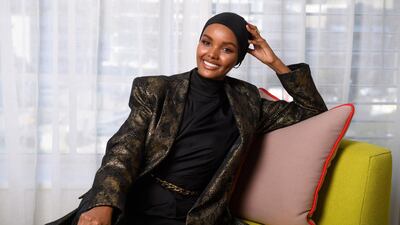
On November 27, model Halima Aden revealed her plans to take part in the Miss Universe pageant as the first Miss Somalia. This was following from the hijab-wearing model's recent lament, through a series of Instagram Stories, about how her hijab was depicted during her early career in fashion.
Some of the projects, such as her collaboration with American Eagle and her debut Vogue Arabia cover, were career highs for the young model, but Aden stated "the truth is I was very uncomfortable" and "I lost touch with who I was".
She added that “I’m guarding my hijab unlike ever before,” and will “never risk compromising it, even for $10 million”.
Aden's most recent plans for the Miss Universe pageant, meanwhile, came with the rejoinder: “That is the takeaway I want everyone to understand. It’s not about abandoning your dreams, but being authentic in your journey.”
Within 24 hours, memes, TikTok reactions and artists’ illustrations memorialising Aden emerged on social media, along with some heated reactions – from Muslim women and others, regarding Aden’s latest stance.
Putting modestwear in the spotlight
Aden is one of the faces of the global modest fashion movement, and was the first hijab-wearing runway model in 2017 at New York Fashion Week. Instantly, she was heralded as an icon of female, Muslim empowerment, thriving in an industry that doesn’t typically prioritise modesty.
Though her journey may have appeared to be an easy integration of Islamic values into the mainstream fashion industry, beneath the surface Aden clearly struggled with reconciling her two worlds. In her case, it came down to the representation of her hijab, which she says will now be draped traditionally for any future appearances – a return to basic, no-frills modesty.
Gigi Hadid was one of the first to lend support to her fellow model, saying: "My sis Halima, you have inspired me since the day I met you and you continue to make me proud."
Aden garners positive reactions from fellow fashion mavens
Many other Muslims, too, have applauded Aden for returning to “proper” hijab. On Twitter, fellow hijab-wearing model Ikram Abdi Omar said that this was a “wake up call” for her too.
"Halima has earn[ed] all my respect and admiration for asking herself the kind of question we tend to avoid asking ourselves. Her introspection and strength to walk away from her successful career is the right influence," said modest fashion influencer and founder of Modesteen magazine Hanan Houachmi on Instagram.
Fashion designer Safiya Abdallah, who describes her brand as "modest-inclusive", also resonates with Aden's struggles. "I think that she started out with these set rules for herself, and then they slowly started to change. When I launched my brand in 2015, I found myself in a similar place – I was the only hijabi at events, so I would wear a turban and then a beanie, and that's really why I created my beanies, to be honest, because I fit in more," she tells The National.

"People thought I was a ‘trendy’ hijabi. They would say ‘you dress really well for a covered girl’.” Though she first thought it to be a positive comment, Abdallah says she realised that it was probably her secular style of modesty that was being complimented, not her decision to cover because of her faith.
In Aden’s recent Instagram Stories, it’s clear that the crux of her displeasure is with how her hijab was over-stylised and made to look like an accessory that could be changed and moulded to fit the occasion, rather than a cemented part of her identity and faith.

“I felt so proud of what she was saying – that she was made to compromise her beliefs, and the way she wanted to look visibly Muslim, because the [fashion industry] was trying to make her ‘Muslimness’ look the least recognisable,” says Abdallah.
Hijab styles are personal: critique from some quarters for Halima Aden
However, others have pointed out that Aden’s deconstructing of her previous outfits discounted them as “true” portrayals of hijab, even though many Muslim women wear their headscarves in these contemporary styles. “All those outfits Halima posted that didn’t represent hijab properly, were hijab to me. There was a lot of modesty. I personally don’t think women need to be in jilbab or abaya for it to be [categorised as] hijab,” says lawyer and podcaster Raifa Rafiq.
Some even implied that this could invoke a sense of "modesty-shaming" for women who ascribe to less traditional styles of covering their hair, while others pointed out that the same people who are now putting Aden on a pedestal, have denounced Muslim fashion influencers such as Ascia Al Faraj, Dina Torkia and Amena Khan, for their decisions to stop covering their hair.
"A woman's decision to don or remove hijab is nobody's business. If you're applauding Halima Aden for her choice to renounce aspects of her career, then respect women who decide to do otherwise. Selective empathy – praising one, shaming the other – exposes self-righteous sanctimony," sociopolitical analyst and cultural commentator Maryyum Mehmood tells The National.
While modest fashion has been hailed as an inclusive, and even empowering style revolution, intense scrutiny on the appearance of Muslim women may be reductive. Approaches to wearing hijab and, by extension, dressing modestly, are diverse and deeply personal – yet these topics continue to spark debate.
Abdallah emphasises that Aden's revelations were personal, not preachy. "She's just talking about her own experience – these are her beliefs – specifically hers. I don't think she's trying to shame anyone," she says. No comment has so far been forthcoming about Aden's Sports Illustrated swimwear shoots, for which she donned a burkini.

