
Saudia Airlines has clarified that the planned resumption of international flights at 1am on May 17 will not include 20 countries placed on a travel red list in February by the Interior Ministry.
The Saudi government halted all international travel in a bid to stop the spread of Covid-19 to the kingdom but still allowed nationals, their families, medical professionals and diplomats to enter the kingdom subject to home quarantine for 14 days.
On January 29, the kingdom announced that the travel ban was being extended from March 29 to May 17 due to delays in the delivery of Covid-19 vaccinations slowing the national inoculation campaign.
The airline told The National on Thursday that they are still awaiting official confirmation from the government regarding the May 17 resumption of international travel but that the 20 countries added to the red list on February 3 would still be off-limits when this happens.
The clarification from Saudi Arabia means those travelling from the UAE, the US, India, Pakistan, the UK, Indonesia, Egypt, Germany, Japan, Ireland, Italy, Argentina, Brazil, Portugal, Turkey, South Africa, Sweden, Switzerland, France and Lebanon will still be unable to enter the kingdom.
The airline’s travel rules posted online indicate that this extends not just to those coming from those 20 countries, but to anyone who has passed through one of these countries in the last 14 days prior to arrival.
Nationals, their families and domestic employees, medical practitioners and diplomats will still be exempt as long as they undergo a 14-day quarantine on arrival.
All arrivals must undergo PCR testing and download the Health Ministry’s Tatamman and Tawakkalna covid-19 tracking and information phone applications. They must then log their quarantine address and enter a daily health status in the application, the Saudi Airlines travel rules stated.
The airline said travel requirements for international destinations are “constantly updated” based on government rulings.
“I was flying back from South Africa and had to quarantine in Ethiopia before coming back,” said Gehan Ali, a South African expatriate living in the kingdom who was recently allowed to return.
Even as international travel was halted due to the pandemic, the kingdom repatriated Saudi nationals or allowed them to fly home.
Saudi national Reem Abdullah said it was comforting to know that the government was looking out for their wellbeing.
“I feel safer knowing that no matter what happens in the future, our government will bring us back,” she said.
"My family that was stuck in the United States was brought back when the ban was introduced."
Saudi roses in the desert - in pictures
-

A worker at the Bin Salman farm among freshly picked Damascena (Damask) roses, which are used to produce rose water and oil. Every spring, roses bloom in the western Saudi city of Taif, transforming pockets of the kingdom's vast desert landscape into fragrant pink patches. And for one month in April, they produce an essential oil that is used to clean the outer walls of the sacred Kaaba, the cubic structure in the holy city of Makkah. AFP -
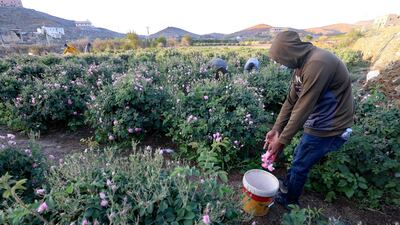
A worker at the Bin Salman farm picks Damascena roses to produce rose water and oil. AFP -

The picked roses are fed into a distiller. AFP -
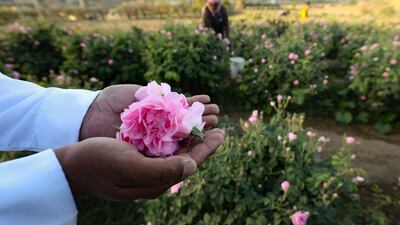
The beautiful and delicately fragrant Damascena rose is used to produce rose water and oil. AFP -

Pickers at the Bin Salman farm in Taif, Saudi Arabia, harvest Damascena rose. AFP -

A worker at the Bin Salman farm tosses freshly picked roses in the air. AFP -

A Bin Salman farm worker checks bottles as they fill with rose water from distillers. AFP -
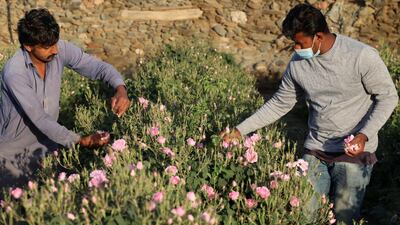
Damascena roses being harvested at Taif in Saudi Arabia. AFP -
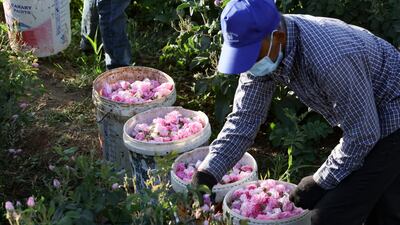
Workers at the Bin Salman farm wear masks as a coronavirus precaution. AFP -
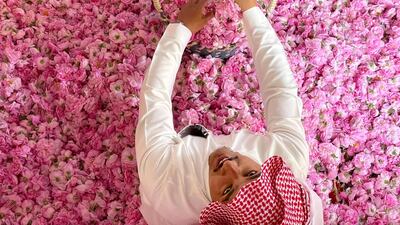
A worker surrounded by freshly picked roses at the Bin Salman farm in the western Saudi city of Taif. AFP -
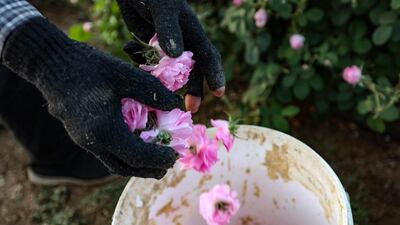
The note in perfumery referred to as 'Damask rose' is produced by the Damascena rose, such as those harvested in Saudi Atrabia. AFP -

Rose oil being extracted from the surface of distilled rose water. AFP -
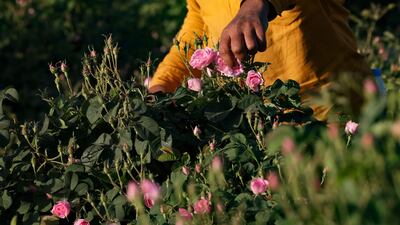
Although commercially harvested at the Bin Salman farm, the Damascena rose still grows wild in Syria and parts of the Caucasus. AFP.



