Saudi Arabia's Supreme Court called on Muslims in the kingdom to watch for the crescent moon on Sunday evening, which would mark the start of Ramadan.
Whoever spots the Moon, whether with the naked eye or through binoculars, should report it to the nearest court and register their testimony, or ask the local authority in the area where they made the sighting to help them to do so, the Supreme Court said on Friday.
Searching for the new crescent moon can be difficult, because it is usually faint and is visible for only about 20 minutes.
Saudi Arabia said it expected Ramadan to begin on April 12 this year, although this early prediction would still need to be confirmed by a Moon-sighting.
If the Moon is observed over the kingdom on Saturday, the holy month will begin the next day. If not, it will start on Monday, April 12.
The Muslim world typically looks to Saudi Arabia when it comes to deciding the days on which major religious events fall, including the start of Ramadan and Eid Al Fitr, which marks the end of the holy month.
___________
Ramadan in Saudi Arabia: all you need to know about the holy month during Covid-19
-
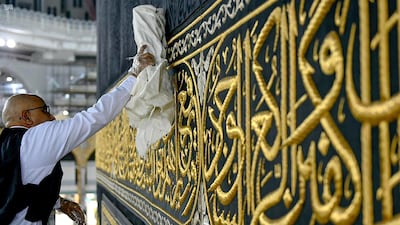
A worker cleans and sterilizes the Kaaba, following the outbreak of the coronavirus disease, ahead of the holy fasting month of Ramadan, in the Grand mosque in the holy city of Mecca, Saudi Arabia April 21, 2020. Reuters -

Workers clean and sterilise the roof of Kaaba, following the outbreak of the coronavirus disease, ahead of the holy fasting month of Ramadan, in the Grand mosque in the holy city of Mecca, Saudi Arabia April 21, 2020. Reuters -
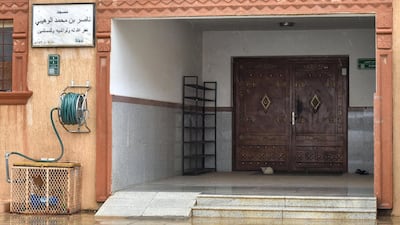
A mosque is closed in a bid to slow the spread of COVID-19 in the Saudi capital Riyadh on April 13, 2020, ahead of the holy Muslim fasting month of Ramadan. AFP -
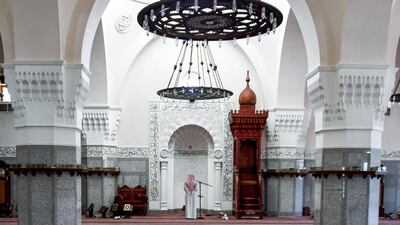
Imam Mohammed, muezzin of the Jaffali mosque in Saudi Arabia's Red Sea coastal city of Jeddah, announces the prayer call at the mosque which is closed due to a government decree as part of efforts to combat the COVID-19 coronavirus pandemic, during the Muslim holy month of Ramadan on April 28, 2020. AFP -

An aerial view shows the Grand Mosque and its surrounding, deserted on the first day of the Muslim fasting month of Ramadan, in the Saudi holy city of Mecca, on April 24, 2020, during the novel coronavirus pandemic crisis. AFP -

A Saudi seller pours dates into a box at his shop, during the 24-hours lockdown to counter the coronavirus disease outbreak, ahead of the holy fasting month of Ramadan, in Riyadh, Saudi Arabia April 20, 2020. Reuters -

A worker wearing a protective face mask and gloves fries traditional Ramadan sweets following the outbreak of the coronavirus disease, during the holy month of Ramadan in Riyadh, Saudi Arabia April 30, 2020. Reuters -
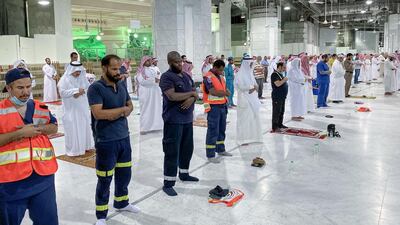
Muslim worshippers perform the "Tarawih" nightly prayer during the holy month of Ramadan, while keeping their distance amid the COVID-19 pandemic, at the Grand Mosque, Islam's holiest site, in the Saudi city of Mecca, late on May 8, 2020. AFP -

A Saudi security guard stands guard as worshippers perform Isha prayer next to the Kaaba in Mecca's Grand Mosque, Islam's holiest site on April 27, 2020. AFP -
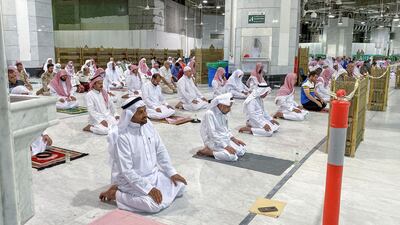
Muslim worshippers perform the "Tarawih" nightly prayer during the holy month of Ramadan, while keeping their distance amid the COVID-19 pandemic, at the Grand Mosque, Islam's holiest site, in the Saudi city of Mecca, late on May 8, 2020. AFP -

Kitchen staff wear protective face masks and gloves, following the outbreak of the coronavirus disease, as they prepare Ramadan meal orders for takeaway and delivery at a restaurant in Riyadh, Saudi Arabia, April 26, 2020. Reuters -

Workers pass through a self-sterilisation gate set up at an entrance of the Kaaba and the Grand Mosque, as a preventive measure amid the the COVID-19 pandemic during the Muslim month of Ramadan in the Saudi holy city of Mecca, on May 8, 2020. AFP -

Men passing through a self-sterilisation gate set up at an entrance of Kaaba and the Grand Mosque as a protective measure against the COVID-19 coronavirus during the holy fasting month of Ramadan in the Saudi holy city of Mecca, May 7, 2020. AFP
___________
Meanwhile, the Saudi interior ministry announced a fine of 10,000 riyals ($2,666) for attempting to perform the Umrah pilgrimage during Ramadan without a permit.
Anyone caught attempting to enter the holy site of Makkah without a permit will be subject to a 1,000 riyal fine, a source at the ministry told the state Saudi Press Agency.

While you're here
The Baghdad Clock
Shahad Al Rawi, Oneworld
Terror attacks in Paris, November 13, 2015
- At 9.16pm, three suicide attackers killed one person outside the Atade de France during a foootball match between France and Germany
- At 9.25pm, three attackers opened fire on restaurants and cafes over 20 minutes, killing 39 people
- Shortly after 9.40pm, three other attackers launched a three-hour raid on the Bataclan, in which 1,500 people had gathered to watch a rock concert. In total, 90 people were killed
- Salah Abdeslam, the only survivor of the terrorists, did not directly participate in the attacks, thought to be due to a technical glitch in his suicide vest
- He fled to Belgium and was involved in attacks on Brussels in March 2016. He is serving a life sentence in France
The%20Emperor%20and%20the%20Elephant
Squad
Ali Kasheif, Salim Rashid, Khalifa Al Hammadi, Khalfan Mubarak, Ali Mabkhout, Omar Abdulrahman, Mohammed Al Attas, Abdullah Ramadan, Zayed Al Ameri (Al Jazira), Mohammed Al Shamsi, Hamdan Al Kamali, Mohammed Barghash, Khalil Al Hammadi (Al Wahda), Khalid Essa, Mohammed Shaker, Ahmed Barman, Bandar Al Ahbabi (Al Ain), Al Hassan Saleh, Majid Suroor (Sharjah) Walid Abbas, Ahmed Khalil (Shabab Al Ahli), Tariq Ahmed, Jasim Yaqoub (Al Nasr), Ali Saleh, Ali Salmeen (Al Wasl), Hassan Al Muharami (Baniyas)
Chris%20Jordan%20on%20Sanchit
The specs
- Engine: 3.9-litre twin-turbo V8
- Power: 640hp
- Torque: 760nm
- On sale: 2026
- Price: Not announced yet
Ten tax points to be aware of in 2026
1. Domestic VAT refund amendments: request your refund within five years
If a business does not apply for the refund on time, they lose their credit.
2. E-invoicing in the UAE
Businesses should continue preparing for the implementation of e-invoicing in the UAE, with 2026 a preparation and transition period ahead of phased mandatory adoption.
3. More tax audits
Tax authorities are increasingly using data already available across multiple filings to identify audit risks.
4. More beneficial VAT and excise tax penalty regime
Tax disputes are expected to become more frequent and more structured, with clearer administrative objection and appeal processes. The UAE has adopted a new penalty regime for VAT and excise disputes, which now mirrors the penalty regime for corporate tax.
5. Greater emphasis on statutory audit
There is a greater need for the accuracy of financial statements. The International Financial Reporting Standards standards need to be strictly adhered to and, as a result, the quality of the audits will need to increase.
6. Further transfer pricing enforcement
Transfer pricing enforcement, which refers to the practice of establishing prices for internal transactions between related entities, is expected to broaden in scope. The UAE will shortly open the possibility to negotiate advance pricing agreements, or essentially rulings for transfer pricing purposes.
7. Limited time periods for audits
Recent amendments also introduce a default five-year limitation period for tax audits and assessments, subject to specific statutory exceptions. While the standard audit and assessment period is five years, this may be extended to up to 15 years in cases involving fraud or tax evasion.
8. Pillar 2 implementation
Many multinational groups will begin to feel the practical effect of the Domestic Minimum Top-Up Tax (DMTT), the UAE's implementation of the OECD’s global minimum tax under Pillar 2. While the rules apply for financial years starting on or after January 1, 2025, it is 2026 that marks the transition to an operational phase.
9. Reduced compliance obligations for imported goods and services
Businesses that apply the reverse-charge mechanism for VAT purposes in the UAE may benefit from reduced compliance obligations.
10. Substance and CbC reporting focus
Tax authorities are expected to continue strengthening the enforcement of economic substance and Country-by-Country (CbC) reporting frameworks. In the UAE, these regimes are increasingly being used as risk-assessment tools, providing tax authorities with a comprehensive view of multinational groups’ global footprints and enabling them to assess whether profits are aligned with real economic activity.
Contributed by Thomas Vanhee and Hend Rashwan, Aurifer
8 traditional Jamaican dishes to try at Kingston 21
- Trench Town Rock: Jamaican-style curry goat served in a pastry basket with a carrot and potato garnish
- Rock Steady Jerk Chicken: chicken marinated for 24 hours and slow-cooked on the grill
- Mento Oxtail: flavoured oxtail stewed for five hours with herbs
- Ackee and salt fish: the national dish of Jamaica makes for a hearty breakfast
- Jamaican porridge: another breakfast favourite, can be made with peanut, cornmeal, banana and plantain
- Jamaican beef patty: a pastry with ground beef filling
- Hellshire Pon di Beach: Fresh fish with pickles
- Out of Many: traditional sweet potato pudding

