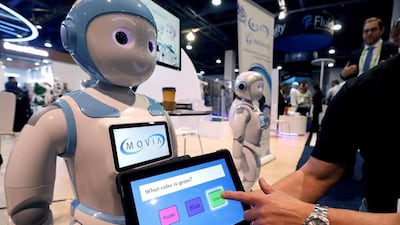
Artificial intelligence is expected to contribute up to $182bn to the UAE's economy by 2035, according to Accenture. Reuters

The UAE is preparing for the future by investing in advanced technology


  • English
  • Arabic

For the first time in modern history, humans are looking for safety in separation. The pandemic has left us relying on social distancing and masks to shield ourselves from an invisible threat that may be lurking in any space and on any surface. And unlike ever before, the online world has become our safe-haven, keeping us away from the dangers of the physical world.

The most important lesson we’ve learnt amid the stark challenges of the past year is that our need to communicate with each other is essential to our survival and well-being.

For humanity to prosper, we must embrace the fact that our new reality requires communication with and through, everything around us: with each other, with our devices and even between devices. And while the pandemic might have laid waste to the old ways of living and working to which we had grown accustomed to, our determination to cope with it and evolve despite it, has created a significant new opportunity.

At no other point in history has humanity had to step into the future. We have made tremendous progress in an unprecedented period of time and we now stand at the verge of a full-fledged industrial revolution that is reshaping our global economy.

Could it be that society’s hope resides in machines that transmit our thoughts, emotions and concerns across cables and networks to colleagues and loved-ones near and far? The growing population of people across the world that are working remotely would suggest so. And this will certainly be further cemented as our children, the future leaders of our world, continue to have their personalities shaped virtually through distance learning and digital interactions.

Across each of the three prior industrial revolutions (steam, electricity and electronics), the direct impact has been a mass optimisation of production. However, the fourth industrial revolution (4IR) is relying on an array of new technologies, including artificial intelligence, internet of things (IoT), cloud computing, blockchain and 5G to completely transform the way industries, governments and societies function. From transport to finance, food, energy, healthcare and education, 4IR technologies will integrate communication through digitisation to enhance production and influence every aspect of our lives.

So, where does our journey to the future start? In light of the global pandemic, it is essential to understand the trends that will govern our world over the next decade. And for that, we must be inspired by countries that have successfully managed the crisis, overcome immense challenges and identified opportunities for growth and success. For us in the UAE, the answer is very simple: the future starts here.

The UAE has demonstrated an unparalleled level of crisis management to emerge as a regional and global force. It remains one of the leading countries on Covid-19 testing and is within the top five worldwide in the percentage of citizens and residents vaccinated, surpassing any of the G20 countries.

While preserving the health of its workforce, it has continued to remain economically vibrant. So much so that at a time when the vast majority of the world was engulfed in attempting to manage the crisis, the UAE became the first Arab country to launch a probe to Mars.

The UAE’s unique ability to navigate through an unprecedented situation is the result of a vision 50 years in the making. Since its establishment in 1971, the country has sought to build an advanced technological and industrial sector. Today, the industrial sector contributes to about eight per cent of the country's gross domestic product, serving as a model for developing countries looking to advance their industrial sector. And it didn’t stop there.

Over the next 50 years, the country is preparing to advance into the post-oil era by diversifying into a knowledge and sustainable innovation-driven economy, developing an industrial sector underpinned by 4IR technologies.

With the launch of a UAE Strategy for the Fourth Industrial Revolution and the establishment of a Ministry for Artificial Intelligence, the Emirates has strengthened its position as one of the most prominent global destinations that can attract foreign direct investment in the advanced technologies sector.

In addition, the young country has made remarkable progress in advancing a number of specialised industries such as aviation, military, mining, renewable energy, and the information and communication technology sector.

For the many reasons above, the fourth edition of the Global Manufacturing and Industrialisation Summit (#GMIS2021) will be held alongside Expo Dubai under the theme of ‘Rewiring Societies: Repurposing Digitalisation for Prosperity’.

From its ambitious inauguration four years ago, the Global Manufacturing and Industrialisation Summit has served as a voice and venue for heads of state, ministers, chief executives, technologists, academics and industry leaders to share their knowledge with the rest of the world.

By promoting the use of technology as a tool for global co-operation, the summit has become an international gathering place for greater investment in capabilities, innovation and global skills development.

#GMIS2021 will reinforce the vision for a future that is reliant on digitalisation and connectivity, a future where our world cannot prosper without humans and machines coexisting in harmony. In line with Expo Dubai’s theme of “Connecting Minds, Creating the Future”, #GMIS2021 will inspire conversations that will shape a digitally inclusive, interconnected and sustainable future for all.

Badr Al-Olama is the head of the organising committee of the Global Manufacturing and Industrialisation Summit.


Who was Alfred Nobel?

The Nobel Prize was created by wealthy Swedish chemist and entrepreneur Alfred Nobel.

  • In his will he dictated that the bulk of his estate should be used to fund "prizes to those who, during the preceding year, have conferred the greatest benefit to humankind".
  • Nobel is best known as the inventor of dynamite, but also wrote poetry and drama and could speak Russian, French, English and German by the age of 17. The five original prize categories reflect the interests closest to his heart.
  • Nobel died in 1896 but it took until 1901, following a legal battle over his will, before the first prizes were awarded.
Long read

Mageed Yahia, director of WFP in UAE: Coronavirus knows no borders, and neither should the response

Mercer, the investment consulting arm of US services company Marsh & McLennan, expects its wealth division to at least double its assets under management (AUM) in the Middle East as wealth in the region continues to grow despite economic headwinds, a company official said.

Mercer Wealth, which globally has $160 billion in AUM, plans to boost its AUM in the region to $2-$3bn in the next 2-3 years from the present $1bn, said Yasir AbuShaban, a Dubai-based principal with Mercer Wealth.

Within the next two to three years, we are looking at reaching $2 to $3 billion as a conservative estimate and we do see an opportunity to do so,” said Mr AbuShaban.

Mercer does not directly make investments, but allocates clients’ money they have discretion to, to professional asset managers. They also provide advice to clients.

“We have buying power. We can negotiate on their (client’s) behalf with asset managers to provide them lower fees than they otherwise would have to get on their own,” he added.

Mercer Wealth’s clients include sovereign wealth funds, family offices, and insurance companies among others.

From its office in Dubai, Mercer also looks after Africa, India and Turkey, where they also see opportunity for growth.

Wealth creation in Middle East and Africa (MEA) grew 8.5 per cent to $8.1 trillion last year from $7.5tn in 2015, higher than last year’s global average of 6 per cent and the second-highest growth in a region after Asia-Pacific which grew 9.9 per cent, according to consultancy Boston Consulting Group (BCG). In the region, where wealth grew just 1.9 per cent in 2015 compared with 2014, a pickup in oil prices has helped in wealth generation.

BCG is forecasting MEA wealth will rise to $12tn by 2021, growing at an annual average of 8 per cent.

Drivers of wealth generation in the region will be split evenly between new wealth creation and growth of performance of existing assets, according to BCG.

Another general trend in the region is clients’ looking for a comprehensive approach to investing, according to Mr AbuShaban.

“Institutional investors or some of the families are seeing a slowdown in the available capital they have to invest and in that sense they are looking at optimizing the way they manage their portfolios and making sure they are not investing haphazardly and different parts of their investment are working together,” said Mr AbuShaban.

Some clients also have a higher appetite for risk, given the low interest-rate environment that does not provide enough yield for some institutional investors. These clients are keen to invest in illiquid assets, such as private equity and infrastructure.

“What we have seen is a desire for higher returns in what has been a low-return environment specifically in various fixed income or bonds,” he said.

“In this environment, we have seen a de facto increase in the risk that clients are taking in things like illiquid investments, private equity investments, infrastructure and private debt, those kind of investments were higher illiquidity results in incrementally higher returns.”

The Abu Dhabi Investment Authority, one of the largest sovereign wealth funds, said in its 2016 report that has gradually increased its exposure in direct private equity and private credit transactions, mainly in Asian markets and especially in China and India. The authority’s private equity department focused on structured equities owing to “their defensive characteristics.”

Company profile

Name:​ One Good Thing ​

Founders:​ Bridgett Lau and Micheal Cooke​

Based in:​ Dubai​​ 

Sector:​ e-commerce​

Size: 5​ employees

Stage: ​Looking for seed funding

Investors:​ ​Self-funded and seeking external investors

Mobile phone packages comparison
UAE currency: the story behind the money in your pockets
Who's who in Yemen conflict

Houthis: Iran-backed rebels who occupy Sanaa and run unrecognised government

Yemeni government: Exiled government in Aden led by eight-member Presidential Leadership Council

Southern Transitional Council: Faction in Yemeni government that seeks autonomy for the south

Habrish 'rebels': Tribal-backed forces feuding with STC over control of oil in government territory

RESULTS
%3Cp%3E5pm%3A%20Wathba%20Stallions%20Cup%20%E2%80%93%20Handicap%20(PA)%20Dh70%2C000%20(Turf)%202%2C200m%3Cbr%3EWinner%3A%20RB%20Sarab%2C%20Allaia%20Tiar%20(jockey)%2C%20Khalifa%20Al%20Neyadi%20(trainer)%3C%2Fp%3E%0A%3Cp%3E5.30pm%3A%20Mamsha%20Alkhair%20%E2%80%93%20Handicap%20(PA)%20Dh80%2C000%20(T)%201%2C600m%3Cbr%3EWinner%3A%20Mutaqadim%2C%20Ray%20Dawson%2C%20Ibrahim%20Al%20Hadhrami%3C%2Fp%3E%0A%3Cp%3E6pm%3A%20Emirates%20Fillies%20Classic%20%E2%80%93%20Prestige%20(PA)%20Dh100%2C000%20(T)%201%2C600m%3Cbr%3EWinner%3A%20Almotajalliah%2C%20Ray%20Dawson%2C%20Ibrahim%20Al%20Hadhrami%3C%2Fp%3E%0A%3Cp%3E6.30pm%3A%20Emirates%20Colts%20Classic%20%E2%80%93%20Prestige%20(PA)%20Dh100%2C000%20(T)%201%2C600m%3Cbr%3EWinner%3A%20Fadwaan%2C%20Antonio%20Fresu%2C%20Ahmed%20Al%20Mehairbi%3C%2Fp%3E%0A%3Cp%3E7pm%3A%20The%20President%E2%80%99s%20Cup%20%E2%80%93%20Group%201%20(PA)%20Dh2%2C500%2C000%20(T)%202%2C200m%3Cbr%3EWinner%3A%20Mujeeb%2C%20Richard%20Mullen%2C%20Salem%20Al%20Ketbi%3C%2Fp%3E%0A%3Cp%3E7.30pm%3A%20The%20President%E2%80%99s%20Cup%20%E2%80%93%20Listed%20(TB)%20Dh380%2C000%20(T)%201%2C400m%3Cbr%3EWinner%3A%20Western%20Writer%2C%20Richard%20Mullen%2C%20Bhupat%20Seemar%3C%2Fp%3E%0A