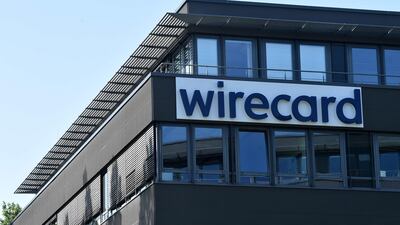

On April 27, accountancy firm KPMG published the findings on an independent audit commissioned by German payment processing giant Wirecard in the hope that it would quash much of the negative publicity that had surrounded the company over the previous 18 months. It didn’t.
Instead, KPMG's verdict – that it couldn’t verify whether vast amounts of the company’s revenue and earnings were genuine – sent Wirecard into a downward spiral that ended with it entering into insolvency on June 25 after declaring a €1.9 billion (Dh8.2bn) hole in its accounts, and the arrest of several of key executives on suspicion of accountancy fraud.
The company had previously been lauded as a European FinTech star and was the newest member of the Dax 30 – the index of the biggest German companies listed on the Frankfurt Stock Exchange – with its valuation peaking at €24bn in August 2018.
KPMG's report focused on claims made in a series of articles by the Financial Times, which highlighted suspicious transactions with three "third-party acquirers" that generated most of Wirecard's profits. These were Dubai-based Al Alam Solution Provider (also known as Al Alam Solutions), Manila-based PayEasy Solutions and Singaporean company Senjo.
Between them, these entities contributed 50 per cent of Wirecard's 2016 sales and 95 per cent of earnings before interest, tax, depreciation and amortisation. Business routed from Dubai-based Al Alam, made one of Wirecard's Middle East subsidiaries, Cardsystems Middle East, its most profitable. It supposedly generated one-third of the company's earnings over a five-year period despite the FT reporting in April 2019 it was being run as a one-man operation from an apartment.
Mark Hiley, the founder and managing partner of The Analyst – a London-based company that sells equity research to hedge funds and asset managers – had expressed concerns about Wirecard for some time. He was perplexed by the fact that despite its high margins, it failed to generate much cash.
"It was, as far as we could see, a company with undifferentiated technology in a highly competitive market and yet enjoyed a stratospheric rating," he told The National.
Neil Campling, a technology industry analyst at Mirabaud Securities, was also nonplussed with Wirecard's technology after attending an 'innovation day' the company held in October 2018.
"The presentations were full of absolute rubbish," Mr Campling said. "There was no innovation."
He began poring through its accounts and also struggled to find where the money was coming from.
“We managed to get hold of 27 subsidiary accounts (the company had more than 50), and we could only find 10 per cent of the revenue and 4 per cent of the group operating profit,” Mr Campling said. Many of the subsidiary company filings were out of date by more than a year.
“We kept looking at the business and thinking, the business either makes no money, or very little money, and the big hole that appeared to happen was in the Middle East,” he says.
Wirecard's two Middle East subsidiaries, Cardsystems Middle East and Wirecard Processing, were guarantors of a €500m bond issued by the company last September. Bond documentation shows neither company filed accounts either for 2017 or 2018. Both said they were “in the process” of appointing auditors.
“We were very aware of how much Wirecard appeared to be dependent on revenue from Dubai in particular and the lack of clarity about where exactly those revenues came from,” Mr Hiley said.
“The limited disclosure and the lack of clarity from the company about issues such as whether these businesses had been audited made it hard to verify the company’s claims.”
It wasn’t just in Dubai that there were issues. Mr Hiley sent an investigative accountant to India last year, where the company had supposedly spent €330m on acquisitions, but he found few signs of where the money had gone.
A lawsuit in 2017 revealed Wirecard paid $200m more for a company, Hermes I-Tickets Private, to a Mauritius-based private equity vehicle than its founders had sold it for just three weeks earlier. In a note last year, Mr Hiley said there was evidence that most of it found its way, via investments made in companies that then became Wirecard customers, back to the company in the form of sales.
When The Analyst's accountant made his way to Wirecard’s affiliate in Chennai, “he found a small office in a dilapidated building” with just a few employees and some broken laptops, Mr Hiley said.
A similar thing happened when the FT sent a reporter to Wirecard’s affiliate in the Philippines and found it was the home of a retired seaman.
Mr Campling said that after listening to an investors’ call in March 2019, when management failed to provide satisfactory answers to questions about its finances, he changed his price target to €0.
During a due diligence exercise, he had asked shareholders what Wirecard did and why they owned shares. Most couldn’t properly answer the first part of the question and cited its huge margins to justify the second.
“I said, ‘don’t you think it’s too good to be true?’. They had ebitda growth of 34 per cent one year, 35 per cent the second and 36 per cent the third. It’s like someone sat there with an Excel spreadsheet saying, ‘let’s just make it a little bit better than last year’.”
Within days of the KPMG report, both Al Alam Solutions Provider and Cardsystems Middle East were dissolved.
Wirecard’s former chief executive, Markus Braun, the company's chief financial officer, its chief accounting officer and the head of its Dubai business have all been arrested on suspicion of falsifying business with third-party partners. A warrant has been issued for the arrest of its chief operating officer, who has reportedly fled the country.
The head of the company’s Dubai business admitted wrongdoing to prosecutors, according to his lawyer, Reuters reported last month.
The fallout is just starting, though. German law firm Tilp, which specialises in class action suits, has already filed a case against Wirecard representing 50,000 investors, which it extended late last month to add Wirecard’s auditors, EY. It also recently filed a case against the regulator, BaFin.
“In our view, EY failed to investigate properly Wirecard’s balance sheets and real economic situation for years,” said a spokesman for the firm. “We are convinced that EY’s behaviour was more then grossly negligent and should lead to direct compensation for claims [by] investors.” A spokeswoman for EY Germany said "we do not comment on pending litigation".
The law firm also castigated the regulator, arguing that it could have uncovered an accounting fraud much sooner if it had investigated claims more thoroughly as opposed to heeding the company's call for a ban on short sellers, which it imposed between February and April last year.
Fahmi Quadir, the founder and chief investment officer of New York-based Safkhet Capital, is also critical of BaFin.
Her fund, a short seller that targets suspected frauds, took a position in Wirecard shares at inception in January 2018 and by the time of its insolvency had scaled this up to more than 25 per cent of the fund’s assets.
Her firm doesn't usually disclose its positions, but did so last year under a lengthy response to BaFin's short-selling ban, where it criticised the regulator's decision.
"We unequivocally support actions taken to address all forms of market manipulation," her letter said. "However, such seemingly unilateral regulatory effort, prompted without sufficient evidentiary disclosure, can create a toxic environment where whistleblowers will avoid coming forward for fear of civil or criminal penalty for telling the truth."
She describes the Wirecard debacle and the lack of oversight by the regulator as “a black mark on the German financial establishment and its standing in the world”.

A spokeswoman for BaFin said it took action after witnessing what appeared to be big – and co-ordinated – short-selling attacks on Wirecard.
“Our target was neither evaluating the outstanding accusations nor shielding a single issuer, our focus was on protecting market confidence,” the spokeswoman said. She added that the regulator “investigated all reports it received in line with its duties”.
Wirecard, which did not respond to requests for comment, is continuing to battle its way through the insolvency process. In an update on July 26, the company said it had secured enough liquidity to continue operations for the time being and that there had been interest from investors in various parts of the business.
The most salvageable seems to be its North American operations, in which 60 out of the 77 parties that have signed confidentiality agreements so far have expressed an interest. Given the fact that it owes about €3.5bn to lenders, it remains to be seen whether asset sales can generate enough cash to repay debts, let alone the army of angry investors that have signed up to the class action suit.

