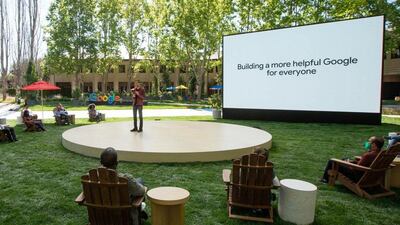
Sundar Pichai, Google's chief executive, says the company's focus on data minimisation pushes them to do more, with less data. Courtesy Google

Five takeaways from Google's developer conference


Alkesh Sharma
  • English
  • Arabic

Alphabet-owned Google launched a number of new features including a redesigned Android operating system (OS), tools to protect personal data, updated Maps and a new partnership with Samsung at the company’s online developer conference on Tuesday.

The conference, which was cancelled last year due to the Covid-19 pandemic, saw a partial attendance from Google employees who watched the keynote address from the lawn of the company’s Mountain View campus.

Here are five takeaways from the conference.

Android undergoes biggest change in history

Google released the first beta version of its new OS, Android 12. It includes the biggest design change in Android's history, the company said.

Android 12 will allow users to check which apps are accessing their data. Courtesy Google

“We rethought the entire experience, from the colours to the shapes, light and motion ... the result is that Android 12 is more expressive, dynamic and personal than ever before,” said Sameer Samat, vice president of product management, Android and Google Play.

Android 12 will let users check which apps are accessing their data and they can control the extent of data that they want to share. It has added a new indicator to the top right of the users’ status bar to show which apps are accessing their microphone or camera.

Today, Android is used in more than 3 billion active devices around the world.

New Maps update

Google announced new updates to the Maps, which will allow users to easily navigate, find local landmarks, spot busy areas and find tourist attractions.

Maps will also be able to show a user how busy an area is compared to others.

Maps will show how busy an entire area is at a point of time. Courtesy Google

The new updates will allow users take the fastest routes and “identify which one is likely to reduce your chances of encountering a hard-braking moment”, Oren Naim, director of product, Google Maps, said.

“We will automatically recommend that route if the ETA [estimated time of arrival] is the same or the difference is minimal.”

Merging with Samsung to challenge Apple Watch

To challenge the dominance of Apple Watch, which has been the best-selling smartwatch for many years, Google has teamed up with Samsung. It has merged its Wear OS with South Korean consumer electronics company's Tizen OS.

“We are bringing the best of Wear and Tizen into a single, unified platform,” said Bjorn Kilburn, director of product management, Wear, at Google.

“By working together we have been able to take strengths of each and combine them into an experience that has faster performance, longer battery life and more of the apps you love available for the watch.”

Fixing your password in Chrome

Google’s web browser Chrome will now help users change their passwords with a single tap in an effort to minimise the chances of data theft and compromised identity.

“On supported sites, whenever you check your passwords and Chrome finds a password that may have been compromised, you will see a ‘change password’ button,” Patrick Nepper, senior product manager, Google Chrome, said.

“When you tap the button, Chrome will not only navigate to the site, but also go through the entire process of changing your password.”

Automated password change feature is already available in the US and will become available across more countries in the coming months, the company said.

Putting users in control of their data

Google has introduced a new, ‘quick delete’ option to delete the last 15 minutes of your search history. In Google Photos, the company has also rolled out a ‘Locked Folder’ feature – a password-protected space where select photos can be saved separately.

Sameer Samat, Google’s vice president of product management, speaks during the keynote address. EPA

“Our focus on data minimisation pushes us to do more, with less data,” said Sundar Pichai, chief executive of the company.

“We strictly uphold responsible data practices so every product we build is private by design. And we create easy to use privacy and security settings so you are in control.”


Key facilities
  • Olympic-size swimming pool with a split bulkhead for multi-use configurations, including water polo and 50m/25m training lanes
  • Premier League-standard football pitch
  • 400m Olympic running track
  • NBA-spec basketball court with auditorium
  • 600-seat auditorium
  • Spaces for historical and cultural exploration
  • An elevated football field that doubles as a helipad
  • Specialist robotics and science laboratories
  • AR and VR-enabled learning centres
  • Disruption Lab and Research Centre for developing entrepreneurial skills
Tips for taking the metro

- set out well ahead of time

- make sure you have at least Dh15 on you Nol card, as there could be big queues for top-up machines

- enter the right cabin. The train may be too busy to move between carriages once you're on

- don't carry too much luggage and tuck it under a seat to make room for fellow passengers

The President's Cake

Director: Hasan Hadi

Starring: Baneen Ahmad Nayyef, Waheed Thabet Khreibat, Sajad Mohamad Qasem 

Rating: 4/5

Roll of honour

Who has won what so far in the West Asia Premiership season?

Western Clubs Champions League - Winners: Abu Dhabi Harlequins; Runners up: Bahrain

Dubai Rugby Sevens - Winners: Dubai Exiles; Runners up: Jebel Ali Dragons

West Asia Premiership - Winners: Jebel Ali Dragons; Runners up: Abu Dhabi Harlequins

UAE Premiership Cup - Winners: Abu Dhabi Harlequins; Runners up: Dubai Exiles

West Asia Cup - Winners: Bahrain; Runners up: Dubai Exiles

West Asia Trophy - Winners: Dubai Hurricanes; Runners up: DSC Eagles

Final West Asia Premiership standings - 1. Jebel Ali Dragons; 2. Abu Dhabi Harlequins; 3. Bahrain; 4. Dubai Exiles; 5. Dubai Hurricanes; 6. DSC Eagles; 7. Abu Dhabi Saracens

Fixture (UAE Premiership final) - Friday, April 13, Al Ain – Dubai Exiles v Abu Dhabi Harlequins

Seemar’s top six for the Dubai World Cup Carnival:

1. Reynaldothewizard
2. North America
3. Raven’s Corner
4. Hawkesbury
5. New Maharajah
6. Secret Ambition

Cry Macho

Director: Clint Eastwood

Stars: Clint Eastwood, Dwight Yoakam

Rating:**

T10 Cricket League
Sharjah Cricket Stadium
December 14- 17
6pm, Opening ceremony, followed by:
Bengal Tigers v Kerala Kings 
Maratha Arabians v Pakhtoons
Tickets available online at q-tickets.com/t10

Tesalam Aleik

Abdullah Al Ruwaished

(Rotana)

Ain Dubai in numbers

126: The length in metres of the legs supporting the structure

1 football pitch: The length of each permanent spoke is longer than a professional soccer pitch

16 A380 Airbuses: The equivalent weight of the wheel rim.

9,000 tonnes: The amount of steel used to construct the project.

5 tonnes: The weight of each permanent spoke that is holding the wheel rim in place

192: The amount of cable wires used to create the wheel. They measure a distance of 2,4000km in total, the equivalent of the distance between Dubai and Cairo.

The specs

Engine: 2.0-litre 4-cyl turbo

Power: 247hp at 6,500rpm

Torque: 370Nm from 1,500-3,500rpm

Transmission: 10-speed auto

Fuel consumption: 7.8L/100km

Price: from Dh94,900

On sale: now

Mercer, the investment consulting arm of US services company Marsh & McLennan, expects its wealth division to at least double its assets under management (AUM) in the Middle East as wealth in the region continues to grow despite economic headwinds, a company official said.

Mercer Wealth, which globally has $160 billion in AUM, plans to boost its AUM in the region to $2-$3bn in the next 2-3 years from the present $1bn, said Yasir AbuShaban, a Dubai-based principal with Mercer Wealth.

Within the next two to three years, we are looking at reaching $2 to $3 billion as a conservative estimate and we do see an opportunity to do so,” said Mr AbuShaban.

Mercer does not directly make investments, but allocates clients’ money they have discretion to, to professional asset managers. They also provide advice to clients.

“We have buying power. We can negotiate on their (client’s) behalf with asset managers to provide them lower fees than they otherwise would have to get on their own,” he added.

Mercer Wealth’s clients include sovereign wealth funds, family offices, and insurance companies among others.

From its office in Dubai, Mercer also looks after Africa, India and Turkey, where they also see opportunity for growth.

Wealth creation in Middle East and Africa (MEA) grew 8.5 per cent to $8.1 trillion last year from $7.5tn in 2015, higher than last year’s global average of 6 per cent and the second-highest growth in a region after Asia-Pacific which grew 9.9 per cent, according to consultancy Boston Consulting Group (BCG). In the region, where wealth grew just 1.9 per cent in 2015 compared with 2014, a pickup in oil prices has helped in wealth generation.

BCG is forecasting MEA wealth will rise to $12tn by 2021, growing at an annual average of 8 per cent.

Drivers of wealth generation in the region will be split evenly between new wealth creation and growth of performance of existing assets, according to BCG.

Another general trend in the region is clients’ looking for a comprehensive approach to investing, according to Mr AbuShaban.

“Institutional investors or some of the families are seeing a slowdown in the available capital they have to invest and in that sense they are looking at optimizing the way they manage their portfolios and making sure they are not investing haphazardly and different parts of their investment are working together,” said Mr AbuShaban.

Some clients also have a higher appetite for risk, given the low interest-rate environment that does not provide enough yield for some institutional investors. These clients are keen to invest in illiquid assets, such as private equity and infrastructure.

“What we have seen is a desire for higher returns in what has been a low-return environment specifically in various fixed income or bonds,” he said.

“In this environment, we have seen a de facto increase in the risk that clients are taking in things like illiquid investments, private equity investments, infrastructure and private debt, those kind of investments were higher illiquidity results in incrementally higher returns.”

The Abu Dhabi Investment Authority, one of the largest sovereign wealth funds, said in its 2016 report that has gradually increased its exposure in direct private equity and private credit transactions, mainly in Asian markets and especially in China and India. The authority’s private equity department focused on structured equities owing to “their defensive characteristics.”

Founders: Abdulmajeed Alsukhan, Turki Bin Zarah and Abdulmohsen Albabtain.

Based: Riyadh

Offices: UAE, Vietnam and Germany

Founded: September, 2020

Number of employees: 70

Sector: FinTech, online payment solutions

Funding to date: $116m in two funding rounds  

Investors: Checkout.com, Impact46, Vision Ventures, Wealth Well, Seedra, Khwarizmi, Hala Ventures, Nama Ventures and family offices

Specs

Engine: 51.5kW electric motor

Range: 400km

Power: 134bhp

Torque: 175Nm

Price: From Dh98,800

Available: Now

UAE squad

Humaira Tasneem (c), Chamani Senevirathne (vc), Subha Srinivasan, NIsha Ali, Udeni Kuruppuarachchi, Chaya Mughal, Roopa Nagraj, Esha Oza, Ishani Senevirathne, Heena Hotchandani, Keveesha Kumari, Judith Cleetus, Chavi Bhatt, Namita D’Souza.

THE NEW BATCH'S FOCUS SECTORS

AiFlux – renewables, oil and gas

DevisionX – manufacturing

Event Gates – security and manufacturing

Farmdar – agriculture

Farmin – smart cities

Greener Crop – agriculture

Ipera.ai – space digitisation

Lune Technologies – fibre-optics

Monak – delivery

NutzenTech – environment

Nybl – machine learning

Occicor – shelf management

Olymon Solutions – smart automation

Pivony – user-generated data

PowerDev – energy big data

Sav – finance

Searover – renewables

Swftbox – delivery

Trade Capital Partners – FinTech

Valorafutbol – sports and entertainment

Workfam – employee engagement

WHAT IS GRAPHENE?

It was discovered in 2004, when Russian-born Manchester scientists Andrei Geim and Kostya Novoselov were experimenting with sticky tape and graphite, the material used as lead in pencils.

Placing the tape on the graphite and peeling it, they managed to rip off thin flakes of carbon. In the beginning they got flakes consisting of many layers of graphene. But when they repeated the process many times, the flakes got thinner.

By separating the graphite fragments repeatedly, they managed to create flakes that were just one atom thick. Their experiment led to graphene being isolated for the very first time.

In 2010, Geim and Novoselov were awarded the Nobel Prize for Physics.