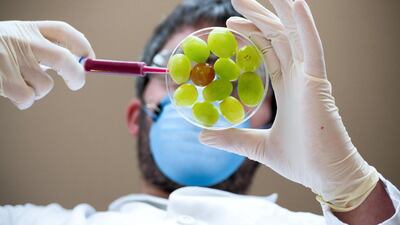
The UK is planning to relax rules on gene-editing in farming, as it looks to shift agricultural policy following the country’s exit from the European Union, boost domestic food production and bolster international trade.
A consultation, which runs until March 17, will analyse whether gene-editing crops and livestock is permissable as ministers said changing the current rules, which originate from the EU, would benefit the farming sector and the environment.
“Gene-editing has the ability to harness the genetic resources that mother nature has provided in order to tackle the challenges of our age,” agriculture minister George Eustice told delegates at the Oxford Farming Conference on Thursday.
“Now that we have left the EU, we are free to make coherent policy decisions based on science and evidence. That begins with this consultation,” he said.
Gene-editing cuts sections of DNA within a single genome to introduce changes that were previously only possible through years of selective breeding in animals and plants.
Mr Eustice said this would help farmers produce crops resistant to pests, extreme weather and disease to ensure consumers receive healthier, more nutritious food.
This process differs to genetic modification, which is banned in the EU and involves mixing the DNA of one species with another. It will continue to be prohibited in the UK.
Mr Eustice said the editing process, which includes breeding crops that perform better and reducing costs for farmers, was “blocked by a European Court of Justice ruling in 2018”, a decision he called “flawed and stifling to scientific process”.
The consultation comes a week after the UK exited the EU, as the government considers future policy for the farming sector and looks to increase domestic production to boost food security and safeguard some of the challenges presented to supply chains by the pandemic.
Tim Smith, chairman of the trade and agriculture commission, said Brexit offered farming exporters and importers an “exciting opportunity” to establish trading relationships across the globe, including with the UAE and wider Middle East.
“The opportunity we've now got is greater than it's ever been for UK producers and farmers to export," he told The National.
"One of our recommendations will be a single point of contact within government that allows a new exporter to pick their country, pick their market and get assistance with that new piece of entrepreneurial activity."
Trade between the UK and the Gulf Co-operation Council hit almost £45 billion ($61.19bn) last year, with a Joint Trade and Investment Review already under way to help establish a free-trade agreement between the regions.
Rob Ward of the department for international trade said exports to the Middle East were already increasing. “The Middle East market is desperate for a lot of really good, healthy conscious products that we have a wealth of here," he said.
“They're really going for the anti-obesity agenda and we're good at that. So there's a lot of help to do it.”
During the Oxford Farming Conference, speakers raised concerns over food standards being lowered if Britain opted to loosen quality regulations.
Scotland’s rural affairs chief Fergus Ewing said regulations are needed to safeguard the future of the industry rather than leaving food production to the market.
“We are very concerned that cheap imported food post-Brexit may threaten British farming. We argued for legal protections against that, protections which were refused by the UK Government,” he said.
“Indeed, if we were to simply reduce, for example, our production of homegrown beef and replace it with imported beef, evidence suggests that our carbon footprint could well substantially increase.”
Mr Smith said while food standard concerns were "valid", the commission’s policy recommendations would not allow for any reduction in standards.
“There will be no turning back the clock on standards in any part of our recommendations on policy,” he said.
The government said gene-editing could result in the development of crops requiring fewer pesticides or fertilisers, or offer health benefits such as tomatoes to lower blood pressure that were recently approved in Japan.
Meanwhile, animal genes could be altered to produce livestock more resistant to certain diseases, in turn reducing the demand for antibiotics to fight infection.
However, Peter Stevenson of Compassion in World Farming said breeding disease-resistant livestock could lead to overcrowding and poorer animal welfare as farmers stock more intensively.
Gareth Morgan, head of farming at the Soil Association, raised concerns about the speed the government is "using Brexit to pursue a deregulatory agenda in this area".
The government said the consultation will focus on stopping certain gene-editing organisms from being regulated to the same degree as genetic modification, as long as they can be produced naturally or through traditional breeding.
"Techniques such as gene-editing are really a natural evolution of conventional approach to plant breeding," said Mr Eustice.
He said that future policy needed to be a fusion of the traditional principles "of good farm husbandry with the best technology available to us in the 21st century".
Prof Robin May, the Food Standard’s Agency’s chief scientific adviser, said gene-edited foods will be marketed only if they do not present a risk to health, mislead consumers or have lower nutritional value that existing foods.
“We will continue to put the consumer first… Any possible change would be based on an appropriate risk assessment that looks at the best available science," he said.

The biog
Favourite hobby: I love to sing but I don’t get to sing as much nowadays sadly.
Favourite book: Anything by Sidney Sheldon.
Favourite movie: The Exorcist 2. It is a big thing in our family to sit around together and watch horror movies, I love watching them.
Favourite holiday destination: The favourite place I have been to is Florence, it is a beautiful city. My dream though has always been to visit Cyprus, I really want to go there.
How will Gen Alpha invest?
Mark Chahwan, co-founder and chief executive of robo-advisory firm Sarwa, forecasts that Generation Alpha (born between 2010 and 2024) will start investing in their teenage years and therefore benefit from compound interest.
“Technology and education should be the main drivers to make this happen, whether it’s investing in a few clicks or their schools/parents stepping up their personal finance education skills,” he adds.
Mr Chahwan says younger generations have a higher capacity to take on risk, but for some their appetite can be more cautious because they are investing for the first time. “Schools still do not teach personal finance and stock market investing, so a lot of the learning journey can feel daunting and intimidating,” he says.
He advises millennials to not always start with an aggressive portfolio even if they can afford to take risks. “We always advise to work your way up to your risk capacity, that way you experience volatility and get used to it. Given the higher risk capacity for the younger generations, stocks are a favourite,” says Mr Chahwan.
Highlighting the role technology has played in encouraging millennials and Gen Z to invest, he says: “They were often excluded, but with lower account minimums ... a customer with $1,000 [Dh3,672] in their account has their money working for them just as hard as the portfolio of a high get-worth individual.”
Spec%20sheet
%3Cp%3E%3Cstrong%3EDisplay%3A%3C%2Fstrong%3E%204.7%22%20Retina%20HD%2C%201334%20x%20750%2C%20625%20nits%2C%201400%3A1%2C%20True%20Tone%2C%20P3%3Cbr%3E%3Cstrong%3EChip%3A%3C%2Fstrong%3E%20Apple%20A15%20Bionic%2C%206-core%20CPU%2C%204-core%20GPU%2C%2016-core%20Neural%20Engine%3Cbr%3E%3Cstrong%3ECamera%3A%3C%2Fstrong%3E%2012MP%2C%20f%2F1.8%2C%205x%20digital%20zoom%2C%20Smart%20HDR%2C%20Deep%20Fusion%3Cbr%3E%3Cstrong%3EVideo%3A%3C%2Fstrong%3E%204K%2B%40%2024%2F30%2F60fps%2C%20full%20HD%2B%40%2030%2F60fps%2C%20HD%2B%40%2030%20fps%3Cstrong%3E%3Cbr%3EFront%20camera%3A%20%3C%2Fstrong%3E7MP%2C%20f%2F2.2%2C%20Smart%20HDR%2C%20Deep%20Fusion%3B%20HD%20video%2B%40%2030fps%3Cbr%3E%3Cstrong%3EBattery%3A%3C%2Fstrong%3E%20Up%20to%2015%20hours%20video%2C%2050%20hours%20audio%3B%2050%25%20fast%20charge%20in%2030%20minutes%20with%2020W%20charger%3B%20wireless%20charging%3Cbr%3E%3Cstrong%3EBiometrics%3A%3C%2Fstrong%3E%20Touch%20ID%3Cbr%3E%3Cstrong%3EDurability%3A%3C%2Fstrong%3E%20IP67%2C%20dust%2C%20water%20resistant%20up%20to%201m%20for%2030%20minutes%3Cbr%3E%3Cstrong%3EPrice%3A%3C%2Fstrong%3E%20From%20Dh1%2C849%3C%2Fp%3E%0A
The Vile
Starring: Bdoor Mohammad, Jasem Alkharraz, Iman Tarik, Sarah Taibah
Director: Majid Al Ansari
Rating: 4/5
Titan Sports Academy:
Programmes: Judo, wrestling, kick-boxing, muay thai, taekwondo and various summer camps
Location: Inside Abu Dhabi City Golf Club, Al Mushrif, Abu Dhabi, UAE
Telephone: 971 50 220 0326
WOMAN AND CHILD
Director: Saeed Roustaee
Starring: Parinaz Izadyar, Payman Maadi
Rating: 4/5
Sholto Byrnes on Myanmar politics
Director: Laxman Utekar
Cast: Vicky Kaushal, Akshaye Khanna, Diana Penty, Vineet Kumar Singh, Rashmika Mandanna
Rating: 1/5
The President's Cake
Director: Hasan Hadi
Starring: Baneen Ahmad Nayyef, Waheed Thabet Khreibat, Sajad Mohamad Qasem
Rating: 4/5
MATCH INFO
Euro 2020 qualifier
Russia v Scotland, Thursday, 10.45pm (UAE)
TV: Match on BeIN Sports
How it works
Booklava works on a subscription model. On signing up you receive a free book as part of a 30-day-trial period, after which you pay US$9.99 (Dh36.70) per month to gain access to a library of books and discounts of up to 30 per cent on selected titles. You can cancel your subscription at any time. For more details go to www.booklava.com
Living in...
This article is part of a guide on where to live in the UAE. Our reporters will profile some of the country’s most desirable districts, provide an estimate of rental prices and introduce you to some of the residents who call each area home.
What to watch out for:
Algae, waste coffee grounds and orange peels will be used in the pavilion's walls and gangways
The hulls of three ships will be used for the roof
The hulls will painted to make the largest Italian tricolour in the country’s history
Several pillars more than 20 metres high will support the structure
Roughly 15 tonnes of steel will be used
'THE WORST THING YOU CAN EAT'
Trans fat is typically found in fried and baked goods, but you may be consuming more than you think.
Powdered coffee creamer, microwave popcorn and virtually anything processed with a crust is likely to contain it, as this guide from Mayo Clinic outlines:
Baked goods - Most cakes, cookies, pie crusts and crackers contain shortening, which is usually made from partially hydrogenated vegetable oil. Ready-made frosting is another source of trans fat.
Snacks - Potato, corn and tortilla chips often contain trans fat. And while popcorn can be a healthy snack, many types of packaged or microwave popcorn use trans fat to help cook or flavour the popcorn.
Fried food - Foods that require deep frying — french fries, doughnuts and fried chicken — can contain trans fat from the oil used in the cooking process.
Refrigerator dough - Products such as canned biscuits and cinnamon rolls often contain trans fat, as do frozen pizza crusts.
Creamer and margarine - Nondairy coffee creamer and stick margarines also may contain partially hydrogenated vegetable oils.
We Weren’t Supposed to Survive But We Did
We weren’t supposed to survive but we did.
We weren’t supposed to remember but we did.
We weren’t supposed to write but we did.
We weren’t supposed to fight but we did.
We weren’t supposed to organise but we did.
We weren’t supposed to rap but we did.
We weren’t supposed to find allies but we did.
We weren’t supposed to grow communities but we did.
We weren’t supposed to return but WE ARE.
Amira Sakalla
The%20stats%20and%20facts
%3Cp%3E1.9%20million%20women%20are%20at%20risk%20of%20developing%20cervical%20cancer%20in%20the%20UAE%3C%2Fp%3E%0A%3Cp%3E80%25%20of%20people%2C%20females%20and%20males%2C%20will%20get%20human%20papillomavirus%20(HPV)%20once%20in%20their%20lifetime%3C%2Fp%3E%0A%3Cp%3EOut%20of%20more%20than%20100%20types%20of%20HPV%2C%2014%20strains%20are%20cancer-causing%3C%2Fp%3E%0A%3Cp%3E99.9%25%20of%20cervical%20cancers%20are%20caused%20by%20the%20virus%3C%2Fp%3E%0A%3Cp%3EA%20five-year%20survival%20rate%20of%20close%20to%2096%25%20can%20be%20achieved%20with%20regular%20screenings%20for%20cervical%20cancer%20detection%3C%2Fp%3E%0A%3Cp%3EWomen%20aged%2025%20to%2029%20should%20get%20a%20Pap%20smear%20every%20three%20years%3C%2Fp%3E%0A%3Cp%3EWomen%20aged%2030%20to%2065%20should%20do%20a%20Pap%20smear%20and%20HPV%20test%20every%20five%20years%3C%2Fp%3E%0A%3Cp%3EChildren%20aged%2013%20and%20above%20should%20get%20the%20HPV%20vaccine%3C%2Fp%3E%0A
