

When movement restrictions first confined UAE residents to their homes to help curb the spread of Covid-19, it was only natural for many employees to cancel their holidays.
However, they not only cancelled bookings to far-flung destinations but also chose to work rather than use up annual leave, with the intention of taking a break later in the year when the pandemic had eased.
With overseas flights still limited, employers are now left with a dilemma – how do they handle a potential glut of unused leave and avoid a queue of staff looking to take days off later in the year when economic activity picks up?
Almost two-fifths of UAE employers intend to allow staff to carry forward unused leave days as a result of Covid-19 into 2021, according to the Covid-19 Middle East Survey from global insurance brokerage Willis Towers Watson.
A similar number, 36 per cent, are unsure how to handle the excess leave days and 22 per cent say any unused days will be forfeited.
"Unused holiday is becoming a headache for many UAE businesses as it has been piling up over the past few months," Thom Janssen, Middle East head of employee insights at Willis Towers Watson, tells The National.
“The risk is that staff all want to use their holiday just as we start to come out of this crisis and the economy is picking up. This would lead to workforce pressures and business disruption. Businesses need to take a proactive stance on how to manage their leave.”
As the coronavirus spread across the globe, it forced countries to implement strict movement restrictions, which paralysed businesses and saw schools and shops close. Many companies had to take drastic action, sometimes cutting pay, making employees redundant or asking their staff to take mandatory leave – either paid or unpaid.
While unpaid leave is only allowed under UAE law if it relates to sick leave, maternity leave or pilgrimage leave, it can also be agreed between an employer and employee, says Mansoor Sarwar, regional director at Sage Middle East.
“A few organisations have invoked these discussions and followed through with it with their staff’s consent as the pandemic is considered an exceptional circumstance," he adds.
Michael Coulson, who works in the Dubai office of a global logistics company, took a week's unpaid leave in April after his employer asked staff to take time off before June – either paid or unpaid.
'It was our choice but they said it might play out better for us if we took the time off unpaid if things got worse," says Mr Coulson, who manages a direct team of nine.
He opted to take unpaid leave, with a week's pay deducted from his basic salary, to ensure he could take a paid holiday later in the year when he hopes the pandemic will have eased.
Jessica Ashford, deputy chief executive of UAE business advisory company Pro Partner Group, says the most common approach companies are adopting for unused balances is enforcing annual leave.
“Employers are directing their employees to use 50 per cent of their annual leave entitlement before the end of the second quarter with some companies setting the actual dates of annual leave,” she says.
“Employers are within their rights under current employment legislation, Article 76 of the UAE labour law and the Ministerial Resolution No. 279/2020, to enforce periods of annual leave."
Claire Donnelly, a senior consultant at Mike Hoff Consulting, agrees that companies should ask their employees to take time off now while business is quiet.
“This will clear down the holiday entitlement being accrued and save the company costs in the future," she adds. "Where the team is working full time – even if on a reduced salary – plan out when each member of the team should take holiday to ensure departmental cover and inform the employee when they will need to be off.”
Where a company has reduced hours and salary, Ms Donnelly says companies can also reduce their holidays on a prorated basis.
“For example, if they are now working 60 per cent of their contracted weekly hours, then reduce their holiday entitlement by the same percentage,” she adds.
For employees whose holiday allowance stays intact, they may find their flight allowance cut instead.
“Contrary to belief, the entitlement to provide a return ticket – annual or biannual – is not included in labour law. However, it is a best practice benefit,” says Ms Donnelly. “Given that employees are unlikely to be travelling at this time, a company may take the decision to remove the flight allowance/ticket and review again in a year's time.”
However, with some employees unwilling to take leave at a time when there are few travel options and children are attending school classes online, what options do employers have?
According to the Willis Towers Watson study, 70 per cent of UAE employers are either adjusting their policy towards unused holiday or considering such a move.
Ms Ashford says employers can set mandatory annual leave dates for employees and assign accountability to line managers to ensure all members of staff have an annual leave plan in place for 2020.
Where it is not practical for staff to take leave, for example healthcare workers whose time is in high demand, employees can either carry leave over until the next year or can be paid for days not taken.
“Under UAE legislation, Article 78 of the UAE Labour law, the employer has the option to allow the employee to carry over leave to the next year. However, it should be noted that the employee's annual leave cannot be deferred more than once in two years,” says Ms Ashford. “[If] the leave is carried over, it should be the first to be used when leave is taken in the next year."
Mr Janssen says most companies already have a maximum number of leave days which can be carried over to the next year, which acts “as a helpful buffer”.
The second option would be for employers to pay staff for leave they cannot use. “Payment should be processed in accordance with the provisions set forth in Article 78 of the UAE labour law whereby the employer is required to pay the employee their normal salary plus an allowance in lieu of leave, for the actual worked days, calculated on the basis of their basic wage,” says Ms Ashford.
While buying back holiday from staff could be a solution, it might not be feasible for companies struggling with cashflow issues because of the pandemic, says Mr Janssen.
"In some cases, there may be no carry over of holiday at all, in which case staff need to use it or lose it," he adds.
Logistics employee Mr Coulson says his employer already adjusted its leave regulations last year.
"When I joined the company, some members of my team had 6 to 8 weeks of holiday they hadn't taken. I believe holiday is vital for their own health and wellbeing so I made sure it was all taken," he says. "Then the company said staff across its global operations could no longer carry leave over. They also stopped staff being paid out for unused leave. This all happened before coronavirus."
Leave policies that see any excess being forfeited is an effective practice, says Mr Sarwar.
"On the one hand it controls excessive accumulation of leave balances on the company books and on the other, it encourages staff to take annual leave at regular intervals, to avoid burn-out," he says.
Ultimately, Mr Janssen says employees should avoid sitting on a large amount of leave as they miss out on the benefits of taking time off, even without foreign travel.
“We have seen some signs of an increase in ‘staycation’ leave for long weekend breaks, but the traditional view is often that a holiday needs to involve travel and must be away from home. That view may need challenging in the months ahead," he adds.
___________
Gallery: Coronavirus in the UAE
-

A medical worker puts away a Covid-19 swab test at one of the Mussaffah testing facilities. Victor Besa / The National -

An Abu Dhabi resident goes for a jog along the Corniche in the capital as the government eases movement restrictions. Victor Besa / The National -

Abu Dhabi residents wear mandatory masks as they walk in the city. Victor Besa / The National -
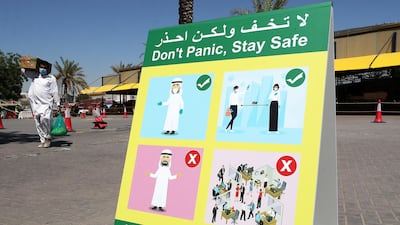
Safety instructions are on display outside Al Awir fruit and vegetable market in Dubai. Pawan Singh / The National -

A person wearing protective face mask and covering his face with laptop bag on a hot day in Bur Dubai area in Dubai. Pawan Singh / The National -
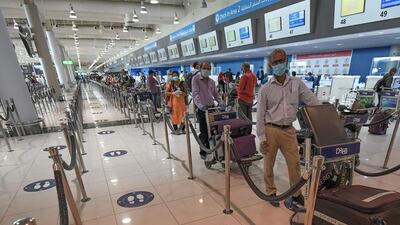
Indian citizens queue to check in at the Dubai International Airport before leaving the UAE on a flight back to their home country on May 7. Inbound flights for UAE residents have also begun operating from select cities. Karim Sahim / AFP -
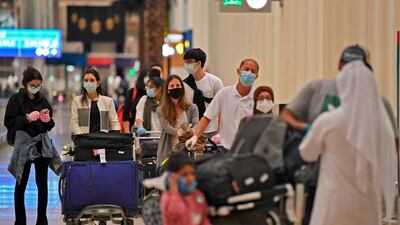
Passengers from an Emirates flight from London queue before being checked by health workers at Dubai International Airport on May 8. Karim Sahib / AFP -

Al Wahda Mall in Abu Dhabi has reopened to the public but with safety measures in place to protect shoppers and staff from contracting Covid-19. Victor Besa / The National -
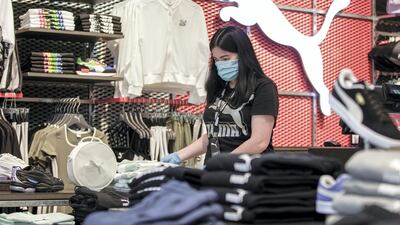
Yas Mall in Abu Dhabi has reopened to the public from 12pm to 9pm. Measures remain in place to keep shoppers and staff safe. Victor Besa / The National -

Yas Mall in Abu Dhabi will be open from midday to 9pm. Supermarkets and pharmacies will be open from 9am to midnight. Victor Besa / The National -

Workers pass by Al Mina vegetables and fruits market in Abu Dhabi. Victor Besa / The National -
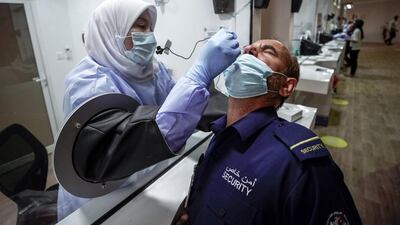
A security guard is given a free Covid-19 test at one of the Mussaffah testing centres. Victor Besa / The National -
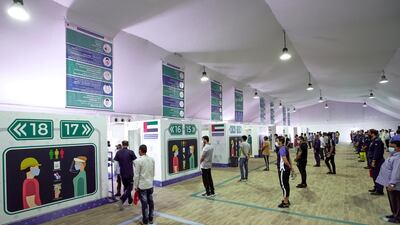
Workers line up to receive a coronavirus test at the Mussaffah industrial area in Abu Dhabi. Victor Besa / The National



