
Over recent years, it has become apparent that democratic governance as we know it is failing around the globe.
Amid a global pandemic, a worsening climate crisis, a war on the doorstep of the G7 and rampant inflation, world leaders are struggling to keep a handle on today’s challenges.
To progress, existing governance systems need a complete overhaul to usher in a new, equitable and decentralised future.
When it comes to global democracy, the writing has been on the wall for some time.
Today, half of the democratic governments around the globe are in decline, the International Institute for Democracy and Electoral Assistance has said.
In its 2022 report, the institute said democratic progress has stalled across countries in its global index in the past five years, with a rise in authoritarian regimes, restrictions on the freedom of expression and growing distrust in election results.
More and more countries have recently experienced highly divided elections, including Brazil, France, Italy, the UK and the US.
For example, the UK went through no less than three prime ministers in 2022, while populism has been on the rise globally in recent years.
In short, it’s clear people are desperate for a change to the legacy system, which has always allowed power to remain concentrated in the hands of the few, to the detriment of the many.
DAO to the rescue
With old models of governance failing, it is perhaps time for a change and, once again, blockchain technology poses a solution with the decentralised autonomous organisation, or DAO.
A DAO has no central leadership and is governed from the bottom up by a community, with its rules recorded on the blockchain in a transparent and immutable manner.
Unlike legacy governance systems, the DAO allows an entire group to make important decisions in full consensus.
DAOs form the foundation of the entire decentralised finance (DeFi) ecosystem.
Through their innovative governance models, DAOs incentivise members to vote on specific issues, offering them rewards in the form of tokens or a proportion of a protocol’s revenue.
Built using open-source code, DAOs are completely transparent and eliminate the risk of rigging, bribery or fraud.
Though DAOS (and DeFi as a whole) only account for a fraction of the global financial ecosystem, they are growing and evolving rapidly.
Today, there are 2,368 DAOs in existence, with more than $100 million in assets and total DAO treasury assets of $25.6 billion.
Their growth has accelerated over the past month, as total treasury assets jumped 79 per cent between March and April, according to data analytics site Deep DAO.
A natural evolution
The DAO model is the obvious evolution of the archaic and outdated shareholder and dividend policies that form the backbone of the business world today.
Far from promoting fairness and equality, today’s models prioritise the interests of shareholders over those of their employees, customers and the wider community.
This results in decisions that seek to boost short-term profits and reinforce existing power structures and wealth inequality, to the detriment of the people and the planet.
Meanwhile, many government bodies today are a drain on public resources amid rampant bureaucracy, inefficiencies and time wasting.
In many developed nations, including the US, the number of government institutions has expanded significantly over the past few decades, yet they contribute little to the world at large.
We could be making much better use of finite financial and natural resources by replacing 60 per cent of all incompetent middle management employees — in the public and private sectors — with smart contracts.
Those policies that are still relevant for the modern world can then be transferred on to the blockchain and managed by code in a transparent and efficient manner.
Unlike government elections, which have suffered from declining turnout for decades, DAO models ensure each participant is involved in decision-making and that their opinion will truly contribute to the future of the organisation.
UAE schools start teaching pupils about blockchain technology — in pictures
-
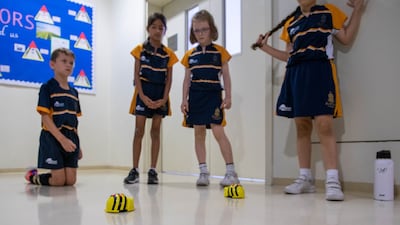
Pupils at Repton Al Barsha play with robots. All photos: Issa Alkindy for The National -
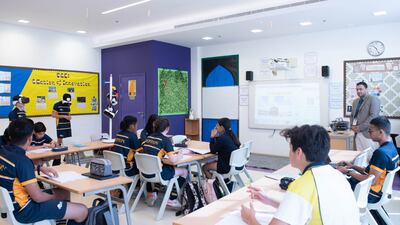
Pupils at Repton schools in the UAE are being introduced to blockchain technology. -

They are also being introduced to the metaverse. -

Pupils with the little yellow robots at Repton Al Barsha. -
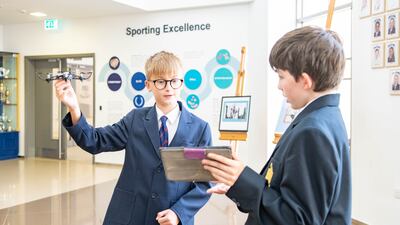
A drone in school at Repton Al Barsha. -

Repton Al Barsha is teaching pupils how to navigate the metaverse safely. -
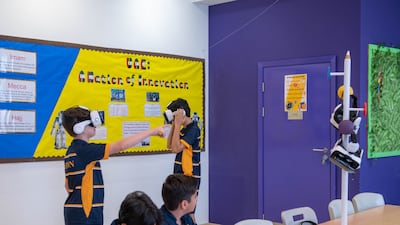
Repton pupils create their avatars in the metaverse.


In this system, each participant’s vote will carry an equal weight, regardless of their social or economic standing.
It’s clearer than ever that the DAO model is the future of governance.
It may take us years to change, but eventually the BlackRocks of this world will be replaced by MoonRock, and Uniswap will become the new Nasdaq.
With all of the innumerable benefits on offer, greater and greater decentralisation is inevitable.
Stefan Rust is chief executive of independent inflation data aggregator Truflation and former chief executive of bitcoin.com

