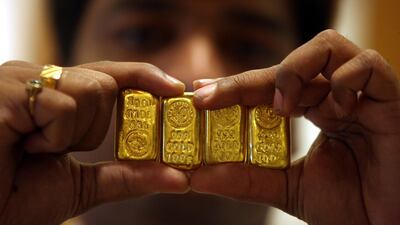
Central banks increased their gold purchases in February as they added 8.8 tonnes gold to their reserves during the month, according to the World Gold Council.
Gold sales by the central banks outweighed purchases in January. Banking regulators around the world sold a net 25.5 tonnes of gold in January as combined sales from Turkey and Russia outweighed buying elsewhere, the trade body said on Wednesday.
Meanwhile, central banks made net gold purchases of 20.6 tonnes in December 2020.
"Central banks tipped back into net purchases during February," Krishan Gopaul, market intelligence manager at the World Gold Council, said in a blog post.
“Buying from India [11.2 tonnes], Uzbekistan [7.2 tonnes], Kazakhstan [1.6 tonnes] and Colombia [0.5 tonnes] outweighed the only notable sale of gold by Turkey [-11.7 tonnes]. Year-to-date, this puts total global central bank net sales at 16.7 tonnes, the weakest start in over a decade.”
Gold plays an important part in central banks’ reserves, with the yellow metal comprising a significant portion of their holdings.
The pandemic has also boosted bullion prices as market uncertainty caused investors to rush to this traditional safe haven asset.
The price of gold rose to a record high of $2,084 an ounce last August, but it has since fallen more than 16 per cent to $1,732.
Central banks tipped back into net purchases during February
Gold prices have dropped as an accelerated vaccine rollout and positive economic data from the US sparked hopes about a faster economic rebound, weighing on the metal’s safe-haven appeal.
Gold purchases by central banks slowed sharply by 59 per cent in 2020 to 273 tonnes, the World Gold Council said in its Gold Demand Trends report in January this year. Official gold reserves grew by 44.8 tonnes during the final quarter last year, more than reversing the 6.5 tonnes of net sales in the third quarter.
Turkey was the largest annual gold buyer, adding 134.5 tonnes to its official gold reserves in 2020, while the UAE added 23.9 tonnes to its gold reserves, according to the report.
The US central bank holds the largest amount of gold reserves at 8,133.5 tonnes, accounting for 78.6 per cent of its total monetary holdings. This is followed by Germany’s Bundesbank with 3,362.4 tonnes and Italy’s Banca d’Italia at 2,451.8 tones, the council said.
The Central Bank of the UAE holds 50.7 tonnes of gold reserves and it accounts for 2.9 per cent of its total monetary holdings. The central bank sold Dh1.7 billion ($462.9m) of gold in January for the first time in three years "to capitalise on near-record prices" and to soften the impact of current global economic challenges, state news agency WAM said last month.
“Our expectation remains that central banks will be net purchasers in 2021, but the immediate outlook for central bank demand remains finely balanced,” Mr Gopaul said.
Demand for gold from the central banks remain uncertain, “with the sector bobbing between net sales and net purchases in recent months”, the council said.
The senior executive at the WGC said the recent net sales should not be looked upon as a change in sentiment towards gold as a reserve asset.
Selling has predominantly come from a small group of central banks whose “chunky sales have tipped the balance in certain months”, Mr Goupal said. These sales have been driven by several factors such as the pandemic-induced economic hardship, heightened local gold demand and coin-minting programmes, he added.
“We continue to see consistent moderate net buying from other countries, although these have been similarly concentrated among a small number of constituent banks,” he said.
The Reserve Bank of India, for instance, continued purchasing gold in March and added 6.5 tonnes to its gold reserves by March 26, the council said.
The Covid‑19 pandemic has not changed the view of central banks on gold, according to a joint survey of 26 banking regulators carried out by trade title Central Banking and Invesco in August 2020.
When determining a central bank’s gold holding, the benefits of diversification stand out as the most relevant factor for reserve managers, the survey found.

%20Ramez%20Gab%20Min%20El%20Akher
%3Cp%3E%3Cstrong%3ECreator%3A%3C%2Fstrong%3E%20Ramez%20Galal%3C%2Fp%3E%0A%3Cp%3E%3Cstrong%3EStarring%3A%3C%2Fstrong%3E%20Ramez%20Galal%3C%2Fp%3E%0A%3Cp%3E%3Cstrong%3EStreaming%20on%3A%20%3C%2Fstrong%3EMBC%20Shahid%3C%2Fp%3E%0A%3Cp%3E%3Cstrong%3ERating%3A%20%3C%2Fstrong%3E2.5%2F5%3C%2Fp%3E%0A
The%20specs%20
%3Cp%3E%3Cstrong%3EEngine%3A%20%3C%2Fstrong%3E2.0-litre%204cyl%20turbo%0D%3Cbr%3E%3Cstrong%3EPower%3A%20%3C%2Fstrong%3E261hp%20at%205%2C500rpm%0D%3Cbr%3E%3Cstrong%3ETorque%3A%20%3C%2Fstrong%3E400Nm%20at%201%2C750-4%2C000rpm%0D%3Cbr%3E%3Cstrong%3ETransmission%3A%20%3C%2Fstrong%3E7-speed%20dual-clutch%20auto%0D%3Cbr%3E%3Cstrong%3EFuel%20consumption%3A%20%3C%2Fstrong%3E10.5L%2F100km%0D%3Cbr%3E%3Cstrong%3EOn%20sale%3A%20%3C%2Fstrong%3ENow%0D%3Cbr%3E%3Cstrong%3EPrice%3A%20%3C%2Fstrong%3EFrom%20Dh129%2C999%20(VX%20Luxury)%3B%20from%20Dh149%2C999%20(VX%20Black%20Gold)%3C%2Fp%3E%0A
RACE CARD
6.30pm: Maiden (TB) Dh82,500 (Dirt) 1,200m
7.05pm: Maiden (TB) Dh82,500 (D) 1,900m
7.40pm: Handicap (TB) Dh102,500 (D) 2,000m
8.15pm: Conditions (TB) Dh120,000 (D) 1,600m
8.50pm: Handicap (TB) Dh95,000 (D) 1,600m
9.25pm: Handicap (TB) Dh87,500 (D) 1,400m
Stage 2
1. Mathieu van der Poel (NED) Alpecin-Fenix 4:18:30
2. Tadej Pogacar (SLV) UAE Team Emirates 0:00:06
3. Primoz Roglic (SLV) Jumbo-Visma 0:00:06
4. Wilco Kelderman (NED) Bora-Hansgrohe 0:00:06
5. Julian Alaphilippe (FRA) Deceuninck-QuickStep 0:00:08
Where to donate in the UAE
The Emirates Charity Portal
You can donate to several registered charities through a “donation catalogue”. The use of the donation is quite specific, such as buying a fan for a poor family in Niger for Dh130.
The General Authority of Islamic Affairs & Endowments
The site has an e-donation service accepting debit card, credit card or e-Dirham, an electronic payment tool developed by the Ministry of Finance and First Abu Dhabi Bank.
Al Noor Special Needs Centre
You can donate online or order Smiles n’ Stuff products handcrafted by Al Noor students. The centre publishes a wish list of extras needed, starting at Dh500.
Beit Al Khair Society
Beit Al Khair Society has the motto “From – and to – the UAE,” with donations going towards the neediest in the country. Its website has a list of physical donation sites, but people can also contribute money by SMS, bank transfer and through the hotline 800-22554.
Dar Al Ber Society
Dar Al Ber Society, which has charity projects in 39 countries, accept cash payments, money transfers or SMS donations. Its donation hotline is 800-79.
Dubai Cares
Dubai Cares provides several options for individuals and companies to donate, including online, through banks, at retail outlets, via phone and by purchasing Dubai Cares branded merchandise. It is currently running a campaign called Bookings 2030, which allows people to help change the future of six underprivileged children and young people.
Emirates Airline Foundation
Those who travel on Emirates have undoubtedly seen the little donation envelopes in the seat pockets. But the foundation also accepts donations online and in the form of Skywards Miles. Donated miles are used to sponsor travel for doctors, surgeons, engineers and other professionals volunteering on humanitarian missions around the world.
Emirates Red Crescent
On the Emirates Red Crescent website you can choose between 35 different purposes for your donation, such as providing food for fasters, supporting debtors and contributing to a refugee women fund. It also has a list of bank accounts for each donation type.
Gulf for Good
Gulf for Good raises funds for partner charity projects through challenges, like climbing Kilimanjaro and cycling through Thailand. This year’s projects are in partnership with Street Child Nepal, Larchfield Kids, the Foundation for African Empowerment and SOS Children's Villages. Since 2001, the organisation has raised more than $3.5 million (Dh12.8m) in support of over 50 children’s charities.
Noor Dubai Foundation
Sheikh Mohammed bin Rashid Al Maktoum launched the Noor Dubai Foundation a decade ago with the aim of eliminating all forms of preventable blindness globally. You can donate Dh50 to support mobile eye camps by texting the word “Noor” to 4565 (Etisalat) or 4849 (du).
The Pope's itinerary
Sunday, February 3, 2019 - Rome to Abu Dhabi
1pm: departure by plane from Rome / Fiumicino to Abu Dhabi
10pm: arrival at Abu Dhabi Presidential Airport
Monday, February 4
12pm: welcome ceremony at the main entrance of the Presidential Palace
12.20pm: visit Abu Dhabi Crown Prince at Presidential Palace
5pm: private meeting with Muslim Council of Elders at Sheikh Zayed Grand Mosque
6.10pm: Inter-religious in the Founder's Memorial
Tuesday, February 5 - Abu Dhabi to Rome
9.15am: private visit to undisclosed cathedral
10.30am: public mass at Zayed Sports City – with a homily by Pope Francis
12.40pm: farewell at Abu Dhabi Presidential Airport
1pm: departure by plane to Rome
5pm: arrival at the Rome / Ciampino International Airport
MATCH INFO
England 19 (Try: Tuilagi; Cons: Farrell; Pens: Ford (4)
New Zealand 7 (Try: Savea; Con: Mo'unga)
Dr Afridi's warning signs of digital addiction
Spending an excessive amount of time on the phone.
Neglecting personal, social, or academic responsibilities.
Losing interest in other activities or hobbies that were once enjoyed.
Having withdrawal symptoms like feeling anxious, restless, or upset when the technology is not available.
Experiencing sleep disturbances or changes in sleep patterns.
What are the guidelines?
Under 18 months: Avoid screen time altogether, except for video chatting with family.
Aged 18-24 months: If screens are introduced, it should be high-quality content watched with a caregiver to help the child understand what they are seeing.
Aged 2-5 years: Limit to one-hour per day of high-quality programming, with co-viewing whenever possible.
Aged 6-12 years: Set consistent limits on screen time to ensure it does not interfere with sleep, physical activity, or social interactions.
Teenagers: Encourage a balanced approach – screens should not replace sleep, exercise, or face-to-face socialisation.
Source: American Paediatric Association
What can victims do?
Always use only regulated platforms
Stop all transactions and communication on suspicion
Save all evidence (screenshots, chat logs, transaction IDs)
Report to local authorities
Warn others to prevent further harm
Courtesy: Crystal Intelligence
