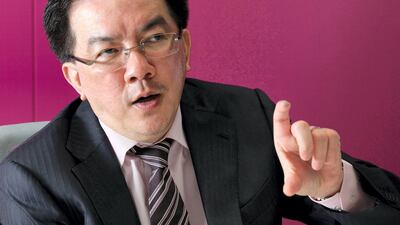
Stanley Thai Sim Kim owns 38% of Supermax, Malaysia's third-largest maker of medical gloves. Bloomberg

How Covid-19 helped create new billionaires


  • English
  • Arabic

It’s been a good year for glove companies and their founders.

Malaysia, a country that produces about 65 per cent of the world’s supply for rubber gloves, now counts at least four billionaires whose fortunes were made in the industry, including two new ones this year alone. Thai Kim Sim of Supermax was the latest to join the club, with a net worth estimated at about $1 billion (Dh3.67bn) at the stock high earlier this month, according to the Bloomberg Billionaires Index.

A jump in demand due to the coronavirus outbreak has propelled shares of companies making protective gear, suddenly turning the Southeast Asian nation into a hotspot for creating ultra-wealthy individuals within the sector. Top Glove Corp., the world’s biggest maker of the product, Hartalega Holdings Bhd. and Kossan Rubber Industries Bhd. have all benefited. But with a fivefold jump, Supermax’s ascent has been particularly notable this year.

Supermax is a very interesting story

“It has become a new norm to wear gloves for various purposes, including medical and retail, and the high usage will benefit their makers in the long term,” said Walter Aw, an analyst at CGS-CIMB Research. “Supermax is a very interesting story. It does its own brand manufacturing, while others are mainly suppliers.”

Mr Thai founded Supermax with his wife in 1987, starting it as a business trading latex gloves before venturing into manufacturing in 1989. It became the first manufacturer to come up with its own glove label, Supermax, in response to the government’s call to brand Malaysian products. The company now exports to more than 160 countries and meets 12 per cent of the global demand for latex examination gloves, according to its website.

Mr Thai and his direct family members own 38 per cent of Supermax, according to company filings. He declined to comment for this story.

Just like social distancing and temperature checks, wearing protective equipment has become the norm with the virus pandemic that has already killed more than 430,000 people worldwide. Global demand for rubber gloves could grow 11 per cent to 330 billion pieces this year, two-thirds of which is likely to come from Malaysia, the country’s rubber glove manufacturers association estimates.

The Southeast Asian nation became a glove powerhouse in the 1980s, when demand began to surge with the AIDS epidemic. Thanks to low labour costs, Malaysian entrepreneurs were able to set up shop. The country’s plantations of rubber trees – British colonists introduced the plants originally from Brazil in the 1870s –and its large oil industry help provide local manufacturers supplies to make the protective equipment.

Top Glove's value has more than tripled this year, lifting the net worth of its founder, Lim Wee Chai, to $2.5bn, according to Bloomberg calculations excluding the value of his pledged shares. The company reported a 366 per cent surge in net income to a record 348 million ringgit (Dh297m / $81m) for the three months through May, with sales also reaching an all-time high. Its executive director said in an analyst briefing Thursday that “the best is yet to come,” with a “more spectacular performance” for the quarters to follow.

Local rivals Hartalega and Kossan Rubber have seen their stock double in 2020. That’s pushed the value of the Hartalega stake held by founder Kuan Kam Hon and his family to $4.8bn, including shares indirectly owned through holding companies. Kossan Rubber’s Lim Kuang Sia, who’s now worth $1.1bn, also became a new billionaire this year.

But with a 394 per cent stock surge in 2020 through Monday, Supermax’s ascent is unparalleled. The company reported a 24 per cent increase in revenue to 447m ringgit for the three months through March, partly driven by an “exponential surge in demand due to the Covid-19 pandemic,” it said in its quarterly release. The company churns out 24 billion gloves annually and is looking to expand that to 44 billion by 2024, according to its 2019 annual report. It bought additional land to increase manufacturing capacity this month.

Mr Thai’s rise to a billionaire hasn’t come without controversy, though. He has appealed against a 2017 conviction for an insider trading offense he allegedly committed in 2007. He was sentenced to five years in jail and fined 5 million ringgit for communicating non-public information about APL Industries, a company Supermax gained control of in 2005 that was delisted in 2009.

A Top Glove factory in Klang outside Kuala Lumpur. Glove manufacturers like Top Glove has seen business pick up as demand for gloves grow. Reuters

While most analysts are positive on Supermax – eight of the 10 tracked by Bloomberg recommend buying the stock, and none advises to sell – some are saying Malaysian glovemakers are at risk should countries such as China expand their production, according to a Maybank Investment Bank report by Lee Yen Ling last week. Their shares gave up some gains on Monday, with Supermax losing 13 per cent for its biggest slump since August 2018. It regained 7.4 per cent at 10.50am in Kuala Lumpur.

But for now, Supermax remains a favourite. The fact that the company manufactures its own brand of gloves means it may be able to sell at higher prices directly to end-customers, according to CGS-CIMB’s Mr Aw, who expects the industry boom to last past the immediate effect of Covid-19.

For Kenanga Research analyst Raymond Choo Ping Khoon, too, Supermax has more good days ahead – not just because of the “abnormal demand and acute supply tightness,” he wrote in a June 10 note, but also thanks to the “scrupulous execution of its expansion plans.” And the recent land acquisitions showed the company’s commitment toward future growth, the analyst said.


The%C2%A0specs%20
%3Cp%3E%3Cstrong%3EEngine%3A%3C%2Fstrong%3E%20Dual%20synchronous%20electric%20motors%20%20%0D%3Cbr%3E%3Cstrong%3EPower%3A%20%3C%2Fstrong%3E646hp%0D%3Cbr%3E%3Cstrong%3ETorque%3A%20%3C%2Fstrong%3E830Nm%0D%3Cbr%3E%3Cstrong%3ETransmission%3A%20%3C%2Fstrong%3ETwo-speed%20auto%20(rear%20axle)%3B%20single-speed%20auto%20(front)%20%0D%3Cbr%3E%3Cstrong%3EPrice%3A%20%3C%2Fstrong%3EFrom%20Dh552%2C311%3B%20Dh660%2C408%20(as%20tested)%0D%3Cbr%3E%3Cstrong%3EOn%20sale%3A%20%3C%2Fstrong%3Enow%3C%2Fp%3E%0A

Mercer, the investment consulting arm of US services company Marsh & McLennan, expects its wealth division to at least double its assets under management (AUM) in the Middle East as wealth in the region continues to grow despite economic headwinds, a company official said.

Mercer Wealth, which globally has $160 billion in AUM, plans to boost its AUM in the region to $2-$3bn in the next 2-3 years from the present $1bn, said Yasir AbuShaban, a Dubai-based principal with Mercer Wealth.

Within the next two to three years, we are looking at reaching $2 to $3 billion as a conservative estimate and we do see an opportunity to do so,” said Mr AbuShaban.

Mercer does not directly make investments, but allocates clients’ money they have discretion to, to professional asset managers. They also provide advice to clients.

“We have buying power. We can negotiate on their (client’s) behalf with asset managers to provide them lower fees than they otherwise would have to get on their own,” he added.

Mercer Wealth’s clients include sovereign wealth funds, family offices, and insurance companies among others.

From its office in Dubai, Mercer also looks after Africa, India and Turkey, where they also see opportunity for growth.

Wealth creation in Middle East and Africa (MEA) grew 8.5 per cent to $8.1 trillion last year from $7.5tn in 2015, higher than last year’s global average of 6 per cent and the second-highest growth in a region after Asia-Pacific which grew 9.9 per cent, according to consultancy Boston Consulting Group (BCG). In the region, where wealth grew just 1.9 per cent in 2015 compared with 2014, a pickup in oil prices has helped in wealth generation.

BCG is forecasting MEA wealth will rise to $12tn by 2021, growing at an annual average of 8 per cent.

Drivers of wealth generation in the region will be split evenly between new wealth creation and growth of performance of existing assets, according to BCG.

Another general trend in the region is clients’ looking for a comprehensive approach to investing, according to Mr AbuShaban.

“Institutional investors or some of the families are seeing a slowdown in the available capital they have to invest and in that sense they are looking at optimizing the way they manage their portfolios and making sure they are not investing haphazardly and different parts of their investment are working together,” said Mr AbuShaban.

Some clients also have a higher appetite for risk, given the low interest-rate environment that does not provide enough yield for some institutional investors. These clients are keen to invest in illiquid assets, such as private equity and infrastructure.

“What we have seen is a desire for higher returns in what has been a low-return environment specifically in various fixed income or bonds,” he said.

“In this environment, we have seen a de facto increase in the risk that clients are taking in things like illiquid investments, private equity investments, infrastructure and private debt, those kind of investments were higher illiquidity results in incrementally higher returns.”

The Abu Dhabi Investment Authority, one of the largest sovereign wealth funds, said in its 2016 report that has gradually increased its exposure in direct private equity and private credit transactions, mainly in Asian markets and especially in China and India. The authority’s private equity department focused on structured equities owing to “their defensive characteristics.”

What is a robo-adviser?

Robo-advisers use an online sign-up process to gauge an investor’s risk tolerance by feeding information such as their age, income, saving goals and investment history into an algorithm, which then assigns them an investment portfolio, ranging from more conservative to higher risk ones.

These portfolios are made up of exchange traded funds (ETFs) with exposure to indices such as US and global equities, fixed-income products like bonds, though exposure to real estate, commodity ETFs or gold is also possible.

Investing in ETFs allows robo-advisers to offer fees far lower than traditional investments, such as actively managed mutual funds bought through a bank or broker. Investors can buy ETFs directly via a brokerage, but with robo-advisers they benefit from investment portfolios matched to their risk tolerance as well as being user friendly.

Many robo-advisers charge what are called wrap fees, meaning there are no additional fees such as subscription or withdrawal fees, success fees or fees for rebalancing.

Our legal columnist

Name: Yousef Al Bahar

Advocate at Al Bahar & Associate Advocates and Legal Consultants, established in 1994

Education: Mr Al Bahar was born in 1979 and graduated in 2008 from the Judicial Institute. He took after his father, who was one of the first Emirati lawyers

Meydan race card

6.30pm: Maiden Dh 165,000 1,600m
7.05pm: Handicap Dh 185,000 2,000m
7.40pm: Maiden Dh 165,000 1,600m
8.15pm: Handicap Dh 190,000 1,400m
8.50pm: Handicap Dh 175,000 1,600m
9.25pm: Handicap Dh 175,000 1,200m
10pm: Handicap Dh 165,000 1,600m

The Way It Was: My Life with Frank Sinatra by Eliot Weisman and Jennifer Valoppi
Hachette Books

Trump v Khan

2016: Feud begins after Khan criticised Trump’s proposed Muslim travel ban to US

2017: Trump criticises Khan’s ‘no reason to be alarmed’ response to London Bridge terror attacks

2019: Trump calls Khan a “stone cold loser” before first state visit

2019: Trump tweets about “Khan’s Londonistan”, calling him “a national disgrace”

2022:  Khan’s office attributes rise in Islamophobic abuse against the major to hostility stoked during Trump’s presidency

July 2025 During a golfing trip to Scotland, Trump calls Khan “a nasty person”

Sept 2025 Trump blames Khan for London’s “stabbings and the dirt and the filth”.

Dec 2025 Trump suggests migrants got Khan elected, calls him a “horrible, vicious, disgusting mayor”

COMPANY%20PROFILE%20
%3Cp%3E%3Cstrong%3EName%3A%3C%2Fstrong%3E%20Haltia.ai%0D%3Cbr%3E%3Cstrong%3EStarted%3A%3C%2Fstrong%3E%202023%0D%3Cbr%3E%3Cstrong%3ECo-founders%3A%3C%2Fstrong%3E%20Arto%20Bendiken%20and%20Talal%20Thabet%0D%3Cbr%3E%3Cstrong%3EBased%3A%3C%2Fstrong%3E%20Dubai%2C%20UAE%0D%3Cbr%3E%3Cstrong%3EIndustry%3A%3C%2Fstrong%3E%20AI%0D%3Cbr%3E%3Cstrong%3ENumber%20of%20employees%3A%3C%2Fstrong%3E%2041%0D%3Cbr%3E%3Cstrong%3EFunding%3A%3C%2Fstrong%3E%20About%20%241.7%20million%0D%3Cbr%3E%3Cstrong%3EInvestors%3A%3C%2Fstrong%3E%20Self%2C%20family%20and%20friends%26nbsp%3B%3C%2Fp%3E%0A
MATCH INFO

Manchester City 2 (Mahrez 04', Ake 84')

Leicester City 5 (Vardy 37' pen, 54', 58' pen, Maddison 77', Tielemans 88' pen)

Man of the match: Jamie Vardy (Leicester City)

THE DETAILS

Director: Milan Jhaveri
Producer: Emmay Entertainment and T-Series
Cast: John Abraham, Manoj Bajpayee
Rating: 2/5

What is safeguarding?

“Safeguarding, not just in sport, but in all walks of life, is making sure that policies are put in place that make sure your child is safe; when they attend a football club, a tennis club, that there are welfare officers at clubs who are qualified to a standard to make sure your child is safe in that environment,” Derek Bell explains.

match info

Manchester United 3 (Martial 7', 44', 74')

Sheffield United 0

UAE currency: the story behind the money in your pockets
Results

6pm: Dubai Trophy – Conditions (TB) $100,000 (Turf) 1,200m 

Winner: Silent Speech, William Buick (jockey), Charlie Appleby
(trainer) 

6.35pm: Jumeirah Derby Trial – Conditions (TB) $60,000 (T)
1,800m 

Winner: Island Falcon, Frankie Dettori, Saeed bin Suroor 

7.10pm: UAE 2000 Guineas Trial – Conditions (TB) $60,000 (Dirt)
1,400m 

Winner: Rawy, Mickael Barzalona, Salem bin Ghadayer 

7.45pm: Al Rashidiya – Group 2 (TB) $180,000 (T) 1,800m 

Winner: Desert Fire, Hector Crouch, Saeed bin Suroor 

8.20pm: Al Fahidi Fort – Group 2 (TB) $180,000 (T) 1,400m 

Winner: Naval Crown, William Buick, Charlie Appleby 

8.55pm: Dubawi Stakes – Group 3 (TB) $150,000 (D) 1,200m 

Winner: Al Tariq, Pat Dobbs, Doug Watsons 

9.30pm: Aliyah – Rated Conditions (TB) $80,000 (D) 2,000m 

Winner: Dubai Icon, Patrick Cosgrave, Saeed bin Suroor  

UPI facts

More than 2.2 million Indian tourists arrived in UAE in 2023
More than 3.5 million Indians reside in UAE
Indian tourists can make purchases in UAE using rupee accounts in India through QR-code-based UPI real-time payment systems
Indian residents in UAE can use their non-resident NRO and NRE accounts held in Indian banks linked to a UAE mobile number for UPI transactions

Match info

Wolves 0

Arsenal 2 (Saka 43', Lacazette 85')

Man of the match: Shkodran Mustafi (Arsenal)

Yahya Al Ghassani's bio

Date of birth: April 18, 1998

Playing position: Winger

Clubs: 2015-2017 – Al Ahli Dubai; March-June 2018 – Paris FC; August – Al Wahda

Company%20Profile
%3Cp%3E%3Cstrong%3ECompany%20name%3A%20%3C%2Fstrong%3ENamara%0D%3Cbr%3E%3Cstrong%3EStarted%3A%20%3C%2Fstrong%3EJune%202022%0D%3Cbr%3E%3Cstrong%3EFounder%3A%20%3C%2Fstrong%3EMohammed%20Alnamara%0D%3Cbr%3E%3Cstrong%3EBased%3A%20%3C%2Fstrong%3EDubai%20%0D%3Cbr%3E%3Cstrong%3ESector%3A%20%3C%2Fstrong%3EMicrofinance%0D%3Cbr%3E%3Cstrong%3ECurrent%20number%20of%20staff%3A%20%3C%2Fstrong%3E16%0D%3Cbr%3E%3Cstrong%3EInvestment%20stage%3A%20%3C%2Fstrong%3ESeries%20A%0D%3Cbr%3E%3Cstrong%3EInvestors%3A%20%3C%2Fstrong%3EFamily%20offices%0D%3Cbr%3E%3C%2Fp%3E%0A
Five personal finance podcasts from The National


To help you get started, tune into these Pocketful of Dirham episodes 

·

Balance is essential to happiness, health and wealth 

·

What is a portfolio stress test? 

·

What are NFTs and why are auction houses interested? 

·

How gamers are getting rich by earning cryptocurrencies 

·

Should you buy or rent a home in the UAE?  

Company%20profile
%3Cp%3E%3Cstrong%3ECompany%20name%3A%20%3C%2Fstrong%3EHakbah%0D%3Cbr%3E%3Cstrong%3EStarted%3A%20%3C%2Fstrong%3E2018%0D%3Cbr%3E%3Cstrong%3EFounder%3A%20%3C%2Fstrong%3ENaif%20AbuSaida%0D%3Cbr%3E%3Cstrong%3EBased%3A%20%3C%2Fstrong%3ESaudi%20Arabia%0D%3Cbr%3E%3Cstrong%3ESector%3A%20%3C%2Fstrong%3EFinTech%0D%3Cbr%3E%3Cstrong%3ECurrent%20number%20of%20staff%3A%20%3C%2Fstrong%3E22%20%0D%3Cbr%3E%3Cstrong%3EInitial%20investment%3A%20%3C%2Fstrong%3E%24200%2C000%0D%3Cbr%3E%3Cstrong%3EInvestment%20stage%3A%20%3C%2Fstrong%3Epre-Series%20A%0D%3Cbr%3E%3Cstrong%3EInvestors%3A%20%3C%2Fstrong%3EGlobal%20Ventures%20and%20Aditum%20Investment%20Management%0D%3Cbr%3E%3Cbr%3E%3C%2Fp%3E%0A
Our family matters legal consultant

Name: Hassan Mohsen Elhais

Position: legal consultant with Al Rowaad Advocates and Legal Consultants.

Roger Federer's 2018 record

Australian Open Champion

Rotterdam Champion

Indian Wells Runner-up

Miami Second round

Stuttgart Champion

Halle Runner-up

Wimbledon Quarter-finals

Cincinnati Runner-up

US Open Fourth round

Shanghai Semi-finals

Basel Champion

Paris Masters Semi-finals


PROFILE OF CURE.FIT

Started: July 2016

Founders: Mukesh Bansal and Ankit Nagori

Based: Bangalore, India

Sector: Health & wellness

Size: 500 employees

Investment: $250 million

Investors: Accel, Oaktree Capital (US); Chiratae Ventures, Epiq Capital, Innoven Capital, Kalaari Capital, Kotak Mahindra Bank, Piramal Group’s Anand Piramal, Pratithi Investment Trust, Ratan Tata (India); and Unilever Ventures (Unilever’s global venture capital arm)

Biog

Age: 50

Known as the UAE’s strongest man

Favourite dish: “Everything and sea food”

Hobbies: Drawing, basketball and poetry

Favourite car: Any classic car

Favourite superhero: The Hulk original

How to help

Call the hotline on 0502955999 or send "thenational" to the following numbers:

2289 - Dh10

2252 - Dh50

6025 - Dh20

6027 - Dh100

6026 - Dh200

In numbers

1,000 tonnes of waste collected daily:

  • 800 tonnes converted into alternative fuel
  • 150 tonnes to landfill
  • 50 tonnes sold as scrap metal

800 tonnes of RDF replaces 500 tonnes of coal

Two conveyor lines treat more than 350,000 tonnes of waste per year

25 staff on site