Crude oil futures in New York are expected to jump during the opening session on Monday after a cyberattack shut a significant pipeline in the US.
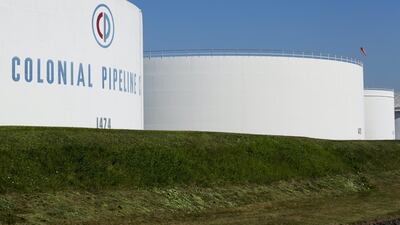
A ransomware attack on Friday led the Colonial Pipeline, the most significant route for transporting refined products, to shut down temporarily. The pipeline accounts for nearly half of the fuel consumed by states along the US Gulf Coast.
A ransomware attack involves encrypting data with malicious software, which leaves systems locked until an extortion fee is paid to the hackers.
The attack is the biggest of its kind on a US pipeline.
"At this time, our primary focus is the safe and efficient restoration of our service and our efforts to return to normal operation,” the company said in a statement.
The company has not yet mentioned when it will resume service.
US crude futures, which settled 0.29 per cent higher at $64.90 per barrel on Friday, are expected to make significant gains due to the outage.
"I expect WTI [West Texas Intermediate] to open higher tomorrow as it has the potential to disrupt supplies throughout the US North East," said Jeffrey Halley, Asia Pacific senior market analyst, at Oanda.
Futures for refined projects such as gasoline are likely to gain the most, with WTI acting as a proxy, he added.
Demand for gasoline has increased in the US, the world's biggest producer of oil and gas, as the country emerges from Covid-19 restrictions.
The shutdown of the pipeline, which has a capacity of 2.5 million barrels per day, as a precautionary measure will have an impact on the supply of products including gasoline, diesel and jet fuel to the US east coast from the Gulf Coast.
The disruption is expected to further fuel the rally in Brent, the international benchmark, which is inching closer to the $70 per barrel threshold.
Brent, under which two-thirds of the world's crude is traded, closed 0.28 per cent higher at $68.28 per barrel on Friday.
"WTI was up by 2 per cent in last week’s trade with early weekly gains providing a strong momentum thrust," said Vijay Valecha, chief investment officer at Dubai-based Century Financial.
"However, this was countered by selling pressure ... towards latter sessions as a continuous rise in new Covid-19 cases across India pressurised the markets."
The devastating second wave of the pandemic has crushed India's already fragile healthcare infrastructure. The country of 1.37 billion has been reporting over 400,000 daily cases over the last couple of days, with more than 22 million infections registered so far.

The Pope's itinerary
Sunday, February 3, 2019 - Rome to Abu Dhabi
1pm: departure by plane from Rome / Fiumicino to Abu Dhabi
10pm: arrival at Abu Dhabi Presidential Airport
Monday, February 4
12pm: welcome ceremony at the main entrance of the Presidential Palace
12.20pm: visit Abu Dhabi Crown Prince at Presidential Palace
5pm: private meeting with Muslim Council of Elders at Sheikh Zayed Grand Mosque
6.10pm: Inter-religious in the Founder's Memorial
Tuesday, February 5 - Abu Dhabi to Rome
9.15am: private visit to undisclosed cathedral
10.30am: public mass at Zayed Sports City – with a homily by Pope Francis
12.40pm: farewell at Abu Dhabi Presidential Airport
1pm: departure by plane to Rome
5pm: arrival at the Rome / Ciampino International Airport
MOUNTAINHEAD REVIEW
Starring: Ramy Youssef, Steve Carell, Jason Schwartzman
Director: Jesse Armstrong
Rating: 3.5/5
RESULT
Chelsea 2
Willian 13'
Ross Barkley 64'
Liverpool 0
Tree of Hell
Starring: Raed Zeno, Hadi Awada, Dr Mohammad Abdalla
Director: Raed Zeno
Rating: 4/5
FIXTURES
December 28
Stan Wawrinka v Pablo Carreno Busta, 5pm
Milos Raonic v Dominic Thiem, no earlier then 7pm
December 29 - semi-finals
Rafael Nadal v Stan Wawrinka / Pablo Carreno Busta, 5pm
Novak Djokovic v Milos Raonic / Dominic Thiem, no earlier then 7pm
December 30
3rd/4th place play-off, 5pm
Final, 7pm
Ten tax points to be aware of in 2026
1. Domestic VAT refund amendments: request your refund within five years
If a business does not apply for the refund on time, they lose their credit.
2. E-invoicing in the UAE
Businesses should continue preparing for the implementation of e-invoicing in the UAE, with 2026 a preparation and transition period ahead of phased mandatory adoption.
3. More tax audits
Tax authorities are increasingly using data already available across multiple filings to identify audit risks.
4. More beneficial VAT and excise tax penalty regime
Tax disputes are expected to become more frequent and more structured, with clearer administrative objection and appeal processes. The UAE has adopted a new penalty regime for VAT and excise disputes, which now mirrors the penalty regime for corporate tax.
5. Greater emphasis on statutory audit
There is a greater need for the accuracy of financial statements. The International Financial Reporting Standards standards need to be strictly adhered to and, as a result, the quality of the audits will need to increase.
6. Further transfer pricing enforcement
Transfer pricing enforcement, which refers to the practice of establishing prices for internal transactions between related entities, is expected to broaden in scope. The UAE will shortly open the possibility to negotiate advance pricing agreements, or essentially rulings for transfer pricing purposes.
7. Limited time periods for audits
Recent amendments also introduce a default five-year limitation period for tax audits and assessments, subject to specific statutory exceptions. While the standard audit and assessment period is five years, this may be extended to up to 15 years in cases involving fraud or tax evasion.
8. Pillar 2 implementation
Many multinational groups will begin to feel the practical effect of the Domestic Minimum Top-Up Tax (DMTT), the UAE's implementation of the OECD’s global minimum tax under Pillar 2. While the rules apply for financial years starting on or after January 1, 2025, it is 2026 that marks the transition to an operational phase.
9. Reduced compliance obligations for imported goods and services
Businesses that apply the reverse-charge mechanism for VAT purposes in the UAE may benefit from reduced compliance obligations.
10. Substance and CbC reporting focus
Tax authorities are expected to continue strengthening the enforcement of economic substance and Country-by-Country (CbC) reporting frameworks. In the UAE, these regimes are increasingly being used as risk-assessment tools, providing tax authorities with a comprehensive view of multinational groups’ global footprints and enabling them to assess whether profits are aligned with real economic activity.
Contributed by Thomas Vanhee and Hend Rashwan, Aurifer
%20Ramez%20Gab%20Min%20El%20Akher
%3Cp%3E%3Cstrong%3ECreator%3A%3C%2Fstrong%3E%20Ramez%20Galal%3C%2Fp%3E%0A%3Cp%3E%3Cstrong%3EStarring%3A%3C%2Fstrong%3E%20Ramez%20Galal%3C%2Fp%3E%0A%3Cp%3E%3Cstrong%3EStreaming%20on%3A%20%3C%2Fstrong%3EMBC%20Shahid%3C%2Fp%3E%0A%3Cp%3E%3Cstrong%3ERating%3A%20%3C%2Fstrong%3E2.5%2F5%3C%2Fp%3E%0A
The bio
Favourite book: Peter Rabbit. I used to read it to my three children and still read it myself. If I am feeling down it brings back good memories.
Best thing about your job: Getting to help people. My mum always told me never to pass up an opportunity to do a good deed.
Best part of life in the UAE: The weather. The constant sunshine is amazing and there is always something to do, you have so many options when it comes to how to spend your day.
Favourite holiday destination: Malaysia. I went there for my honeymoon and ended up volunteering to teach local children for a few hours each day. It is such a special place and I plan to retire there one day.
It's up to you to go green
Nils El Accad, chief executive and owner of Organic Foods and Café, says going green is about “lifestyle and attitude” rather than a “money change”; people need to plan ahead to fill water bottles in advance and take their own bags to the supermarket, he says.
“People always want someone else to do the work; it doesn’t work like that,” he adds. “The first step: you have to consciously make that decision and change.”
When he gets a takeaway, says Mr El Accad, he takes his own glass jars instead of accepting disposable aluminium containers, paper napkins and plastic tubs, cutlery and bags from restaurants.
He also plants his own crops and herbs at home and at the Sheikh Zayed store, from basil and rosemary to beans, squashes and papayas. “If you’re going to water anything, better it be tomatoes and cucumbers, something edible, than grass,” he says.
“All this throwaway plastic - cups, bottles, forks - has to go first,” says Mr El Accad, who has banned all disposable straws, whether plastic or even paper, from the café chain.
One of the latest changes he has implemented at his stores is to offer refills of liquid laundry detergent, to save plastic. The two brands Organic Foods stocks, Organic Larder and Sonnett, are both “triple-certified - you could eat the product”.
The Organic Larder detergent will soon be delivered in 200-litre metal oil drums before being decanted into 20-litre containers in-store.
Customers can refill their bottles at least 30 times before they start to degrade, he says. Organic Larder costs Dh35.75 for one litre and Dh62 for 2.75 litres and refills will cost 15 to 20 per cent less, Mr El Accad says.
But while there are savings to be had, going green tends to come with upfront costs and extra work and planning. Are we ready to refill bottles rather than throw them away? “You have to change,” says Mr El Accad. “I can only make it available.”
