
Planned investment in the Middle East and North Africa region’s power sector slumped by a third amid the pandemic-driven slowdown this year. However, investments already committed to the sector remained stable in 2020, according to the Arab Petroleum Investments Corporation.
The $114 billion drop in planned funding is driven partly by several regional projects being moved to committed investment status in 2020, Apicorp, a multilateral lender focused on the energy sector, said in its 2020-2024 Mena Power Investment Outlook report.
Stalled projects in Iran, Iraq, Tunisia and Lebanon due to the direct impact of the pandemic also drove the overall value of planned investments down, Apicorp said on Tuesday.
Other factors that contributed to the decrease in planned investments included increased surplus capacities in Egypt and Saudi Arabia.
“Compared to other energy sectors, the investment landscape in the power sector held relatively steady despite the Covid-19 pandemic,” Ahmed Ali Attiga, chief executive of Apicorp, said.
“We expect the power sector to play a vital role in accelerating the post-pandemic recovery process as enhancing energy security and digital services take on increased strategic importance."
In its 2019-2023 projections made last year, Apicorp, which funds energy sector projects in Opec-member countries, expected overall investment in the Mena’s energy sector to reach $1 trillion, with the power sector accounting for the largest share of spending at 36 per cent.
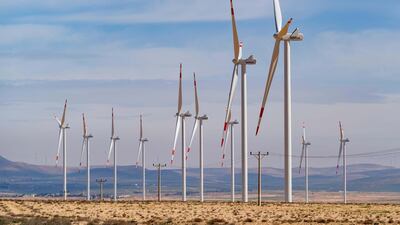
Planned projects represent almost two-thirds of the total value of the 2020-2024 Mena power sector’s project pipeline. Mirroring global trends, renewables currently account for the largest share of planned and committed power projects for the five-year period at around one third of total investment value.
Oil and gas-fired power plants account for 27 per cent of total investments, while nuclear power and coal represent 15 per cent and 3 per cent respectively.
The increased penetration of clean energy in the Mena region is driven by unprecedented cost declines in renewable energy and governments’ renewable energy targets, which range from 13 per cent to 52 per cent of installed capacity by 2030.
However, the lack of grid-scale storage means that fossil fuels – primarily natural gas – and nuclear, will remain indispensable to the power supply mix in the foreseeable future, Apicorp said.
The recent push by several countries to boost regional electricity interconnectivity may lead to an increase in investments in power transmission and distribution projects, it added.
Mena economies, especially the six-member economic bloc of the GCC, have invested heavily in electricity generation projects over the past few years. Saudi Arabia and the UAE are pursuing ambitious power generation targets to meet future demand, while the region has also opened up power generation projects for private sector investment.
However, the role of the private sector and financing in the power industry will largely remain dependent on sector reforms and government guarantees, according to Apicorp.
“Looking ahead, policy efficiency and the digitalisation of the power sector weigh in as the most influential factors in the future for power demand and investments,” Leila Benali, chief economist at Apicorp, said.
"In addition to becoming a more interconnected power market, the Mena region holds vast potential as an exporter for net-zero products, especially given the shift towards electrification from sources such as hydrogen and ammonia.”

