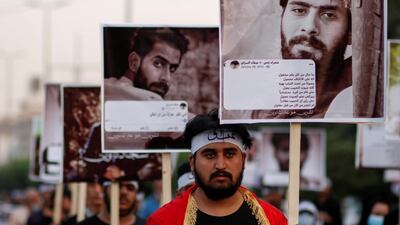
From his third-floor office in eastern Baghdad, Iraqi Oil Minister Ihsan Abdul Jabbar can see the rowdy protesters below as they march towards Tahrir Square, the symbolic heart of Iraq’s latest uprising.
On Sunday, thousands of Iraqis again gathered with national flags at the square, across the Tigris river from the heavily-fortified Green Zone, where the US has its embassy. Their list of grievances was long: corrupt politicians, daily power cuts, dilapidated hospitals, crumbling roads and a lack of jobs.
“We want our country back!” they chanted.
Iraq may be the world’s third-biggest oil exporter, but its economy is cratering after the coronavirus pandemic sapped global demand for energy and caused prices to collapse. The state’s finances are so dire it can’t pay teachers and civil servants on time, threatening a repeat of the upheaval that last year brought down the government and saw hundreds of protesters killed.
That’s created a dilemma for 46-year-old Mr Jabbar, a chemical engineer and career oil man who is now caught between the demands of an angry population and the pledges made to allies in Opec, which is trying to bolster a fragile market by reining in supply. It needs major producers like Iraq to toe the line. For Iraq, restraining supply carries a massive economic – and political – cost. But breaking ranks is risky, too: it could mean lower prices for everyone.
Some Iraqis want the government to put them first by simply pumping more oil, a move that could unravel the finely calibrated output agreement; if a producer as significant as Iraq flouts the pact, there would be little to stop smaller ones doing the same.
“I waited more than 45 days for my so-called monthly salary,” said Ziyad Al Mustansir, a 44-year-old secondary school teacher in Baghdad. “The government should have looked after the country’s interests when it came to Opec. If such deals mean losses for the country, we shouldn’t go with them.”
Under a deal reached in April between Iraq and other members of the Opec+ group, Baghdad had to curb its daily production by around 1 million barrels – worth roughly $40 million – to 3.6 million.
The idea was that supply cuts would raise crude prices enough to make up for lost exports. While prices have more than doubled since the agreement was struck to $40 per barrel, they are still down almost 40 per cent this year, languishing at levels far below what Iraq needs to finance its budget. The government’s monthly revenue, at $3 billion, is less than half of what it was last year.
Iraq has already breached its output limit on several occasions and angered Opec+, which is led by Saudi Arabia and Russia.
Iraqi officials have repeatedly said they are committed to the agreement, that they are pumping in line and will compensate for over-production. But after earlier breaches, traders are watching closely for signs it will surpass the cap again.
“It will become increasingly difficult for Opec+ to maintain discipline as countries, especially Iraq, become more desperate,” said Tarek Fadlallah, the chief executive of Nomura Asset Management’s Middle Eastern unit.
All nations within Opec+ have been stung by oil’s crash. Russia’s ruble has lost almost a fifth of its value, Saudi Arabia tripled value-added tax to make up for shrinking oil income, and more than 60 people died this month during protests in Nigeria.
But Iraq, where oil accounts for almost all government revenue, is in about the worst position. Its gross domestic product will contract 12 per cent this year, more than any other Opec member under a production quota, according to International Monetary Fund forecasts.
It’s been in chaos for much of the period since the US-led invasion of 2003 that toppled Saddam Hussein, suffering civil war, an insurgency by Islamic State and a push by the Kurds for independence in the north, a major oil-producing region. And while Opec+ includes all of Iraq’s production in its calculations, the Kurdistan region has its own say over oil policy.
The latest crisis is causing divisions between politicians and Prime Minister Mustafa Al Kadhimi, who only came to power in May. His administration says it won’t be able to pay Iraq’s roughly 7 million public workers and pensioners next month unless parliament approves a law allowing the government to borrow an extra $35bn.
Opposition politicians say the country’s debt load is already too high and its leaders cannot be trusted to take on more. Iraq’s dollar-bond yields have surged almost 300 basis points since early September, an indication investors are fretting. At more than 10 per cent, they’re the highest in the Middle East.
“The borrowing could lead to the collapse of our economic system,” Mohammad Saheb Al-Darraji, a member of parliament’s finance committee, said.
Mr Al Kadhimi, who travelled to France, Germany and the UK this month to try to woo money from oil and gas investors, is also struggling to restrain militias backed by neighbouring Iran. Iraq has been a hotbed in the proxy war between the Islamic Republic and the US, which has threatened to close its Baghdad embassy unless the government stops the militias from firing rockets at it.
Lockdowns to stop the spread of the coronavirus, meanwhile, have hammered businesses across the country, which has recorded more cases and deaths than anywhere in the Middle East aside from Iran. Unemployment has soared to 14 per cent.
The latest protests are a test for Mr Al Kadhimi, who has tried to present himself as a champion of the demonstrators’ demands. It was mass demonstrations a year ago that forced his predecessor, Adil Abd Al-Mahdi, to resign.
As one of the five original members of Opec, which was founded in Baghdad in 1960, Iraq is unlikely to quit the organisation. If it did, it would risk Saudi Arabia retaliating by increasing production and sending oil prices even lower.
Iraqi officials may instead press the Saudis for financial aid if crude prices remain below $45 per barrel in the first half of 2021, according to a source.
The country’s economic malaise and the tens of billions of dollars it spent in the war to defeat ISIS between 2014 and 2017 justify an exemption from its quota, according to Jabbar Al Luaibi, who was oil minister between 2016 and 2018.
“Instead of cutting around 1 million barrels per day, Iraq could have cut 500,000,” he said. “Lower the percentage. We don’t want to hit Opec policy, but this is the country’s situation and Opec members should take it into consideration.”
Saudi Arabia, nervous that giving one country an easier ride would lead to others demanding the same, won’t budge easily. The kingdom’s energy minister, Prince Abdulaziz bin Salman, has insisted on total compliance.
Opec+ had planned to ease some production cuts in January. But with oil prices under renewed pressure from an acceleration in virus cases and rising production in Libya, it may be forced into a delay. The risk for Opec is that it is even harder to persuade governments to comply if restraints are in place for longer.
It would be the last thing Iraq needs as anger builds among public sector workers, who increasingly fear they will never get paid.
“We hear rumours we might even have our salaries cut,” said Mr Al Mustansir, the teacher. “If this happens, it will be catastrophic.”

