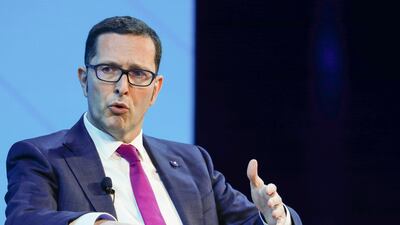
German exploration and production company Wintershall Dea will adopt a wait-and-see approach to Libya, despite the lifting of a blockade and a surge in production.
The producer is also bullish about hydrogen's potential as a fuel that can help to combat climate change.
"I think we still have to see proof that there is more stability. I appreciate that it is a positive development that the blockade of the terminals has been lifted, and that there is a new government in place preparing for elections," chief executive Mario Mehren told The National.
"But it is all very fragile in Libya, so I would still tend to be cautious.”
Wintershall Dea, a subsidiary of the world’s largest chemicals company, BASF, has been operating in Libya since 1958.
The company also operates in Egypt and has a 10 per cent stake in Abu Dhabi's ultra-sour Ghasha concession. Wintershall Dea is working alongside Adnoc, Lukoil, Eni and OMV to raise production from the fields to 1.5 billion cubic feet per day of gas and 120,000 barrels per day of crude and high-value condensate by 2025.
Libya, a key Opec producer, resumed production after a peace deal was brokered between the country's warring factions.
The North African country could produce 1.45 million bpd by the end of the year, Mustafa Sanalla, chairman of the National Oil Corporation, told Bloomberg last week.
Libyan production is currently at 1.3 million bpd, with further increases contingent on the NOC receiving funds allocated to it under the budget and security at its oil installations.
Libya “is close to our heart”, Mr Mehren said, “but it is not moving the needle in terms of in terms of Wintershall Dea’s overall production”.
During the blockade imposed by Field Marshal Khalifa Haftar, Wintershall Dea managed to continue production from its offshore Al Jurf field, which it operates with the NOC and French energy company Total.
“There, the production is on a very stable basis,” said Mr Mehren.
Last year, the German company transferred the right to operate some of its onshore fields in the Sirte basin to a joint venture led by the NOC.
“This handover happened in October and we have seen first liftings since then, so production is up and running again,” said Mr Mehren.
He declined to specify the volumes produced by Wintershall Dea onshore but said “what can be produced is currently being produced”.
Wintershall is optimistic about “big potential” associated with the development of hydrogen, particularly Russia's large natural gas reserves.
The company will prioritise the development of the resource as part of its efforts to reach net-zero emissions by 2030.
“There is a significant potential for German-Russian co-operation in carbon capture and storage, in using the depleted reservoirs and their infrastructure in Western Siberia as well as in the exploration and use of potential aquifers in Eastern Siberia,” said Mr Mehren.
The German company posted a loss of €1.33 billion ($1.6bn) in 2020, which is more than double the deficit it registered in the previous year.
Wintershall Dea plans to spend between €1bn and €1.1bn this year, with €200 million to €350m allocated to exploration.
“It is going to be dedicated to a large extent to Norway and to Mexico,” he said.
The company said there is significant potential for discovery on the southern side of the Gulf of Mexico, after discoveries were made in the Polok and Chinwol prospects.
“We are basically looking into our existing portfolio and optimising that; we are not planning to go into any new countries,” said Mr Mehren.
The company plans to increase its production to between 620,000 barrels of oil equivalent per day and 640,000 boepd, from 623,000 boepd last year.
Wintershall Dea will operate on the basis of a conservative range of $40 to $55 a barrel despite prices being 75 per cent higher than they were in November and currently trading close to $70 a barrel.
Mr Mehren cited "volatility and uncertainty" and said even if prices were to average $60 per barrel, the company would only benefit from that.
Wintershall Dea, which merged with Dea, owned by Russia's LetterOne in May 2019, is still considering an initial public offering this year. It had initially targeted a listing by the second half of the year, possibly in Frankfurt.
The company is "prepared for an IPO" but the decision to go public will be made by shareholders, BASF and LetterOne, Mr Mehren said.

Ten tax points to be aware of in 2026
1. Domestic VAT refund amendments: request your refund within five years
If a business does not apply for the refund on time, they lose their credit.
2. E-invoicing in the UAE
Businesses should continue preparing for the implementation of e-invoicing in the UAE, with 2026 a preparation and transition period ahead of phased mandatory adoption.
3. More tax audits
Tax authorities are increasingly using data already available across multiple filings to identify audit risks.
4. More beneficial VAT and excise tax penalty regime
Tax disputes are expected to become more frequent and more structured, with clearer administrative objection and appeal processes. The UAE has adopted a new penalty regime for VAT and excise disputes, which now mirrors the penalty regime for corporate tax.
5. Greater emphasis on statutory audit
There is a greater need for the accuracy of financial statements. The International Financial Reporting Standards standards need to be strictly adhered to and, as a result, the quality of the audits will need to increase.
6. Further transfer pricing enforcement
Transfer pricing enforcement, which refers to the practice of establishing prices for internal transactions between related entities, is expected to broaden in scope. The UAE will shortly open the possibility to negotiate advance pricing agreements, or essentially rulings for transfer pricing purposes.
7. Limited time periods for audits
Recent amendments also introduce a default five-year limitation period for tax audits and assessments, subject to specific statutory exceptions. While the standard audit and assessment period is five years, this may be extended to up to 15 years in cases involving fraud or tax evasion.
8. Pillar 2 implementation
Many multinational groups will begin to feel the practical effect of the Domestic Minimum Top-Up Tax (DMTT), the UAE's implementation of the OECD’s global minimum tax under Pillar 2. While the rules apply for financial years starting on or after January 1, 2025, it is 2026 that marks the transition to an operational phase.
9. Reduced compliance obligations for imported goods and services
Businesses that apply the reverse-charge mechanism for VAT purposes in the UAE may benefit from reduced compliance obligations.
10. Substance and CbC reporting focus
Tax authorities are expected to continue strengthening the enforcement of economic substance and Country-by-Country (CbC) reporting frameworks. In the UAE, these regimes are increasingly being used as risk-assessment tools, providing tax authorities with a comprehensive view of multinational groups’ global footprints and enabling them to assess whether profits are aligned with real economic activity.
Contributed by Thomas Vanhee and Hend Rashwan, Aurifer
Expert advice
“Join in with a group like Cycle Safe Dubai or TrainYAS, where you’ll meet like-minded people and always have support on hand.”
Stewart Howison, co-founder of Cycle Safe Dubai and owner of Revolution Cycles
“When you sweat a lot, you lose a lot of salt and other electrolytes from your body. If your electrolytes drop enough, you will be at risk of cramping. To prevent salt deficiency, simply add an electrolyte mix to your water.”
Cornelia Gloor, head of RAK Hospital’s Rehabilitation and Physiotherapy Centre
“Don’t make the mistake of thinking you can ride as fast or as far during the summer as you do in cooler weather. The heat will make you expend more energy to maintain a speed that might normally be comfortable, so pace yourself when riding during the hotter parts of the day.”
Chandrashekar Nandi, physiotherapist at Burjeel Hospital in Dubai
Profile
Co-founders of the company: Vilhelm Hedberg and Ravi Bhusari
Launch year: In 2016 ekar launched and signed an agreement with Etihad Airways in Abu Dhabi. In January 2017 ekar launched in Dubai in a partnership with the RTA.
Number of employees: Over 50
Financing stage: Series B currently being finalised
Investors: Series A - Audacia Capital
Sector of operation: Transport
UAE currency: the story behind the money in your pockets
Honeymoonish
%3Cp%3E%3Cstrong%3EDirector%3A%3C%2Fstrong%3E%20Elie%20El%20Samaan%3C%2Fp%3E%0A%3Cp%3E%3Cstrong%3EStarring%3A%20%3C%2Fstrong%3ENour%20Al%20Ghandour%2C%20Mahmoud%20Boushahri%3C%2Fp%3E%0A%3Cp%3E%3Cstrong%3ERating%3A%3C%2Fstrong%3E%203%2F5%3C%2Fp%3E%0A
HERO%20CUP%20TEAMS
%3Cp%3E%3Cstrong%3E%3Cins%3EContinental%20Europe%3Cbr%3E%3C%2Fins%3E%3C%2Fstrong%3EFrancesco%20Molinari%20(c)%3Cbr%3EThomas%20Detry%3Cbr%3ERasmus%20Hojgaard%3Cbr%3EAdrian%20Meronk%3Cbr%3EGuido%20Migliozzi%3Cbr%3EAlex%20Noren%3Cbr%3EVictor%20Perez%3Cbr%3EThomas%20Pieters%3Cbr%3ESepp%20Straka%3Cbr%3EPlayer%20TBC%3C%2Fp%3E%0A%3Cp%3E%3Cstrong%3E%3Cins%3EGreat%20Britain%20%26amp%3B%20Ireland%3C%2Fins%3E%3C%2Fstrong%3E%3Cbr%3ETommy%20Fleetwood%20(c)%3Cbr%3EEwen%20Ferguson%3Cbr%3ETyrrell%20Hatton%3Cbr%3EShane%20Lowry%3Cbr%3ERobert%20MacIntyre%3Cbr%3ESeamus%20Power%3Cbr%3ECallum%20Shinkwin%3Cbr%3EJordan%20Smith%3Cbr%3EMatt%20Wallace%3Cbr%3EPlayer%20TBC%3C%2Fp%3E%0A
ENGLAND SQUAD
Joe Root (c), Moeen Ali, Jimmy Anderson, Jonny Bairstow, Stuart Broad, Jos Buttler, Alastair Cook, Sam Curran, Keaton Jennings, Ollie Pope, Adil Rashid, Ben Stokes, James Vince, Chris Woakes
