Abu Dhabi National Oil Company plans to accelerate the deployment of digital technology to increase its production capacity to 5 million barrels per day by 2030, as it looks to generate cost efficiencies and cut emissions.
"Our target is basically to increase production capacity by 25 per cent by 2030, increase ultimate recovery from our reservoirs to 70 per cent and significantly lower unit technical cost from our industry leading low base," Mohamed Al Marzouqi, senior vice president, development at Adnoc told The National in an interview.
On Monday, Adnoc said it generated $1.1 billion in business value through the deployment of Big Data and analytics at its Thamama Centre, which oversees upstream operations. The company accrued $2bn in cost savings over the last five years by employing advanced technology and digitalisation to optimise its drilling operations.
The centre is instrumental in reducing exploration costs "by hundreds of millions of dollars", the company said in a statement.
Mr Al Marzouqi said the centre, which helped the company streamline operations during the pandemic is currently looking at technology that can improve realisation rates by nearly a "1000 times".
"If we're taking years to develop certain development scenarios, we'll try to do it in days. Basically, we have a clear roadmap, around these mandates internally within Thamama," he said.
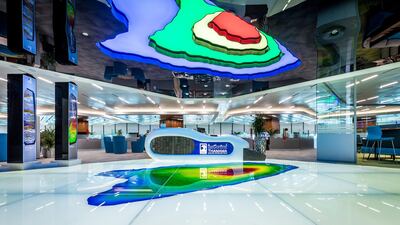
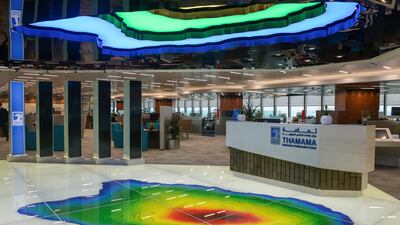
The Thamama centre, which is named after the most dominant reservoir formation in Abu Dhabi is part of the company's ongoing investments in advanced technology, digitalisation and artificial intelligence, in order to drive greater efficiencies.
The UAE accounts for 4.2 per cent of global oil output, much of it from fields managed by Adnoc. The national oil company plans to raise its production capacity to 5m bpd by 2030 from just over 4m bpd at present. Efficiencies generated by technology deployed at Thamama are key to responding to market dynamics and furthering the development of its upstream expansion.
"The value generated by Thamama since its start in 2017 highlights how Adnoc is harnessing advanced technologies, digitalisation and Big Data as well as deep engineering expertise to maintain Adnoc's position as a leading low cost and low carbon player in our industry," said Adnoc upstream executive director Yaser Saeed Al Mazrouei.
He was speaking on the sidelines of the Adnoc Innovation Week, which is taking place from February 21 to 25.
Adnoc is hosting a number of events to coincide with the UAE Innovation Week, including the first roundtable for chief technical officers from international energy companies.
"Thamama is also helping us to nurture the UAE’s next generation of engineers and data scientists, as well as serving as a hub to harness AI solutions together with the recently established joint venture between Adnoc and G42, AIQ," Mr Al Mazrouei said.
Last October, Adnoc formed a joint venture known as AIQ with Abu Dhabi artificial intelligence firm Group 42 to develop and commercialise AI products and applications for the oil and gas industry.
A month later, AIQ, Group 42 and the world's largest energy services firm, Schlumberger, agreed a deal to develop and sell AI products for the global exploration and production market.
A key metric at Adnoc's Thamama centre is not only reduction of costs, but also carbon footprint.
"The mandate needs to be achieved. [We need to be] efficient on the carbon and on the cost," Mr Al Marzouqi said.
Digital initiatives in reservoir modelling are helping offset carbon emissions by identifying cost-effective ways for CO2 injection into reservoirs while boosting production.
Thamama's technology initiatives include co-development of one of the world's largest oil rim and gas cap reservoirs.
The initiative will help the company "monetise several trillion cubic feet of gas and associated condensate while maximising the oil value," Adnoc said.
The Thamama centre is also optimising field development costs by designing wells with custom-fit completions and deploying them at scale.
The centre is home to 15 new digitalisation projects in Thamama that offer potential to deliver around $500m in additional value per year when fully deployed over the coming years.
Thamama is also helping accelerate Adnoc's seismic survey, providing 100 petabytes of high-resolution images of the sub-surface across Abu Dhabi, which is then turned into prospects by Adnoc experts. A petabyte is the equivalent of 1,000 terabytes.
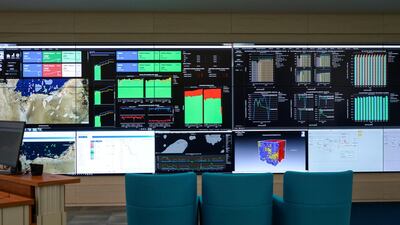
Adnoc's digitalisation is also supported by the Panorama Digital Command Centre, which oversees operations across the value chain in realtime. The centre has so far generated over $1bn in value since inception.
The company has also found AI applications for value chain optimisation, predictive maintenance, and blockchain-based hydrocarbon accounting.

The Buckingham Murders
Starring: Kareena Kapoor Khan, Ash Tandon, Prabhleen Sandhu
Director: Hansal Mehta
Rating: 4 / 5
Monster Hunter: World
Capcom
PlayStation 4, Xbox One
Infiniti QX80 specs
Engine: twin-turbocharged 3.5-liter V6
Power: 450hp
Torque: 700Nm
Price: From Dh450,000, Autograph model from Dh510,000
Available: Now
Afro%20salons
%3Cp%3E%3Cstrong%3EFor%20women%3A%3C%2Fstrong%3E%3Cbr%3ESisu%20Hair%20Salon%2C%20Jumeirah%201%2C%20Dubai%3Cbr%3EBoho%20Salon%2C%20Al%20Barsha%20South%2C%20Dubai%3Cbr%3EMoonlight%2C%20Al%20Falah%20Street%2C%20Abu%20Dhabi%3Cbr%3E%3Cstrong%3EFor%20men%3A%3C%2Fstrong%3E%3Cbr%3EMK%20Barbershop%2C%20Dar%20Al%20Wasl%20Mall%2C%20Dubai%3Cbr%3ERegency%20Saloon%2C%20Al%20Zahiyah%2C%20Abu%20Dhabi%3Cbr%3EUptown%20Barbershop%2C%20Al%20Nasseriya%2C%20Sharjah%3C%2Fp%3E%0A
Game Changer
Director: Shankar
Stars: Ram Charan, Kiara Advani, Anjali, S J Suryah, Jayaram
Rating: 2/5
Heavily-sugared soft drinks slip through the tax net
Some popular drinks with high levels of sugar and caffeine have slipped through the fizz drink tax loophole, as they are not carbonated or classed as an energy drink.
Arizona Iced Tea with lemon is one of those beverages, with one 240 millilitre serving offering up 23 grams of sugar - about six teaspoons.
A 680ml can of Arizona Iced Tea costs just Dh6.
Most sports drinks sold in supermarkets were found to contain, on average, five teaspoons of sugar in a 500ml bottle.
Benefits of first-time home buyers' scheme
- Priority access to new homes from participating developers
- Discounts on sales price of off-plan units
- Flexible payment plans from developers
- Mortgages with better interest rates, faster approval times and reduced fees
- DLD registration fee can be paid through banks or credit cards at zero interest rates
Our legal consultant
Name: Dr Hassan Mohsen Elhais
Position: legal consultant with Al Rowaad Advocates and Legal Consultants.
How green is the expo nursery?
Some 400,000 shrubs and 13,000 trees in the on-site nursery
An additional 450,000 shrubs and 4,000 trees to be delivered in the months leading up to the expo
Ghaf, date palm, acacia arabica, acacia tortilis, vitex or sage, techoma and the salvadora are just some heat tolerant native plants in the nursery
Approximately 340 species of shrubs and trees selected for diverse landscape
The nursery team works exclusively with organic fertilisers and pesticides
All shrubs and trees supplied by Dubai Municipality
Most sourced from farms, nurseries across the country
Plants and trees are re-potted when they arrive at nursery to give them room to grow
Some mature trees are in open areas or planted within the expo site
Green waste is recycled as compost
Treated sewage effluent supplied by Dubai Municipality is used to meet the majority of the nursery’s irrigation needs
Construction workforce peaked at 40,000 workers
About 65,000 people have signed up to volunteer
Main themes of expo is ‘Connecting Minds, Creating the Future’ and three subthemes of opportunity, mobility and sustainability.
Expo 2020 Dubai to open in October 2020 and run for six months
Some of Darwish's last words
"They see their tomorrows slipping out of their reach. And though it seems to them that everything outside this reality is heaven, yet they do not want to go to that heaven. They stay, because they are afflicted with hope." - Mahmoud Darwish, to attendees of the Palestine Festival of Literature, 2008
His life in brief: Born in a village near Galilee, he lived in exile for most of his life and started writing poetry after high school. He was arrested several times by Israel for what were deemed to be inciteful poems. Most of his work focused on the love and yearning for his homeland, and he was regarded the Palestinian poet of resistance. Over the course of his life, he published more than 30 poetry collections and books of prose, with his work translated into more than 20 languages. Many of his poems were set to music by Arab composers, most significantly Marcel Khalife. Darwish died on August 9, 2008 after undergoing heart surgery in the United States. He was later buried in Ramallah where a shrine was erected in his honour.
TICKETS
Tickets start at Dh100 for adults, while children can enter free on the opening day. For more information, visit www.mubadalawtc.com.
It's up to you to go green
Nils El Accad, chief executive and owner of Organic Foods and Café, says going green is about “lifestyle and attitude” rather than a “money change”; people need to plan ahead to fill water bottles in advance and take their own bags to the supermarket, he says.
“People always want someone else to do the work; it doesn’t work like that,” he adds. “The first step: you have to consciously make that decision and change.”
When he gets a takeaway, says Mr El Accad, he takes his own glass jars instead of accepting disposable aluminium containers, paper napkins and plastic tubs, cutlery and bags from restaurants.
He also plants his own crops and herbs at home and at the Sheikh Zayed store, from basil and rosemary to beans, squashes and papayas. “If you’re going to water anything, better it be tomatoes and cucumbers, something edible, than grass,” he says.
“All this throwaway plastic - cups, bottles, forks - has to go first,” says Mr El Accad, who has banned all disposable straws, whether plastic or even paper, from the café chain.
One of the latest changes he has implemented at his stores is to offer refills of liquid laundry detergent, to save plastic. The two brands Organic Foods stocks, Organic Larder and Sonnett, are both “triple-certified - you could eat the product”.
The Organic Larder detergent will soon be delivered in 200-litre metal oil drums before being decanted into 20-litre containers in-store.
Customers can refill their bottles at least 30 times before they start to degrade, he says. Organic Larder costs Dh35.75 for one litre and Dh62 for 2.75 litres and refills will cost 15 to 20 per cent less, Mr El Accad says.
But while there are savings to be had, going green tends to come with upfront costs and extra work and planning. Are we ready to refill bottles rather than throw them away? “You have to change,” says Mr El Accad. “I can only make it available.”
KILLING OF QASSEM SULEIMANI
The five pillars of Islam
Mercer, the investment consulting arm of US services company Marsh & McLennan, expects its wealth division to at least double its assets under management (AUM) in the Middle East as wealth in the region continues to grow despite economic headwinds, a company official said.
Mercer Wealth, which globally has $160 billion in AUM, plans to boost its AUM in the region to $2-$3bn in the next 2-3 years from the present $1bn, said Yasir AbuShaban, a Dubai-based principal with Mercer Wealth.
“Within the next two to three years, we are looking at reaching $2 to $3 billion as a conservative estimate and we do see an opportunity to do so,” said Mr AbuShaban.
Mercer does not directly make investments, but allocates clients’ money they have discretion to, to professional asset managers. They also provide advice to clients.
“We have buying power. We can negotiate on their (client’s) behalf with asset managers to provide them lower fees than they otherwise would have to get on their own,” he added.
Mercer Wealth’s clients include sovereign wealth funds, family offices, and insurance companies among others.
From its office in Dubai, Mercer also looks after Africa, India and Turkey, where they also see opportunity for growth.
Wealth creation in Middle East and Africa (MEA) grew 8.5 per cent to $8.1 trillion last year from $7.5tn in 2015, higher than last year’s global average of 6 per cent and the second-highest growth in a region after Asia-Pacific which grew 9.9 per cent, according to consultancy Boston Consulting Group (BCG). In the region, where wealth grew just 1.9 per cent in 2015 compared with 2014, a pickup in oil prices has helped in wealth generation.
BCG is forecasting MEA wealth will rise to $12tn by 2021, growing at an annual average of 8 per cent.
Drivers of wealth generation in the region will be split evenly between new wealth creation and growth of performance of existing assets, according to BCG.
Another general trend in the region is clients’ looking for a comprehensive approach to investing, according to Mr AbuShaban.
“Institutional investors or some of the families are seeing a slowdown in the available capital they have to invest and in that sense they are looking at optimizing the way they manage their portfolios and making sure they are not investing haphazardly and different parts of their investment are working together,” said Mr AbuShaban.
Some clients also have a higher appetite for risk, given the low interest-rate environment that does not provide enough yield for some institutional investors. These clients are keen to invest in illiquid assets, such as private equity and infrastructure.
“What we have seen is a desire for higher returns in what has been a low-return environment specifically in various fixed income or bonds,” he said.
“In this environment, we have seen a de facto increase in the risk that clients are taking in things like illiquid investments, private equity investments, infrastructure and private debt, those kind of investments were higher illiquidity results in incrementally higher returns.”
The Abu Dhabi Investment Authority, one of the largest sovereign wealth funds, said in its 2016 report that has gradually increased its exposure in direct private equity and private credit transactions, mainly in Asian markets and especially in China and India. The authority’s private equity department focused on structured equities owing to “their defensive characteristics.”