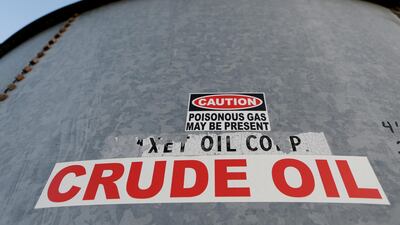
A storage tank in the Permian Basin in Loving County, Texas. The election of Ebrahim Raisi as Iran's new president is likely to complicate ongoing talks between Washington and Tehran to restore the nuclear deal. Reuters
A storage tank in the Permian Basin in Loving County, Texas. The election of Ebrahim Raisi as Iran's new president is likely to complicate ongoing talks between Washington and Tehran to restore the nu

Brent rallies to above $75 for first time in more than two years as market fundamentals tighten


Jennifer Gnana
  • English
  • Arabic

Brent, the international benchmark for more than half of the world’s oil, rallied to above $75 per barrel during early trading for the first time since 2018, as the world's largest economies rebound from the pandemic and US-Iran talks stall, delaying a return of Iranian crude to the market.

Brent later pared its gains, declining 0.2 per cent to trade at $75.75 per barrel at 4.57pm UAE time. West Texas Intermediate, which tracks US crude grades, fell 0.38 per cent to reach $73.38 per barrel.

The benchmarks softened their earlier rally amid indications that Opec+, the group led by Saudi Arabia and Russia, plans to add more supply in August.

"Reports that Opec+ is already discussing, ahead of its scheduled meeting, to increase its output from August indicates that the demand-supply gap is already becoming an issue and that the alliance is working on a plan to tap that deficit," said Louise Dickson, oil markets analyst at Rystad Energy.

Global oil demand is expected to return to pre-Covid levels by the end of 2022, with the rebound supported across sectors and products, the International Energy Agency said earlier this month.

Demand for crude is expected to grow this year by 5.4 million barrels per day and a further 3.1 million bpd to average 99.5 million bpd, according to the Paris-based agency.

Oil's immunity to price volatility in either the commodity or currency markets strongly suggests that demand is high and rising, said Jeffrey Halley, senior market analyst, Asia Pacific at Oanda.

"By default, that indicates that the global recovery in the real world remains on track even as other asset classes chase their tails," he added.

The election of Ebrahim Raisi as Iran's new president this week may complicate the ongoing dialogue between Washington and Tehran to restore the nuclear deal.

Iran was Opec’s fourth-largest producer before the resumption of US sanctions by the Trump administration.

"Talks between Iran and world powers have not progressed enough to have the US in actual attendance," said Edward Moya, senior market analyst, the Americas at Oanda.

"The longer talks drag, the further Iranian sanction relief is delayed. Iranian output is expected to increase in the third quarter, but if no breakthroughs are made over the next few weeks, that could be in jeopardy," he added.

Middle East producers are bullish about oil's prospects. Iraq, Opec's second-largest producer expects oil to reach $80 per barrel.

In a report on Monday, Bank of America said tighter supply and demand balances in 2022 could push oil to $100 a barrel, with Brent poised to average $75 next year.

"A combo of factors could push oil to $100 next year ... there is plenty of pent up mobility demand after an 18 month lockdown. Second, mass transit will lag, boosting private car usage for a prolonged period of time. Third, pre-pandemic studies show more remote work could result in more miles driven, as work-from-home turns into work-from-car," the BofA said.

"In short, demand is poised to bounce back and supply may not fully keep up, placing Opec in control of the oil market in 2022."


Mercer, the investment consulting arm of US services company Marsh & McLennan, expects its wealth division to at least double its assets under management (AUM) in the Middle East as wealth in the region continues to grow despite economic headwinds, a company official said.

Mercer Wealth, which globally has $160 billion in AUM, plans to boost its AUM in the region to $2-$3bn in the next 2-3 years from the present $1bn, said Yasir AbuShaban, a Dubai-based principal with Mercer Wealth.

Within the next two to three years, we are looking at reaching $2 to $3 billion as a conservative estimate and we do see an opportunity to do so,” said Mr AbuShaban.

Mercer does not directly make investments, but allocates clients’ money they have discretion to, to professional asset managers. They also provide advice to clients.

“We have buying power. We can negotiate on their (client’s) behalf with asset managers to provide them lower fees than they otherwise would have to get on their own,” he added.

Mercer Wealth’s clients include sovereign wealth funds, family offices, and insurance companies among others.

From its office in Dubai, Mercer also looks after Africa, India and Turkey, where they also see opportunity for growth.

Wealth creation in Middle East and Africa (MEA) grew 8.5 per cent to $8.1 trillion last year from $7.5tn in 2015, higher than last year’s global average of 6 per cent and the second-highest growth in a region after Asia-Pacific which grew 9.9 per cent, according to consultancy Boston Consulting Group (BCG). In the region, where wealth grew just 1.9 per cent in 2015 compared with 2014, a pickup in oil prices has helped in wealth generation.

BCG is forecasting MEA wealth will rise to $12tn by 2021, growing at an annual average of 8 per cent.

Drivers of wealth generation in the region will be split evenly between new wealth creation and growth of performance of existing assets, according to BCG.

Another general trend in the region is clients’ looking for a comprehensive approach to investing, according to Mr AbuShaban.

“Institutional investors or some of the families are seeing a slowdown in the available capital they have to invest and in that sense they are looking at optimizing the way they manage their portfolios and making sure they are not investing haphazardly and different parts of their investment are working together,” said Mr AbuShaban.

Some clients also have a higher appetite for risk, given the low interest-rate environment that does not provide enough yield for some institutional investors. These clients are keen to invest in illiquid assets, such as private equity and infrastructure.

“What we have seen is a desire for higher returns in what has been a low-return environment specifically in various fixed income or bonds,” he said.

“In this environment, we have seen a de facto increase in the risk that clients are taking in things like illiquid investments, private equity investments, infrastructure and private debt, those kind of investments were higher illiquidity results in incrementally higher returns.”

The Abu Dhabi Investment Authority, one of the largest sovereign wealth funds, said in its 2016 report that has gradually increased its exposure in direct private equity and private credit transactions, mainly in Asian markets and especially in China and India. The authority’s private equity department focused on structured equities owing to “their defensive characteristics.”