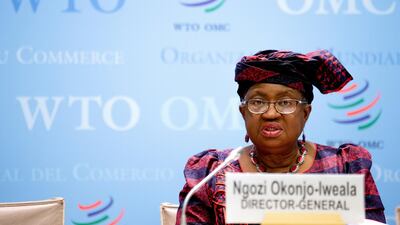
The global economy faces a long wait to achieve herd immunity if current inequality in vaccine distribution persists, the new head of the World Trade Organisation said.
Only 0.1 per cent of vaccines that have been administered so far have been in low-income countries, while 86 per cent have been in high and middle-income countries, WTO director general Ngozi Okonjo-Iweala said in an online panel event at the International Monetary Fund's Spring Meeting on Thursday evening.
“If we don’t do something to change the pace at which the poorer countries are getting access to vaccines, it will take a long time to get to herd immunity for the world,” Ms Okonjo-Iweala said.
“This is really in the self-interest of everyone. As we know, mutations and variants are coming out and the rest of the world that has been vaccinated might see the gains they’ve made reversed.”
Earlier this week, the IMF revised its forecast for global economic growth upwards to 6 per cent for this year, higher than its 5.5 per cent forecast in January, citing the rapid vaccine rollout and substantial fiscal and monetary stimulus by governments and central banks.
But the fund also warned of a "divergence" – between countries such as China and the US whose economies are likely to return to pre-pandemic levels this year and low-income countries and smaller, tourism-dependent islands that will still be much poorer.
About 150 countries are unlikely to return to pre-pandemic levels by the end of this year and 110 will still be suffering from the same fate next year.
The fund’s managing director, Kristalina Georgieva, told the panel that governments and central bankers acted “swiftly, decisively and on a large scale” to the economic threat caused by the pandemic, with $16 trillion of fiscal stimulus and the equivalent of $10tn in accommodative monetary policy.
For this year and next, though, “vaccine policy is economic policy”, Ms Georgieva said.
“It is even a higher priority than the traditional tools of fiscal and monetary policy. Without it, we cannot turn the fate of the world economy around.”
The US has had the highest rate of infections of any nation, with more than 31.7m cases declared as of Thursday night. But its rapid distribution of vaccines, with more than 100 million people having had at least one shot and 60 million people now fully immunised, is already providing an economic boost.
More than 916,000 jobs were created in the US in March, a figure which rises to almost one million when revisions for January and February are factored in, Federal Reserve chairman Jerome Powell told the panel.
"We want to see a string of months like that," he said.
Yet even in the the world’s largest economy the recovery remains “uneven and incomplete”, Mr Powell said.
“The burden is still falling on on lower income workers. The unemployment rate in the bottom quartile is still 20 per cent, there’s still 8.5 million people out of work.”
He also said many of the jobs lost during the pandemic may never return if companies invest in technology to replace some roles.
“We need to keep supporting [the unemployed], we need to keep supporting the economy and we will,” he said.
Paschal Donohoe, Ireland's finance minister and president of the Eurogroup, admitted the vaccine programme in Europe had taken time to establish, with 28 million vaccines distributed for the EU's 448 million population in February.
“By the time we get to April, we expect that to be 100m vaccines and the goal that the EU has of vaccinating 70 per cent of our adult population by the summer, we will get there and we will deliver that.”
This will lay the foundation for the EU to be able to supply "billions" of vaccines to the world next year from 50 manufacturing sites throughout the bloc, he said.
Global trade, which contracted 5 per cent last year, will grow 8 per cent this year, Ms Okonjo-Iweala said.
“We see imports and exports in Asia and North America rebounding quite quickly and faster than, say, sub-Saharan Africa and the Middle East. So the divergence we see in recovery is reflected also in divergence in trade,” she said.

Top tips
Create and maintain a strong bond between yourself and your child, through sensitivity, responsiveness, touch, talk and play. “The bond you have with your kids is the blueprint for the relationships they will have later on in life,” says Dr Sarah Rasmi, a psychologist.
Set a good example. Practise what you preach, so if you want to raise kind children, they need to see you being kind and hear you explaining to them what kindness is. So, “narrate your behaviour”.
Praise the positive rather than focusing on the negative. Catch them when they’re being good and acknowledge it.
Show empathy towards your child’s needs as well as your own. Take care of yourself so that you can be calm, loving and respectful, rather than angry and frustrated.
Be open to communication, goal-setting and problem-solving, says Dr Thoraiya Kanafani. “It is important to recognise that there is a fine line between positive parenting and becoming parents who overanalyse their children and provide more emotional context than what is in the child’s emotional development to understand.”
Ten tax points to be aware of in 2026
1. Domestic VAT refund amendments: request your refund within five years
If a business does not apply for the refund on time, they lose their credit.
2. E-invoicing in the UAE
Businesses should continue preparing for the implementation of e-invoicing in the UAE, with 2026 a preparation and transition period ahead of phased mandatory adoption.
3. More tax audits
Tax authorities are increasingly using data already available across multiple filings to identify audit risks.
4. More beneficial VAT and excise tax penalty regime
Tax disputes are expected to become more frequent and more structured, with clearer administrative objection and appeal processes. The UAE has adopted a new penalty regime for VAT and excise disputes, which now mirrors the penalty regime for corporate tax.
5. Greater emphasis on statutory audit
There is a greater need for the accuracy of financial statements. The International Financial Reporting Standards standards need to be strictly adhered to and, as a result, the quality of the audits will need to increase.
6. Further transfer pricing enforcement
Transfer pricing enforcement, which refers to the practice of establishing prices for internal transactions between related entities, is expected to broaden in scope. The UAE will shortly open the possibility to negotiate advance pricing agreements, or essentially rulings for transfer pricing purposes.
7. Limited time periods for audits
Recent amendments also introduce a default five-year limitation period for tax audits and assessments, subject to specific statutory exceptions. While the standard audit and assessment period is five years, this may be extended to up to 15 years in cases involving fraud or tax evasion.
8. Pillar 2 implementation
Many multinational groups will begin to feel the practical effect of the Domestic Minimum Top-Up Tax (DMTT), the UAE's implementation of the OECD’s global minimum tax under Pillar 2. While the rules apply for financial years starting on or after January 1, 2025, it is 2026 that marks the transition to an operational phase.
9. Reduced compliance obligations for imported goods and services
Businesses that apply the reverse-charge mechanism for VAT purposes in the UAE may benefit from reduced compliance obligations.
10. Substance and CbC reporting focus
Tax authorities are expected to continue strengthening the enforcement of economic substance and Country-by-Country (CbC) reporting frameworks. In the UAE, these regimes are increasingly being used as risk-assessment tools, providing tax authorities with a comprehensive view of multinational groups’ global footprints and enabling them to assess whether profits are aligned with real economic activity.
Contributed by Thomas Vanhee and Hend Rashwan, Aurifer
RESULTS
6.30pm: Al Maktoum Challenge Round-1 Group 1 (PA) Dh119,373 (Dirt) 1,600m
Winner: Brraq, Adrie de Vries (jockey), Jean-Claude Pecout (trainer)
7.05pm: Handicap (TB) Dh102,500 (D) 1,200m
Winner: Taamol, Connor Beasley, Ali Rashid Al Raihe.
7.40pm: Handicap (TB) Dh105,000 (Turf) 1,800m
Winner: Eqtiraan, Connor Beasley, Ali Rashid Al Raihe.
8.15pm: UAE 1000 Guineas Trial (TB) Dh183,650 (D) 1,400m
Winner: Soft Whisper, Pat Cosgrave, Saeed bin Suroor.
9.50pm: Handicap (TB) Dh105,000 (D) 1,600m
Winner: Hypothetical, Mickael Barzalona, Salem bin Ghadayer.
9.25pm: Handicap (TB) Dh95,000 (T) 1,000m
Winner: Etisalat, Sando Paiva, Ali Rashid Al Raihe
The%20specs%20
%3Cp%3E%3Cstrong%3EEngine%3A%20%3C%2Fstrong%3E2.0-litre%204cyl%20turbo%0D%3Cbr%3E%3Cstrong%3EPower%3A%20%3C%2Fstrong%3E261hp%20at%205%2C500rpm%0D%3Cbr%3E%3Cstrong%3ETorque%3A%20%3C%2Fstrong%3E400Nm%20at%201%2C750-4%2C000rpm%0D%3Cbr%3E%3Cstrong%3ETransmission%3A%20%3C%2Fstrong%3E7-speed%20dual-clutch%20auto%0D%3Cbr%3E%3Cstrong%3EFuel%20consumption%3A%20%3C%2Fstrong%3E10.5L%2F100km%0D%3Cbr%3E%3Cstrong%3EOn%20sale%3A%20%3C%2Fstrong%3ENow%0D%3Cbr%3E%3Cstrong%3EPrice%3A%20%3C%2Fstrong%3EFrom%20Dh129%2C999%20(VX%20Luxury)%3B%20from%20Dh149%2C999%20(VX%20Black%20Gold)%3C%2Fp%3E%0A
Mercer, the investment consulting arm of US services company Marsh & McLennan, expects its wealth division to at least double its assets under management (AUM) in the Middle East as wealth in the region continues to grow despite economic headwinds, a company official said.
Mercer Wealth, which globally has $160 billion in AUM, plans to boost its AUM in the region to $2-$3bn in the next 2-3 years from the present $1bn, said Yasir AbuShaban, a Dubai-based principal with Mercer Wealth.
“Within the next two to three years, we are looking at reaching $2 to $3 billion as a conservative estimate and we do see an opportunity to do so,” said Mr AbuShaban.
Mercer does not directly make investments, but allocates clients’ money they have discretion to, to professional asset managers. They also provide advice to clients.
“We have buying power. We can negotiate on their (client’s) behalf with asset managers to provide them lower fees than they otherwise would have to get on their own,” he added.
Mercer Wealth’s clients include sovereign wealth funds, family offices, and insurance companies among others.
From its office in Dubai, Mercer also looks after Africa, India and Turkey, where they also see opportunity for growth.
Wealth creation in Middle East and Africa (MEA) grew 8.5 per cent to $8.1 trillion last year from $7.5tn in 2015, higher than last year’s global average of 6 per cent and the second-highest growth in a region after Asia-Pacific which grew 9.9 per cent, according to consultancy Boston Consulting Group (BCG). In the region, where wealth grew just 1.9 per cent in 2015 compared with 2014, a pickup in oil prices has helped in wealth generation.
BCG is forecasting MEA wealth will rise to $12tn by 2021, growing at an annual average of 8 per cent.
Drivers of wealth generation in the region will be split evenly between new wealth creation and growth of performance of existing assets, according to BCG.
Another general trend in the region is clients’ looking for a comprehensive approach to investing, according to Mr AbuShaban.
“Institutional investors or some of the families are seeing a slowdown in the available capital they have to invest and in that sense they are looking at optimizing the way they manage their portfolios and making sure they are not investing haphazardly and different parts of their investment are working together,” said Mr AbuShaban.
Some clients also have a higher appetite for risk, given the low interest-rate environment that does not provide enough yield for some institutional investors. These clients are keen to invest in illiquid assets, such as private equity and infrastructure.
“What we have seen is a desire for higher returns in what has been a low-return environment specifically in various fixed income or bonds,” he said.
“In this environment, we have seen a de facto increase in the risk that clients are taking in things like illiquid investments, private equity investments, infrastructure and private debt, those kind of investments were higher illiquidity results in incrementally higher returns.”
The Abu Dhabi Investment Authority, one of the largest sovereign wealth funds, said in its 2016 report that has gradually increased its exposure in direct private equity and private credit transactions, mainly in Asian markets and especially in China and India. The authority’s private equity department focused on structured equities owing to “their defensive characteristics.”
Jetour T1 specs
Engine: 2-litre turbocharged
Power: 254hp
Torque: 390Nm
Price: From Dh126,000
Available: Now
First Person
Richard Flanagan
Chatto & Windus
Company%20Profile
%3Cp%3E%3Cstrong%3ECompany%20name%3A%3C%2Fstrong%3E%20Cargoz%3Cbr%3E%3Cstrong%3EDate%20started%3A%3C%2Fstrong%3E%20January%202022%3Cbr%3E%3Cstrong%3EFounders%3A%3C%2Fstrong%3E%20Premlal%20Pullisserry%20and%20Lijo%20Antony%3Cbr%3E%3Cstrong%3EBased%3A%3C%2Fstrong%3E%20Dubai%3Cbr%3E%3Cstrong%3ENumber%20of%20staff%3A%3C%2Fstrong%3E%2030%3Cbr%3E%3Cstrong%3EInvestment%20stage%3A%3C%2Fstrong%3E%20Seed%3C%2Fp%3E%0A
Our House, Louise Candlish,
Simon & Schuster
MATCH INFO
Real Madrid 2
Vinicius Junior (71') Mariano (90 2')
Barcelona 0
THE BIO
Ambition: To create awareness among young about people with disabilities and make the world a more inclusive place
Job Title: Human resources administrator, Expo 2020 Dubai
First jobs: Co-ordinator with Magrudy Enterprises; HR coordinator at Jumeirah Group
Entrepreneur: Started his own graphic design business
Favourite singer: Avril Lavigne
Favourite travel destination: Germany and Saudi Arabia
Family: Six sisters
Company%C2%A0profile
%3Cp%3E%3Cstrong%3ECompany%20name%3A%20%3C%2Fstrong%3ETuhoon%0D%3Cbr%3E%3Cstrong%3EYear%20started%3A%20%3C%2Fstrong%3EJune%202021%0D%3Cbr%3E%3Cstrong%3ECo-founders%3A%20%3C%2Fstrong%3EFares%20Ghandour%2C%20Dr%20Naif%20Almutawa%2C%20Aymane%20Sennoussi%0D%3Cbr%3E%3Cstrong%3EBased%3A%20%3C%2Fstrong%3ERiyadh%0D%3Cbr%3E%3Cstrong%3ESector%3A%20%3C%2Fstrong%3Ehealth%20care%0D%3Cbr%3E%3Cstrong%3ESize%3A%20%3C%2Fstrong%3E15%20employees%2C%20%24250%2C000%20in%20revenue%0D%3Cbr%3EI%3Cstrong%3Envestment%20stage%3A%20s%3C%2Fstrong%3Eeed%0D%3Cbr%3E%3Cstrong%3EInvestors%3A%20%3C%2Fstrong%3EWamda%20Capital%2C%20Nuwa%20Capital%2C%20angel%20investors%3C%2Fp%3E%0A
Teams
India (playing XI): Virat Kohli (c), Ajinkya Rahane, Rohit Sharma, Mayank Agarwal, Cheteshwar Pujara, Hanuma Vihari, Ravichandran Ashwin, Ravindra Jadeja, Wriddhiman Saha (wk), Ishant Sharma, Mohammed Shami
South Africa (squad): Faf du Plessis (c), Temba Bavuma, Theunis de Bruyn, Quinton de Kock, Dean Elgar, Zubayr Hamza, Keshav Maharaj, Aiden Markram, Senuran Muthusamy, Lungi Ngidi, Anrich Nortje, Vernon Philander, Dane Piedt, Kagiso Rabada, Rudi Second
Going grey? A stylist's advice
If you’re going to go grey, a great style, well-cared for hair (in a sleek, classy style, like a bob), and a young spirit and attitude go a long way, says Maria Dowling, founder of the Maria Dowling Salon in Dubai.
It’s easier to go grey from a lighter colour, so you may want to do that first. And this is the time to try a shorter style, she advises. Then a stylist can introduce highlights, start lightening up the roots, and let it fade out. Once it’s entirely grey, a purple shampoo will prevent yellowing.
“Get professional help – there’s no other way to go around it,” she says. “And don’t just let it grow out because that looks really bad. Put effort into it: properly condition, straighten, get regular trims, make sure it’s glossy.”
UAE currency: the story behind the money in your pockets
Europa League group stage draw
Group A: Villarreal, Maccabi Tel Aviv, Astana, Slavia Prague.
Group B: Dynamo Kiev, Young Boys, Partizan Belgrade, Skenderbeu.
Group C: Sporting Braga, Ludogorets, Hoffenheim, Istanbul Basaksehir.
Group D: AC Milan, Austria Vienna , Rijeka, AEK Athens.
Group E: Lyon, Everton, Atalanta, Apollon Limassol.
Group F: FC Copenhagen, Lokomotiv Moscow, Sheriff Tiraspol, FC Zlin.
Group G: Vitoria Plzen, Steaua Bucarest, Hapoel Beer-Sheva, FC Lugano.
Group H: Arsenal, BATE Borisov, Cologne, Red Star Belgrade.
Group I: Salzburg, Marseille, Vitoria Guimaraes, Konyaspor.
Group J: Athletic Bilbao, Hertha Berlin, Zorya Luhansk, Ostersund.
Group K: Lazio, Nice, Zulte Waregem, Vitesse Arnhem.
Group L: Zenit St Petersburg, Real Sociedad, Rosenborg, Vardar
Emergency
Director: Kangana Ranaut
Stars: Kangana Ranaut, Anupam Kher, Shreyas Talpade, Milind Soman, Mahima Chaudhry
Rating: 2/5
