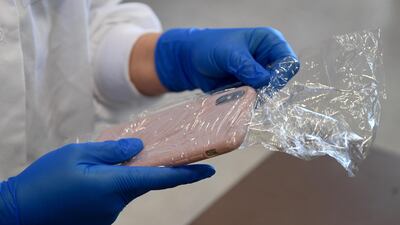
The global PPE market including masks, gowns and gloves is expected to reach $93 billion in 2027. AFP

Surgical glove makers struggle to keep pace with booming demand


  • English
  • Arabic

With no end in sight to the coronavirus pandemic, worldwide demand for surgical gloves - as for other types of personal protective equipment - is booming, leaving manufacturers struggling to keep up.

The global personal protective equipment market including masks, gowns and gloves is expected to balloon from $52 billion (Dh190.84bn) last year to $93bn in 2027, according to German market data specialist, Statista.

And, like other such products that were previously predominantly the domain of specialist medical personnel, the surgical glove has become much sought after even by the general public.

US-based Allied Market Research estimates that the global disposable gloves market amounted to $6.8bn in 2019, and is expected to nearly triple to $18.8bn by 2027.

Just as worldwide shortages of masks and disinfectant gels have pushed up the prices of those products, single-use medical gloves have become increasingly difficult and costly to come by during the health crisis.

"We have health centres calling us every day trying to get their hands on gloves," said Sebastien Lenoble, director of Netherlands-based Shield Scientific, which markets gloves for medical, industrial and laboratory applications.

"These aren't our usual clients. They are coming to us because they are desperate to find gloves."

While the World Health Organisation says that wearing rubber or latex gloves in public offers little protection against infection, they are becoming an increasingly common sight in shops and public transport around the world.

"We are observing a more than threefold increase in demand for examination gloves and demand for surgical gloves has also increased significantly," said Monika Riedel, spokeswoman for Austrian company Semperit, whose Sempermed subsidiary makes between seven and eight billion gloves every year.

Malaysia is the world's biggest maker of rubber gloves, accounting for around 60 per cent of global exports.

And according to the Malaysian manufacturers' association Margma, worldwide demand is projected to rise from 296 billion in 2019 to 330 billion this year.

Given the surge, the industry is forecasting a shortage that is expected to last well into next year, Margma said.

Malaysian manufacturer Top Glove, which describes itself as the world's biggest producer of rubber gloves, said it is seeing orders for 11-12 billion a month, compared with 4.5 billion prior to the pandemic.

As a result, customers must now wait nearly 600 days for their orders to be filled, compared with a normal delivery time of 30-40 days, said chief executive, Lim Wee Chai.

In addition, with raw materials in short supply, production costs are also rising.

"The shortage of raw material for our nitrile gloves and the disruption to the supply or production of other material such as packaging materials due to the global lockdown, has caused an increase in the production cost," said Top Glove.

That would be passed on to customers in the form of higher prices.

While health experts argue that regular handwashing offers better protection against Covid-19 than gloves, the current boom for PPE is expected to pose another problem further down the line.

Environmental campaigners are concerned that millions of tonnes of single-use gloves will end up polluting the oceans.

Mercer, the investment consulting arm of US services company Marsh & McLennan, expects its wealth division to at least double its assets under management (AUM) in the Middle East as wealth in the region continues to grow despite economic headwinds, a company official said.

Mercer Wealth, which globally has $160 billion in AUM, plans to boost its AUM in the region to $2-$3bn in the next 2-3 years from the present $1bn, said Yasir AbuShaban, a Dubai-based principal with Mercer Wealth.

Within the next two to three years, we are looking at reaching $2 to $3 billion as a conservative estimate and we do see an opportunity to do so,” said Mr AbuShaban.

Mercer does not directly make investments, but allocates clients’ money they have discretion to, to professional asset managers. They also provide advice to clients.

“We have buying power. We can negotiate on their (client’s) behalf with asset managers to provide them lower fees than they otherwise would have to get on their own,” he added.

Mercer Wealth’s clients include sovereign wealth funds, family offices, and insurance companies among others.

From its office in Dubai, Mercer also looks after Africa, India and Turkey, where they also see opportunity for growth.

Wealth creation in Middle East and Africa (MEA) grew 8.5 per cent to $8.1 trillion last year from $7.5tn in 2015, higher than last year’s global average of 6 per cent and the second-highest growth in a region after Asia-Pacific which grew 9.9 per cent, according to consultancy Boston Consulting Group (BCG). In the region, where wealth grew just 1.9 per cent in 2015 compared with 2014, a pickup in oil prices has helped in wealth generation.

BCG is forecasting MEA wealth will rise to $12tn by 2021, growing at an annual average of 8 per cent.

Drivers of wealth generation in the region will be split evenly between new wealth creation and growth of performance of existing assets, according to BCG.

Another general trend in the region is clients’ looking for a comprehensive approach to investing, according to Mr AbuShaban.

“Institutional investors or some of the families are seeing a slowdown in the available capital they have to invest and in that sense they are looking at optimizing the way they manage their portfolios and making sure they are not investing haphazardly and different parts of their investment are working together,” said Mr AbuShaban.

Some clients also have a higher appetite for risk, given the low interest-rate environment that does not provide enough yield for some institutional investors. These clients are keen to invest in illiquid assets, such as private equity and infrastructure.

“What we have seen is a desire for higher returns in what has been a low-return environment specifically in various fixed income or bonds,” he said.

“In this environment, we have seen a de facto increase in the risk that clients are taking in things like illiquid investments, private equity investments, infrastructure and private debt, those kind of investments were higher illiquidity results in incrementally higher returns.”

The Abu Dhabi Investment Authority, one of the largest sovereign wealth funds, said in its 2016 report that has gradually increased its exposure in direct private equity and private credit transactions, mainly in Asian markets and especially in China and India. The authority’s private equity department focused on structured equities owing to “their defensive characteristics.”

Shipping%20and%20banking%20
%3Cp%3EThe%20sixth%20sanctions%20package%20will%20also%20see%20European%20insurers%20banned%20from%20covering%20Russian%20shipping%2C%20more%20individuals%20added%20to%20the%20EU's%20sanctions%20list%20and%20Russia's%20Sberbank%20cut%20off%20from%20international%20payments%20system%20Swift.%3C%2Fp%3E%0A
Results

5.30pm: Maiden (TB) Dh82,500 (Turf) 1,400m; Winner: Mcmanaman, Sam Hitchcock (jockey), Doug Watson (trainer)

6.05pm: Handicap (TB) Dh87,500 (T) 1,400m; Winner: Bawaasil, Sam Hitchcott, Doug Watson

6.40pm: Handicap (TB) Dh105,000 (Dirt) 1,400m; Winner: Bochart, Fabrice Veron, Satish Seemar

7.15pm: Handicap (TB) Dh105,000 (T) 1,200m; Winner: Mutaraffa, Antonio Fresu, Musabah Al Muhairi

7.50pm: Longines Stakes – Conditions (TB) Dh120,00 (D) 1,900m; Winner: Rare Ninja, Royston Ffrench, Salem bin Ghadayer

8.25pm: Zabeel Trophy – Rated Conditions (TB) Dh120,000 (T) 1,600m; Winner: Alfareeq, Antonio Fresu, Musabah Al Muhairi

9pm: Handicap (TB) Dh105,000 (T) 2,410m; Winner: Good Tidings, Antonio Fresu, Musabah Al Muhairi

9.35pm: Handicap (TB) Dh92,500 (T) 2,000m; Winner: Zorion, Abdul Aziz Al Balushi, Helal Al Alawi


WHAT%20MACRO%20FACTORS%20ARE%20IMPACTING%20META%20TECH%20MARKETS%3F
%3Cp%3E%E2%80%A2%20Looming%20global%20slowdown%20and%20recession%20in%20key%20economies%3C%2Fp%3E%0A%3Cp%3E%E2%80%A2%20Russia-Ukraine%20war%3C%2Fp%3E%0A%3Cp%3E%E2%80%A2%20Interest%20rate%20hikes%20and%20the%20rising%20cost%20of%20debt%20servicing%3C%2Fp%3E%0A%3Cp%3E%E2%80%A2%20Oil%20price%20volatility%3C%2Fp%3E%0A%3Cp%3E%E2%80%A2%20Persisting%20inflationary%20pressures%3C%2Fp%3E%0A%3Cp%3E%E2%80%A2%20Exchange%20rate%20fluctuations%3C%2Fp%3E%0A%3Cp%3E%E2%80%A2%20Shortage%20of%20labour%2Fskills%3C%2Fp%3E%0A%3Cp%3E%E2%80%A2%20A%20resurgence%20of%20Covid%3F%3C%2Fp%3E%0A
INVESTMENT PLEDGES

Cartlow: $13.4m

Rabbitmart: $14m

Smileneo: $5.8m

Soum: $4m

imVentures: $100m

Plug and Play: $25m

The Penguin

Starring: Colin Farrell, Cristin Milioti, Rhenzy Feliz

Creator: Lauren LeFranc

Rating: 4/5

Jurassic%20Park
%3Cp%3E%3Cstrong%3EDirector%3A%20%3C%2Fstrong%3ESteven%20Spielberg%3Cbr%3E%3Cstrong%3EStars%3A%3C%2Fstrong%3E%20Sam%20Neill%2C%20Jeff%20Goldblum%20and%20Richard%20Attenborough%3Cbr%3E%3Cstrong%3ERating%3A%3C%2Fstrong%3E%205%2F5%3C%2Fp%3E%0A
Living in...

This article is part of a guide on where to live in the UAE. Our reporters will profile some of the country’s most desirable districts, provide an estimate of rental prices and introduce you to some of the residents who call each area home.

Profile

Company: Justmop.com

Date started: December 2015

Founders: Kerem Kuyucu and Cagatay Ozcan

Sector: Technology and home services

Based: Jumeirah Lake Towers, Dubai

Size: 55 employees and 100,000 cleaning requests a month

Funding:  The company’s investors include Collective Spark, Faith Capital Holding, Oak Capital, VentureFriends, and 500 Startups.
