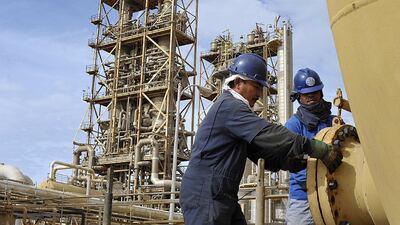
Workers at the Sirte Oil Company in Brega, Libya. The blockade has cost Libya $11bn in fiscal revenue. Reuters

Libya economy set for recovery in 2021 but faces continued challenges, World Bank says


Jennifer Gnana
  • English
  • Arabic

Libya, North Africa’s second-largest oil producer, continues to face myriad economic challenges even as its gross domestic product is expected to rise by 67 per cent this year on higher oil prices, according to the World Bank.

The country faces "fragmentation of state institutions" amid an ongoing conflict, which has disrupted oil revenue, the main driver of the economy, the World Bank said in its Libya Economic Monitor. Libya's economy contracted by about 31 per cent in 2020.

“Libya faces enormous economic challenges and desperately needs unified institutions, good governance, strong political will and long overdue reforms,” said Jesko Hentschel, World Bank country director for the Maghreb and Malta.

“The Libyan people have gone through so many tribulations. The security and political environments have seen signs of improvement lately. The road ahead will not be smooth, but it provides hope for peace, stability, and development," he added.

The North African country relies on hydrocarbons export for over 60 per cent of aggregate economic output and over 90 per cent of both fiscal revenue and merchandise exports. However, a nearly-year long blockade of Libya's exports curtailed development of its economy during a particularly challenging year due to the Covid-19 pandemic.

The Washington-based lender described the blockade as "debilitating" for Libya's "acutely undiversified economy", whose performance last year was the worst in "recent record".

The blockade has cost Libya $11 billion in lost fiscal revenues, according to the Central Bank of Tripoli.

The ongoing pandemic has further exacerbated the impact of economic and social dislocation in the conflict-ridden country, the bank added.

Libya remains prone to disruptions to oil exports, according to the World Bank.

Last week, Libya's National Oil Corporation declared a force majeure on exports from Hariga Port in the east. It said the closure was due to the central bank's refusal to release the budget needed for the oil sector "for long months".

Libyan production rose to 1.19 million barrels per day in March, about 10 times higher than the 121,000 bpd it produced in the third quarter of last year, according to secondary Opec sources.

If the Hariga port, which has a capacity to export 120,000 bpd continues to remain shut, more than 100,000 bpd of Libyan production could be shut-in, according to Louise Dickson, an oil markets analyst at Rystad Energy.

The Work Bank said the country's oil and gas output will remain the main driver of economic growth in 2021. Higher international oil prices will help support the overall rebound in oil output, "filtering through stronger government consumption and investment, and in turn supporting a recovery in private consumption".

Earlier this month, the International Monetary Fund cited an 88 per cent decline in Libya's fiscal breakeven price of oil to $48.8 per barrel as indication of the country's economic recovery in 2021.

Growth in the non-oil sector, however, will remain subdued, impeded by ongoing conflict. Poor provision of services, including power, and the lingering effects of the Covid-19 pandemic will also hinder growth of the country's non-oil economy.

The decline in oil revenue has also led to lower government spending. The government in Tripoli slashed expenditure by 22 per cent to 36.2bn Libyan dinars ($8bn) from 46.1bn dinars in 2020.

Wages and salaries accounted for the largest share of the government's expenditure. Total fiscal revenue stood at 23bn dinars in 2020, about 40 per cent of total revenue earned in 2019, the World Bank said, citing Tripoli's finance ministry data.

Fast%20X
%3Cp%3E%3Cstrong%3EDirector%3A%3C%2Fstrong%3E%20Louis%20Leterrier%3C%2Fp%3E%0A%3Cp%3E%3Cstrong%3EStars%3A%3C%2Fstrong%3E%20Vin%20Diesel%2C%20Michelle%20Rodriguez%2C%20Jason%20Statham%2C%20Tyrese%20Gibson%2C%20Ludacris%2C%20Jason%20Momoa%2C%20John%20Cena%2C%20Jordana%20Brewster%2C%20Nathalie%20Emmanuel%2C%20Sung%20Kang%2C%20Brie%20Larson%2C%20Helen%20Mirren%20and%20Charlize%20Theron%3C%2Fp%3E%0A%3Cp%3E%3Cstrong%3ERating%3A%3C%2Fstrong%3E%203%2F5%3C%2Fp%3E%0A
The years Ramadan fell in May

1987

1954

1921

1888

Ten tax points to be aware of in 2026

1. Domestic VAT refund amendments: request your refund within five years

If a business does not apply for the refund on time, they lose their credit.

2. E-invoicing in the UAE

Businesses should continue preparing for the implementation of e-invoicing in the UAE, with 2026 a preparation and transition period ahead of phased mandatory adoption. 

3. More tax audits

Tax authorities are increasingly using data already available across multiple filings to identify audit risks. 

4. More beneficial VAT and excise tax penalty regime

Tax disputes are expected to become more frequent and more structured, with clearer administrative objection and appeal processes. The UAE has adopted a new penalty regime for VAT and excise disputes, which now mirrors the penalty regime for corporate tax.

5. Greater emphasis on statutory audit

There is a greater need for the accuracy of financial statements. The International Financial Reporting Standards standards need to be strictly adhered to and, as a result, the quality of the audits will need to increase.

6. Further transfer pricing enforcement

Transfer pricing enforcement, which refers to the practice of establishing prices for internal transactions between related entities, is expected to broaden in scope. The UAE will shortly open the possibility to negotiate advance pricing agreements, or essentially rulings for transfer pricing purposes. 

7. Limited time periods for audits

Recent amendments also introduce a default five-year limitation period for tax audits and assessments, subject to specific statutory exceptions. While the standard audit and assessment period is five years, this may be extended to up to 15 years in cases involving fraud or tax evasion. 

8. Pillar 2 implementation 

Many multinational groups will begin to feel the practical effect of the Domestic Minimum Top-Up Tax (DMTT), the UAE's implementation of the OECD’s global minimum tax under Pillar 2. While the rules apply for financial years starting on or after January 1, 2025, it is 2026 that marks the transition to an operational phase.

9. Reduced compliance obligations for imported goods and services

Businesses that apply the reverse-charge mechanism for VAT purposes in the UAE may benefit from reduced compliance obligations. 

10. Substance and CbC reporting focus

Tax authorities are expected to continue strengthening the enforcement of economic substance and Country-by-Country (CbC) reporting frameworks. In the UAE, these regimes are increasingly being used as risk-assessment tools, providing tax authorities with a comprehensive view of multinational groups’ global footprints and enabling them to assess whether profits are aligned with real economic activity. 

Contributed by Thomas Vanhee and Hend Rashwan, Aurifer

The biog

Age: 32

Qualifications: Diploma in engineering from TSI Technical Institute, bachelor’s degree in accounting from Dubai’s Al Ghurair University, master’s degree in human resources from Abu Dhabi University, currently third years PHD in strategy of human resources.

Favourite mountain range: The Himalayas

Favourite experience: Two months trekking in Alaska
