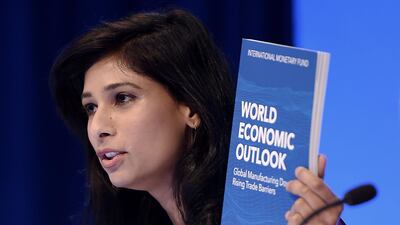
Gita Gopinath, chief economist of the IMF, says there is divergence between financial market indicators and the real economic activity. AFP

Financial markets' disconnect from real economy may lead to corrections, IMF says


Sarmad Khan
  • English
  • Arabic

There is a “striking divergence” between financial markets and the real economy, which could lead to greater volatility and sharp corrections, the International Monetary Fund said.

Financial market indicators point to stronger prospects of a recovery in global output than what activity in the pandemic-hit real economy suggests, Gita Gopinath, the fund’s chief economist, said on Tuesday.

“This divergence may portend greater volatility in financial markets,” she said in a blog post. “Worse health and economic news can lead to sharp corrections.”

The S&P 500 has recouped most of its losses since the start of the crisis, despite an economic collapse in the US and the Federal Reserve’s forecast of a 6.5 per cent fall in gross domestic product this year.

Ms Gopinath said the Africa and FTSE Russell emerging market indexes have improved substantially while the Bovespa, Brazil’s benchmark equities index, has risen significantly despite the recent surge in Covid-19 infection rates in the country.

The increase in sovereign debt spreads and the depreciation of emerging market currencies are also smaller than what was experienced during the global financial crisis, with a few exceptions.

“This is notable considering the larger scale of the shock to emerging markets during the ‘Great Lockdown’,” Ms Gopinath said.

Portfolio flows to emerging and developing economies have also stabilised, despite the economic upheaval in these economies.

The virus has infected about 8.05 million people worldwide and killed more than 437,000, according to Johns Hopkins University, which is tracking the outbreak.

The pandemic forced governments to close borders and shut all but essential businesses to stem the spread of the virus, which brought economic activity to a standstill. Countries started to gradually reopen their economies last month in adherence with World Health Organisation guidelines.

Earlier this month, the Organisation for Economic Cooperation and Development said global output is projected to contract by 7.6 per cent this year in the absence of a vaccine, while unemployment in some of the world’s largest economies could more than double to about 11 per cent.

The World Bank expects global output to shrink by 5.2 per cent, while the IMF said on Monday that it expects to cut its April forecast of a 3 per cent contraction when it releases its latest projections on June 24.

The fund’s managing director Kristalina Georgieva said last week that about 170 countries will be left worse off by the pandemic, with lower per capita income by the end of this year despite an injection of about $10 trillion (Dh36.7tn) by governments and central banks to stabilise the world economy.

As more economies reopen four months after the WHO declared Covid-19 a pandemic, the rate of infection continues to rise in some emerging market and developing countries. The infection rate in some US states has increased and China, the world’s second largest economy, is battling a new outbreak of Covid-19 in Beijing.

Despite the second wave of infections and prospects of a worsening economic outlook, equity markets have generally rallied in recent weeks, with the S&P500 index climbing 37 per cent from its lowest close this year on March 23.

The most probable factor behind this divergence is the stronger policy response to the crisis, Ms Gopinath said.

“Monetary policy has become accommodative across the board, with unprecedented support from major central banks and monetary easing in emerging markets, including through first-time use of unconventional policies,” she said.

The pandemic has also dealt a “uniquely large blow” to the global services sector, hitting it harder than manufacturing.

“This time is different. In the peak months of the lockdown the contraction in services has been even larger than in manufacturing, and it is seen in advanced and emerging market economies alike,” Ms Gopinath said.

“It is possible that with pent-up consumer demand, there will be a quicker rebound, unlike after previous crises. However, this is not guaranteed in a health crisis as consumers may change spending behaviour to minimise social interaction.”

A significant challenge will be around the adequate production and distribution of vaccines and treatments when they become available, and this will require a global effort.

“As the recovery progresses, policies should support the reallocation of workers from shrinking sectors to sectors with stronger prospects,” Ms Gopinath said.


Who's who in Yemen conflict

Houthis: Iran-backed rebels who occupy Sanaa and run unrecognised government

Yemeni government: Exiled government in Aden led by eight-member Presidential Leadership Council

Southern Transitional Council: Faction in Yemeni government that seeks autonomy for the south

Habrish 'rebels': Tribal-backed forces feuding with STC over control of oil in government territory

Notable salonnières of the Middle East through history

Al Khasan (Okaz, Saudi Arabia)

Tamadir bint Amr Al Harith, known simply as Al Khasan, was a poet from Najd famed for elegies, earning great renown for the eulogy of her brothers Mu’awiyah and Sakhr, both killed in tribal wars. Although not a salonnière, this prestigious 7th century poet fostered a culture of literary criticism and could be found standing in the souq of Okaz and reciting her poetry, publicly pronouncing her views and inviting others to join in the debate on scholarship. She later converted to Islam.


Maryana Marrash (Aleppo)

A poet and writer, Marrash helped revive the tradition of the salon and was an active part of the Nadha movement, or Arab Renaissance. Born to an established family in Aleppo in Ottoman Syria in 1848, Marrash was educated at missionary schools in Aleppo and Beirut at a time when many women did not receive an education. After touring Europe, she began to host salons where writers played chess and cards, competed in the art of poetry, and discussed literature and politics. An accomplished singer and canon player, music and dancing were a part of these evenings.


Princess Nazil Fadil (Cairo)

Princess Nazil Fadil gathered religious, literary and political elite together at her Cairo palace, although she stopped short of inviting women. The princess, a niece of Khedive Ismail, believed that Egypt’s situation could only be solved through education and she donated her own property to help fund the first modern Egyptian University in Cairo.


Mayy Ziyadah (Cairo)

Ziyadah was the first to entertain both men and women at her Cairo salon, founded in 1913. The writer, poet, public speaker and critic, her writing explored language, religious identity, language, nationalism and hierarchy. Born in Nazareth, Palestine, to a Lebanese father and Palestinian mother, her salon was open to different social classes and earned comparisons with souq of where Al Khansa herself once recited.

Guardians%20of%20the%20Galaxy%20Vol%203
%3Cp%3E%3Cstrong%3EDirector%3A%20%3C%2Fstrong%3EJames%20Gunn%3C%2Fp%3E%0A%3Cp%3E%3Cstrong%3EStars%3A%3C%2Fstrong%3E%20Chris%20Pratt%2C%20Zoe%20Saldana%2C%20Dave%20Bautista%2C%20Vin%20Diesel%2C%20Bradley%20Cooper%3C%2Fp%3E%0A%3Cp%3E%3Cstrong%3ERating%3A%3C%2Fstrong%3E%204%2F5%3C%2Fp%3E%0A
Turning%20waste%20into%20fuel
%3Cp%3EAverage%20amount%20of%20biofuel%20produced%20at%20DIC%20factory%20every%20month%3A%20%3Cstrong%3EApproximately%20106%2C000%20litres%3C%2Fstrong%3E%3C%2Fp%3E%0A%3Cp%3EAmount%20of%20biofuel%20produced%20from%201%20litre%20of%20used%20cooking%20oil%3A%20%3Cstrong%3E920ml%20(92%25)%3C%2Fstrong%3E%3C%2Fp%3E%0A%3Cp%3ETime%20required%20for%20one%20full%20cycle%20of%20production%20from%20used%20cooking%20oil%20to%20biofuel%3A%20%3Cstrong%3EOne%20day%3C%2Fstrong%3E%3C%2Fp%3E%0A%3Cp%3EEnergy%20requirements%20for%20one%20cycle%20of%20production%20from%201%2C000%20litres%20of%20used%20cooking%20oil%3A%3Cbr%3E%3Cstrong%3E%E2%96%AA%20Electricity%20-%201.1904%20units%3Cbr%3E%E2%96%AA%20Water-%2031%20litres%3Cbr%3E%E2%96%AA%20Diesel%20%E2%80%93%2026.275%20litres%3C%2Fstrong%3E%3C%2Fp%3E%0A
Guide to intelligent investing
Investing success often hinges on discipline and perspective. As markets fluctuate, remember these guiding principles:
  • Stay invested: Time in the market, not timing the market, is critical to long-term gains.
  • Rational thinking: Breathe and avoid emotional decision-making; let logic and planning guide your actions.
  • Strategic patience: Understand why you’re investing and allow time for your strategies to unfold.
 
 
AndhaDhun

Director: Sriram Raghavan

Producer: Matchbox Pictures, Viacom18

Cast: Ayushmann Khurrana, Tabu, Radhika Apte, Anil Dhawan

Rating: 3.5/5

The biog

Favourite food: Fish and seafood

Favourite hobby: Socialising with friends

Favourite quote: You only get out what you put in!

Favourite country to visit: Italy

Favourite film: Lock Stock and Two Smoking Barrels.

Family: We all have one!

MATCH INFO

Uefa Champions League final:

Who: Real Madrid v Liverpool
Where: NSC Olimpiyskiy Stadium, Kiev, Ukraine
When: Saturday, May 26, 10.45pm (UAE)
TV: Match on BeIN Sports

GAC GS8 Specs

Engine: 2.0-litre 4cyl turbo

Power: 248hp at 5,200rpm

Torque: 400Nm at 1,750-4,000rpm

Transmission: 8-speed auto

Fuel consumption: 9.1L/100km

On sale: Now

Price: From Dh149,900

Asia Cup 2018 final

Who: India v Bangladesh

When: Friday, 3.30pm, Dubai International Stadium

Watch: Live on OSN Cricket HD

Why seagrass matters
  • Carbon sink: Seagrass sequesters carbon up to 35X faster than tropical rainforests
  • Marine nursery: Crucial habitat for juvenile fish, crustations, and invertebrates
  • Biodiversity: Support species like sea turtles, dugongs, and seabirds
  • Coastal protection: Reduce erosion and improve water quality
Coffee: black death or elixir of life?

It is among the greatest health debates of our time; splashed across newspapers with contradicting headlines - is coffee good for you or not?

Depending on what you read, it is either a cancer-causing, sleep-depriving, stomach ulcer-inducing black death or the secret to long life, cutting the chance of stroke, diabetes and cancer.

The latest research - a study of 8,412 people across the UK who each underwent an MRI heart scan - is intended to put to bed (caffeine allowing) conflicting reports of the pros and cons of consumption.

The study, funded by the British Heart Foundation, contradicted previous findings that it stiffens arteries, putting pressure on the heart and increasing the likelihood of a heart attack or stroke, leading to warnings to cut down.

Numerous studies have recognised the benefits of coffee in cutting oral and esophageal cancer, the risk of a stroke and cirrhosis of the liver. 

The benefits are often linked to biologically active compounds including caffeine, flavonoids, lignans, and other polyphenols, which benefit the body. These and othetr coffee compounds regulate genes involved in DNA repair, have anti-inflammatory properties and are associated with lower risk of insulin resistance, which is linked to type-2 diabetes.

But as doctors warn, too much of anything is inadvisable. The British Heart Foundation found the heaviest coffee drinkers in the study were most likely to be men who smoked and drank alcohol regularly.

Excessive amounts of coffee also unsettle the stomach causing or contributing to stomach ulcers. It also stains the teeth over time, hampers absorption of minerals and vitamins like zinc and iron.

It also raises blood pressure, which is largely problematic for people with existing conditions.

So the heaviest drinkers of the black stuff - some in the study had up to 25 cups per day - may want to rein it in.

Rory Reynolds

All or Nothing

Amazon Prime

Four stars