

Eurozone retail sales dropped 2 per cent on the month in September, a bigger-than-expected decline as purchases across all categories plummeted even before the latest lockdowns started, according to Eurostat.
While retail sales in the 19 countries sharing the euro were still 2.2 per cent up on last September, they were still below economists’ expectations and followed a 4.2-per-cent month-on-month rise in August.
“September’s data show that eurozone retail sales were coming off the boil even before many non-essential retailers were forced to shut up shop,” said Jack Allen-Reynolds, senior Europe economist at Capital Economics.
“Online spending will probably pick up again, but by nowhere enough to prevent total household consumption from falling again in Q4.”
-
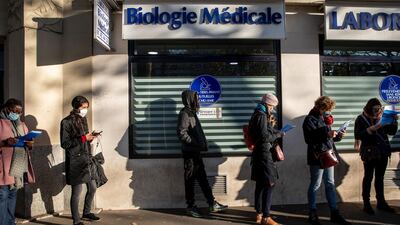
Visitors uses smartphones while queuing outside a Covid-19 test center in Paris, France. Bloomberg -
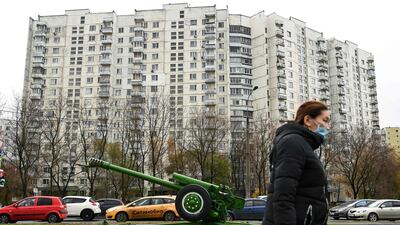
A pedestrian wearing a protective face mask walks past a cannon in Moscow. Russia confirmed 19,404 new Covid-19 cases on November 5. AFP -
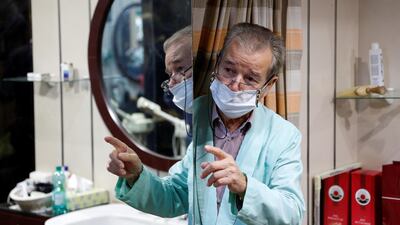
Barber Luigi Pinzo, 80, gestures to a client two days before closing his salon after 60 years because of a lack clients and fear of the coronavirus disease in Rome, Italy. Reuters -
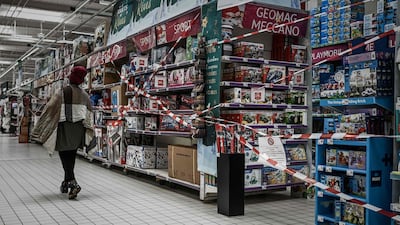
A customer walks past the closed toy department of a supermarket in Bordeaux, France. AFP -

A dog runs in an empty street near the Sacre-Coeur basilic in Paris, France. AFP -
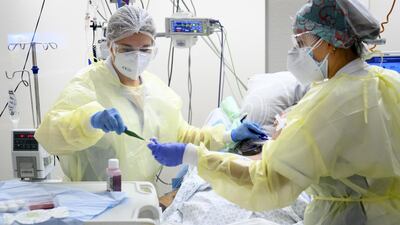
Medical workers treat a patient with Covid-19 in the intensive care unit at the eHnv hospital in Yverdon-les-Bains, Switzerland. EPA -

A health worker collects a nose swab sample for a test at a drive-in coronavirus testing facility in Yverdon-les-Bains, Switzerland. EPA -
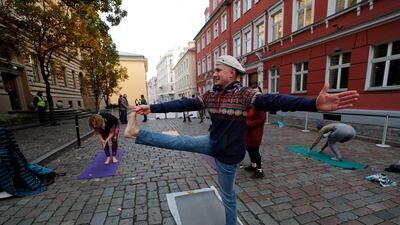
People exercise during a protest against Covid-19 restrictions in Riga, Latvia. EPA


Non-essential retailers have been forced to close their stores in several countries, including France, Germany and parts of Italy. Under Italy’s new rules, unveiled on Wednesday, shops must close if they are in a so-called “red zone,” which currently applies in four of the country’s twenty regions, which together account for nearly a third of the country’s gross domestic product.
Eurostat’s latest retail data offer a mixed picture for the third quarter of the year, when coronavirus restrictions eased in most EU countries, with a surge in spending in August sandwiched between weakness in July and September.
Belgium and France saw the largest declines in September, with contractions of 7.4 per cent and 4.5 per cent respectively, as both countries experienced a sharp rise in the number of Covid-19 cases over the course of the month.
The main downwards pressure on retail sales across the bloc came from clothing and footwear, which fell 7.6 per cent in September.
However a 5.5-per-cent decline in mail orders and internet sales volumes showed that it was not only restrictions on leaving the home that were encouraging consumers to make fewer purchases.
Non-food products as a whole suffered a 2.6-per-cent drop in September, while sales of food, drinks and tobacco dropped 1.4 per cent over the same period.
“The generosity of schemes across the euro area to pay the wages of workers who cannot do their jobs during the pandemic mean that the labour market has thus far been largely shielded from the recession, and household incomes have been somewhat protected,” said Josie Dent, managing economist at the Centre for Economics and Business Research.
“Yet, as more virus infections sweep the continent, consumers are likely to hold back on spending in order to build up savings amid difficult economic circumstances. This can explain the drop in retail sales in September, even in the internet sales category, which is unaffected by the rising social distancing restrictions.”
Europe’s economy is facing a sluggish recovery next year that leaves it open to rising company failures and long-term unemployment, the European Commission said on Thursday. It expects the euro-area economy to grow 4.2 per cent in 2021, less than previous anticipated.
“Europe’s rebound has been interrupted due to the resurgence in Covid-19 cases,” Paolo Gentiloni, EU commissioner for the economy, said in a statement. “In the current context of very high uncertainty, national economic and fiscal policies must remain supportive.”
With people told to stay at home across the euro zone, and the closure of retail stores in some parts of the bloc, a further hit on retail sales is now expected.
"Online spending will probably pick up again, but by nowhere enough to prevent total household consumption from falling again in Q4," said Mr Allen-Reynolds.
"As lockdowns cause more workers to go on to short-time work schemes and others lose their jobs, incomes will fall and precautionary savings will increase, so wider consumer spending is likely to decline too. We have pencilled in a 3 per cent quarter-on-quarter fall in GDP in Q4."

