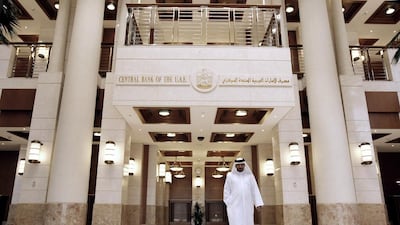
The Central Bank of the UAE will continue to focus on financial and fiscal stability during the current crisis, supporting economic growth, countering inflation and boosting the country’s foreign currency reserves, its chairman said.
The “critical juncture” the world is at amid the global pandemic, requires further development of the financial infrastructure and digital solutions, which the UAE regulator is overseeing, Sheikh Mansour bin Zayed Al Nahyan, Deputy Prime Minister and Minister of Presidential Affairs, said according to Wam.
"Efficient policies and mechanisms will be developed to respond to rapid developments in the global banking and monetary sector," Sheikh Mansour said.
"The coming period will see significant support by the board for the central bank's senior management to embrace digital transformation and to ensure greater efficiency and a higher level of operability," he told a virtual CBUAE board meeting.
The competence and expertise of the UAE central bank will help propel it among the best banking regulators regionally and globally over the next five years, Sheikh Mansour added.
The UAE banking regulator is also looking to “accelerate digitalisation efforts by overhauling the current policies and corporate governance laws and regulations," Abdulhamid Saeed, Governor of the CBUAE said.
It is also focusing on the development of a digital Identity for financial institutions, enhancing cybersecurity and developing an open banking framework, he added.
The central bank board, which was restructured earlier this month, also discussed the development of the financial infrastructure in the country and digital solutions for small and medium-sized enterprises (SMEs).
The UAE banking regulator has taken a series of measures to strengthen the financial system and support the country’s economy amid the pandemic-driven slowdown. It is encouraging banks to lend to companies, especially SMEs, to help them steer through the current economic volatility.
The CBUAE was among the first regulators in the Middle East and North Africa to roll out Dh256 billion worth of stimulus measures. It started with a Dh100bn package on March 14 that included a direct Dh50bn injection of funds to boost liquidity by way of zero-cost collateralised loans.
Measures also included an easing of lenders’ capital and liquidity reserve requirements. Last month, the central bank said that lenders have already drawn down 88 per cent of its Dh50bn Targeted Economic Support Scheme.
Earlier this month, Mr Saeed said the UAE’s banking sector is well-capitalised and can withstanding macroeconomic shocks of any size. The UAE’s banks had an average capital adequacy ratio of 16.9 per cent at the end of March this year, and an eligible liquid asset ratio of 16.6 per cent.
“The banking system proved its ability to face the consequences of Covid-19 pandemic and perform its role in supporting the economy,” Mr Saeed said, at the time.

RESULTS
Bantamweight:
Zia Mashwani (PAK) bt Chris Corton (PHI)
Super lightweight:
Flavio Serafin (BRA) bt Mohammad Al Khatib (JOR)
Super lightweight:
Dwight Brooks (USA) bt Alex Nacfur (BRA)
Bantamweight:
Tariq Ismail (CAN) bt Jalal Al Daaja (JOR)
Featherweight:
Abdullatip Magomedov (RUS) bt Sulaiman Al Modhyan (KUW)
Middleweight:
Mohammad Fakhreddine (LEB) bt Christofer Silva (BRA)
Middleweight:
Rustam Chsiev (RUS) bt Tarek Suleiman (SYR)
Welterweight:
Khamzat Chimaev (SWE) bt Mzwandile Hlongwa (RSA)
Lightweight:
Alex Martinez (CAN) bt Anas Siraj Mounir (MAR)
Welterweight:
Jarrah Al Selawi (JOR) bt Abdoul Abdouraguimov (FRA)
Our legal columnist
Name: Yousef Al Bahar
Advocate at Al Bahar & Associate Advocates and Legal Consultants, established in 1994
Education: Mr Al Bahar was born in 1979 and graduated in 2008 from the Judicial Institute. He took after his father, who was one of the first Emirati lawyers
Zayed Sustainability Prize
WORLD RECORD FEES FOR GOALKEEPERS
1) Kepa Arrizabalaga, Athletic Bilbao to Chelsea (£72m)
2) Alisson, Roma to Liverpool (£67m)
3) Ederson, Benfica to Manchester City (£35m)
4) Gianluigi Buffon, Parma to Juventus (£33m)
5) Angelo Peruzzi, Inter Milan to Lazio (£15.7m
The 12 Syrian entities delisted by UK
Ministry of Interior
Ministry of Defence
General Intelligence Directorate
Air Force Intelligence Agency
Political Security Directorate
Syrian National Security Bureau
Military Intelligence Directorate
Army Supply Bureau
General Organisation of Radio and TV
Al Watan newspaper
Cham Press TV
Sama TV
Mercer, the investment consulting arm of US services company Marsh & McLennan, expects its wealth division to at least double its assets under management (AUM) in the Middle East as wealth in the region continues to grow despite economic headwinds, a company official said.
Mercer Wealth, which globally has $160 billion in AUM, plans to boost its AUM in the region to $2-$3bn in the next 2-3 years from the present $1bn, said Yasir AbuShaban, a Dubai-based principal with Mercer Wealth.
“Within the next two to three years, we are looking at reaching $2 to $3 billion as a conservative estimate and we do see an opportunity to do so,” said Mr AbuShaban.
Mercer does not directly make investments, but allocates clients’ money they have discretion to, to professional asset managers. They also provide advice to clients.
“We have buying power. We can negotiate on their (client’s) behalf with asset managers to provide them lower fees than they otherwise would have to get on their own,” he added.
Mercer Wealth’s clients include sovereign wealth funds, family offices, and insurance companies among others.
From its office in Dubai, Mercer also looks after Africa, India and Turkey, where they also see opportunity for growth.
Wealth creation in Middle East and Africa (MEA) grew 8.5 per cent to $8.1 trillion last year from $7.5tn in 2015, higher than last year’s global average of 6 per cent and the second-highest growth in a region after Asia-Pacific which grew 9.9 per cent, according to consultancy Boston Consulting Group (BCG). In the region, where wealth grew just 1.9 per cent in 2015 compared with 2014, a pickup in oil prices has helped in wealth generation.
BCG is forecasting MEA wealth will rise to $12tn by 2021, growing at an annual average of 8 per cent.
Drivers of wealth generation in the region will be split evenly between new wealth creation and growth of performance of existing assets, according to BCG.
Another general trend in the region is clients’ looking for a comprehensive approach to investing, according to Mr AbuShaban.
“Institutional investors or some of the families are seeing a slowdown in the available capital they have to invest and in that sense they are looking at optimizing the way they manage their portfolios and making sure they are not investing haphazardly and different parts of their investment are working together,” said Mr AbuShaban.
Some clients also have a higher appetite for risk, given the low interest-rate environment that does not provide enough yield for some institutional investors. These clients are keen to invest in illiquid assets, such as private equity and infrastructure.
“What we have seen is a desire for higher returns in what has been a low-return environment specifically in various fixed income or bonds,” he said.
“In this environment, we have seen a de facto increase in the risk that clients are taking in things like illiquid investments, private equity investments, infrastructure and private debt, those kind of investments were higher illiquidity results in incrementally higher returns.”
The Abu Dhabi Investment Authority, one of the largest sovereign wealth funds, said in its 2016 report that has gradually increased its exposure in direct private equity and private credit transactions, mainly in Asian markets and especially in China and India. The authority’s private equity department focused on structured equities owing to “their defensive characteristics.”
