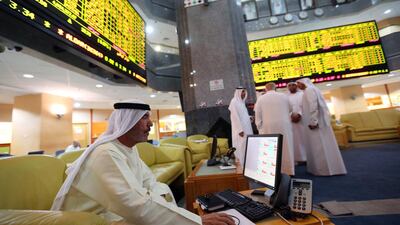
General Holding Corporation (Senaat), a part of Abu Dhabi’s holding company ADQ, submitted an offer to combine its wholly-owned subsidiary Emirates Steel with Arkan Building Materials Company to create an industrial group with assets of Dh13 billion ($3.54bn).
Under the terms of the proposed deal, Senaat would transfer Emirates Steel to Arkan for a convertible instrument that would automatically convert into approximately 5.1 billion ordinary Arkan shares upon completion of the deal, Senaat said in a statement on Sunday.
The conversion price of the instrument is set at Dh0.798 per share, which values Arkan at about Dh1.4bn. Upon completion, Senaat would own approximately 87.5 per cent of the entire issued share capital of the combined group.
“We believe the combination of Emirates Steel and Arkan presents an excellent opportunity for Arkan’s shareholders, offering increased scale, financial strength, resilience and value via a best-in-class player with international ambitions,” Khalifa Al Suwaidi, chairman of Senaat, said.
“Emirates Steel has invested ahead of the market in upgrading and future-proofing its operations” and the proposed combination of the two companies will “create value for stakeholders in the UAE and beyond”, he added.
Senaat said the proposed combination of Arkan and Emirates Steel would create the largest listed entity of its kind in the UAE. It will also give investors an opportunity for the first time to have access to a steel producer on a UAE bourse, which is expected to have "a positive impact on overall demand and liquidity for the combined group’s shares".
The combined group will also play a key role in delivering the UAE’s industrial strategy "Operation 300bn", Senaat said. It is set to benefit from the post-Covid recovery anticipated in the UAE and a broader pickup in activity within the GCC construction sector as various governmental stimulus programmes fuel spending on infrastructure projects.
The combined entity will compete alongside global industry leaders and will have a "compelling strategic proposition, with strong potential for growth", Senaat said.
The board of Arkan said it will consider the transaction before making any recommendations to shareholders.
"Should an agreement be reached between the two parties, an Arkan general assembly meeting would consider approving the transaction during second half of 2021," the company said in a statement to the Abu Dhabi Securities Exchange, where its shares trade.
“At this time, there is no certainty that any transaction will occur,” it said.
The offer is subject to government approval, including from the Securities and Commodities Authority, as well as the shareholders.
Senaat, which manages more than Dh27.2bn of industrial assets, has holdings in metals, oil and gas services, construction and building materials and food and beverages. In March 2020, ADQ assumed the ownership of Senaat, following which the conglomerate has been consolidating its holdings.
We believe the combination of Emirates Steel and Arkan presents an excellent opportunity for Arkan's shareholders, offering increased scale, financial strength, resilience and value
In January, Senaat’s food and beverage subsidiary Agthia completed its merger with Al Foah, the world’s largest date processing and packaging company. Agthia and Al Foah are both owned by ADQ through Senaat.
In February, Abu Dhabi's National Petroleum Construction Company merged with the National Marine Dredging Company. Before the merger, ADQ held a 32 per cent stake in ADX-listed NMDC and was the majority owner of NPCC through Senaat.
ADQ holds government stakes in a broad portfolio of companies, including Abu Dhabi Airports, Abu Dhabi Ports, Emirates Steel, Emirates Nuclear Energy Corporation, Etihad Rail, Abu Dhabi Securities Exchange, healthcare operator Seha, media hub TwoFour 54 and others.
It has merged a number of its subsidiaries over the past year to streamline businesses and create stronger entities. In July, Abu Dhabi Power Company and Abu Dhabi National Energy Company completed a merger to create a utilities business with Dh200bn of assets. Another ADQ-portfolio company Abu Dhabi Ports also acquired industrial zones operator Zones Corp in the same month.

Mercer, the investment consulting arm of US services company Marsh & McLennan, expects its wealth division to at least double its assets under management (AUM) in the Middle East as wealth in the region continues to grow despite economic headwinds, a company official said.
Mercer Wealth, which globally has $160 billion in AUM, plans to boost its AUM in the region to $2-$3bn in the next 2-3 years from the present $1bn, said Yasir AbuShaban, a Dubai-based principal with Mercer Wealth.
“Within the next two to three years, we are looking at reaching $2 to $3 billion as a conservative estimate and we do see an opportunity to do so,” said Mr AbuShaban.
Mercer does not directly make investments, but allocates clients’ money they have discretion to, to professional asset managers. They also provide advice to clients.
“We have buying power. We can negotiate on their (client’s) behalf with asset managers to provide them lower fees than they otherwise would have to get on their own,” he added.
Mercer Wealth’s clients include sovereign wealth funds, family offices, and insurance companies among others.
From its office in Dubai, Mercer also looks after Africa, India and Turkey, where they also see opportunity for growth.
Wealth creation in Middle East and Africa (MEA) grew 8.5 per cent to $8.1 trillion last year from $7.5tn in 2015, higher than last year’s global average of 6 per cent and the second-highest growth in a region after Asia-Pacific which grew 9.9 per cent, according to consultancy Boston Consulting Group (BCG). In the region, where wealth grew just 1.9 per cent in 2015 compared with 2014, a pickup in oil prices has helped in wealth generation.
BCG is forecasting MEA wealth will rise to $12tn by 2021, growing at an annual average of 8 per cent.
Drivers of wealth generation in the region will be split evenly between new wealth creation and growth of performance of existing assets, according to BCG.
Another general trend in the region is clients’ looking for a comprehensive approach to investing, according to Mr AbuShaban.
“Institutional investors or some of the families are seeing a slowdown in the available capital they have to invest and in that sense they are looking at optimizing the way they manage their portfolios and making sure they are not investing haphazardly and different parts of their investment are working together,” said Mr AbuShaban.
Some clients also have a higher appetite for risk, given the low interest-rate environment that does not provide enough yield for some institutional investors. These clients are keen to invest in illiquid assets, such as private equity and infrastructure.
“What we have seen is a desire for higher returns in what has been a low-return environment specifically in various fixed income or bonds,” he said.
“In this environment, we have seen a de facto increase in the risk that clients are taking in things like illiquid investments, private equity investments, infrastructure and private debt, those kind of investments were higher illiquidity results in incrementally higher returns.”
The Abu Dhabi Investment Authority, one of the largest sovereign wealth funds, said in its 2016 report that has gradually increased its exposure in direct private equity and private credit transactions, mainly in Asian markets and especially in China and India. The authority’s private equity department focused on structured equities owing to “their defensive characteristics.”
How to keep control of your emotions
If your investment decisions are being dictated by emotions such as fear, greed, hope, frustration and boredom, it is time for a rethink, Chris Beauchamp, chief market analyst at online trading platform IG, says.
Greed
Greedy investors trade beyond their means, open more positions than usual or hold on to positions too long to chase an even greater gain. “All too often, they incur a heavy loss and may even wipe out the profit already made.
Tip: Ignore the short-term hype, noise and froth and invest for the long-term plan, based on sound fundamentals.
Fear
The risk of making a loss can cloud decision-making. “This can cause you to close out a position too early, or miss out on a profit by being too afraid to open a trade,” he says.
Tip: Start with a plan, and stick to it. For added security, consider placing stops to reduce any losses and limits to lock in profits.
Hope
While all traders need hope to start trading, excessive optimism can backfire. Too many traders hold on to a losing trade because they believe that it will reverse its trend and become profitable.
Tip: Set realistic goals. Be happy with what you have earned, rather than frustrated by what you could have earned.
Frustration
Traders can get annoyed when the markets have behaved in unexpected ways and generates losses or fails to deliver anticipated gains.
Tip: Accept in advance that asset price movements are completely unpredictable and you will suffer losses at some point. These can be managed, say, by attaching stops and limits to your trades.
Boredom
Too many investors buy and sell because they want something to do. They are trading as entertainment, rather than in the hope of making money. As well as making bad decisions, the extra dealing charges eat into returns.
Tip: Open an online demo account and get your thrills without risking real money.
Sole survivors
- Cecelia Crocker was on board Northwest Airlines Flight 255 in 1987 when it crashed in Detroit, killing 154 people, including her parents and brother. The plane had hit a light pole on take off
- George Lamson Jr, from Minnesota, was on a Galaxy Airlines flight that crashed in Reno in 1985, killing 68 people. His entire seat was launched out of the plane
- Bahia Bakari, then 12, survived when a Yemenia Airways flight crashed near the Comoros in 2009, killing 152. She was found clinging to wreckage after floating in the ocean for 13 hours.
- Jim Polehinke was the co-pilot and sole survivor of a 2006 Comair flight that crashed in Lexington, Kentucky, killing 49.
