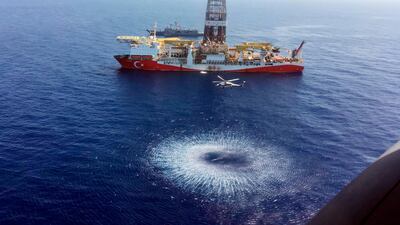
A helicopter flies over Turkish drilling ship Fatih as it sails towards Cyprus in the eastern Mediterranean to explore for natural gas. AP

Why offshore gas in the Eastern Mediterranean has a complicated road ahead


Robin Mills
  • English
  • Arabic

The gas fields of the eastern Mediterranean, discovered over the past decade, have conjured a mix of myth: Aphrodite goddess of beauty, the sorceress Calypso, and the sea beast Leviathan.

But the process of bringing these resources to market has been an odyssey with many twists and turns. Now the political struggle has become a clash of the titans.

The American firm Noble discovered the Tamar gas field off Israel in 2009, the giant Leviathan field in 2010, then Aphrodite off Cyprus (the Greek, internationally recognised country) in 2011. Eni of Italy found Zohr in deep water offshore Egypt in 2015, the largest gas field ever discovered in the Mediterranean, then Calypso off Cyprus in 2018. Meanwhile Greece-based Energean began developing the smaller Tanin and Karish fields in Israel.

These resources were hoped to be the foundation for a major collaborative effort in the region on gas development and exports, improving European energy security by providing an alternative to Russian gas, and tying together long-quarrelling neighbours in cooperation.

In 2012, the East Mediterranean pipeline was proposed, to bring the area’s gas to Crete, mainland Greece then onwards to Italy. It would be the world’s deepest and longest undersea pipeline. Alternatively, a liquefied natural gas (LNG) plant, possibly a floating unit, could be built somewhere to export by tanker.

Most commentary has focused on the political obstacles to development, and they are certainly massive. Israel’s maritime border dispute with Lebanon has gone quiet, and Noble has concluded deals to sell gas to neighbouring Jordan and Egypt.

Instead, the main recent problems revolve around Turkey. Ankara does not recognise Greek Cyprus, but backs the Turkish Republic of Northern Cyprus, which it occupies. No other country recognises the territory.

Turkey is also not party to the UN Convention on the Law of the Sea, which governs maritime boundaries, one of only a few states in this position. Israel, Syria and the US are other notable hold-outs.

In November, Turkey signed an agreement with the Government of National Accord (GNA) in the Libyan capital of Tripoli to demarcate their maritime border, ignoring the proximity of the Greek island of Crete. The Turkish energy minister said last month it would begin exploring the area for oil and gas within three to four months.

The Turkish drill-ship Yavuz, the title of the Ottoman sultan, who conquered the Levant and Egypt, has been drilling in various locations off Cyprus. No discoveries have been announced, nor is it clear what Turkey would do with any gas found, but the intention is to contest Greek Cyprus’s right to these waters and stake a claim for any future negotiations.

In response, the EU has sanctioned Turkish individuals over the drilling. And a grouping of Cyprus, Greece, Egypt, France and the UAE has condemned Turkey’s drilling in the area.

But the economic and commercial obstacles to full development of the fields are, if anything, more important. Most of the local markets are small and already saturated. Egypt is well-supplied by Zohr and its legacy fields for now, though it will likely need more in the mid-2020s.

The other big regional market, Turkey, was searching avidly for additional supplies a few years back. But with the completion of the TurkStream pipeline from Russia, the Trans-Anatolian pipeline from Azerbaijan, new LNG import capacity, the option of the Iraqi Kurdistan region at some point, and a slowing economy, Ankara is now spoilt for choice. This gives it no incentive to search for political solutions to facilitate East Mediterranean imports.

What about the long-running plan of diversifying European supplies? Israeli regulations do not allow gas to be exported at a lower price than it is sold in the country. Energean, with the cheapest contracts, sells at $4 (Dh14.7) per million British thermal units.

At current oil prices, Egypt is paying gas producers about $3.50-$4.50. Yet the European market is heavily oversupplied, and the Covid-19 pandemic will drive demand down further. Spot liquefied natural gas is available now at just over $2, and the Dutch TTF hub, the leading Europe trading point, for $1.70.

Even if international prices recover, as they should to a degree, it is clear there is no economic case to build an expensive pipeline or LNG plant to move gas to Europe and sell it at a lower price.

Bringing together supplies from several countries, fields and operators to serve a single export route is commercially tricky. Meanwhile Egypt has even shut down its operational LNG plant, at Idku near Alexandria, and halted plans to restart the other facility, at Damietta in the eastern delta, as exports are unprofitable.

Recent exploration has been disappointing. Much-hyped wells off Egypt have been dry or found limited volumes. A consortium of Eni, France’s Total and Russia’s Novatek completed Lebanon’s debut offshore well in April, but it also came up dry. This dashed already unrealistic hopes for a hydrocarbon windfall to bail out the country’s crisis-hit economy.

Offshore gas was the reason for conceiving of the East Mediterranean as a unitary area of policy in the first place. Now it has become a secondary character in bigger political plots. Odysseus, detained by Calypso for seven years, took ten years to return home to Greece. Eastern Mediterranean gas developers face an even longer and more convoluted route ahead.

Robin M. Mills is CEO of Qamar Energy, and author of The Myth of the Oil Crisis

CHATGPT%20ENTERPRISE%20FEATURES
%3Cp%3E%E2%80%A2%20Enterprise-grade%20security%20and%20privacy%3C%2Fp%3E%0A%3Cp%3E%E2%80%A2%20Unlimited%20higher-speed%20GPT-4%20access%20with%20no%20caps%3C%2Fp%3E%0A%3Cp%3E%E2%80%A2%20Longer%20context%20windows%20for%20processing%20longer%20inputs%3C%2Fp%3E%0A%3Cp%3E%E2%80%A2%20Advanced%20data%20analysis%20capabilities%3C%2Fp%3E%0A%3Cp%3E%E2%80%A2%20Customisation%20options%3C%2Fp%3E%0A%3Cp%3E%E2%80%A2%20Shareable%20chat%20templates%20that%20companies%20can%20use%20to%20collaborate%20and%20build%20common%20workflows%3C%2Fp%3E%0A%3Cp%3E%E2%80%A2%20Analytics%20dashboard%20for%20usage%20insights%3C%2Fp%3E%0A%3Cp%3E%E2%80%A2%20Free%20credits%20to%20use%20OpenAI%20APIs%20to%20extend%20OpenAI%20into%20a%20fully-custom%20solution%20for%20enterprises%3C%2Fp%3E%0A
Seven%20Winters%20in%20Tehran
%3Cp%3E%3Cstrong%3EDirector%20%3A%3C%2Fstrong%3E%20Steffi%20Niederzoll%3C%2Fp%3E%0A%3Cp%3E%3Cstrong%3EStarring%3A%3C%2Fstrong%3E%20Reyhaneh%20Jabbari%2C%20Shole%20Pakravan%2C%20Zar%20Amir%20Ebrahimi%3C%2Fp%3E%0A%3Cp%3E%3Cstrong%3ERating%3A%3C%2Fstrong%3E%204%2F5%3C%2Fp%3E%0A

Mercer, the investment consulting arm of US services company Marsh & McLennan, expects its wealth division to at least double its assets under management (AUM) in the Middle East as wealth in the region continues to grow despite economic headwinds, a company official said.

Mercer Wealth, which globally has $160 billion in AUM, plans to boost its AUM in the region to $2-$3bn in the next 2-3 years from the present $1bn, said Yasir AbuShaban, a Dubai-based principal with Mercer Wealth.

Within the next two to three years, we are looking at reaching $2 to $3 billion as a conservative estimate and we do see an opportunity to do so,” said Mr AbuShaban.

Mercer does not directly make investments, but allocates clients’ money they have discretion to, to professional asset managers. They also provide advice to clients.

“We have buying power. We can negotiate on their (client’s) behalf with asset managers to provide them lower fees than they otherwise would have to get on their own,” he added.

Mercer Wealth’s clients include sovereign wealth funds, family offices, and insurance companies among others.

From its office in Dubai, Mercer also looks after Africa, India and Turkey, where they also see opportunity for growth.

Wealth creation in Middle East and Africa (MEA) grew 8.5 per cent to $8.1 trillion last year from $7.5tn in 2015, higher than last year’s global average of 6 per cent and the second-highest growth in a region after Asia-Pacific which grew 9.9 per cent, according to consultancy Boston Consulting Group (BCG). In the region, where wealth grew just 1.9 per cent in 2015 compared with 2014, a pickup in oil prices has helped in wealth generation.

BCG is forecasting MEA wealth will rise to $12tn by 2021, growing at an annual average of 8 per cent.

Drivers of wealth generation in the region will be split evenly between new wealth creation and growth of performance of existing assets, according to BCG.

Another general trend in the region is clients’ looking for a comprehensive approach to investing, according to Mr AbuShaban.

“Institutional investors or some of the families are seeing a slowdown in the available capital they have to invest and in that sense they are looking at optimizing the way they manage their portfolios and making sure they are not investing haphazardly and different parts of their investment are working together,” said Mr AbuShaban.

Some clients also have a higher appetite for risk, given the low interest-rate environment that does not provide enough yield for some institutional investors. These clients are keen to invest in illiquid assets, such as private equity and infrastructure.

“What we have seen is a desire for higher returns in what has been a low-return environment specifically in various fixed income or bonds,” he said.

“In this environment, we have seen a de facto increase in the risk that clients are taking in things like illiquid investments, private equity investments, infrastructure and private debt, those kind of investments were higher illiquidity results in incrementally higher returns.”

The Abu Dhabi Investment Authority, one of the largest sovereign wealth funds, said in its 2016 report that has gradually increased its exposure in direct private equity and private credit transactions, mainly in Asian markets and especially in China and India. The authority’s private equity department focused on structured equities owing to “their defensive characteristics.”

if you go

Getting there

Etihad (Etihad.com), Emirates (emirates.com) and Air France (www.airfrance.com) fly to Paris’ Charles de Gaulle Airport, from Abu Dhabi and Dubai respectively. Return flights cost from around Dh3,785. It takes about 40 minutes to get from Paris to Compiègne by train, with return tickets costing €19. The Glade of the Armistice is 6.6km east of the railway station.

Staying there

On a handsome, tree-lined street near the Chateau’s park, La Parenthèse du Rond Royal (laparenthesedurondroyal.com) offers spacious b&b accommodation with thoughtful design touches. Lots of natural woods, old fashioned travelling trunks as decoration and multi-nozzle showers are part of the look, while there are free bikes for those who want to cycle to the glade. Prices start at €120 a night.

More information: musee-armistice-14-18.fr ; compiegne-tourisme.fr; uk.france.fr

COMPANY%20PROFILE
%3Cp%3E%3Cstrong%3ECompany%20name%3C%2Fstrong%3E%3A%20ASI%20(formerly%20DigestAI)%3C%2Fp%3E%0A%3Cp%3E%3Cstrong%3EStarted%3A%3C%2Fstrong%3E%202017%3C%2Fp%3E%0A%3Cp%3E%3Cstrong%3EFounders%3A%3C%2Fstrong%3E%20Quddus%20Pativada%3C%2Fp%3E%0A%3Cp%3E%3Cstrong%3EBased%3A%3C%2Fstrong%3E%20Dubai%2C%20UAE%3C%2Fp%3E%0A%3Cp%3E%3Cstrong%3EIndustry%3A%3C%2Fstrong%3E%20Artificial%20intelligence%2C%20education%20technology%3C%2Fp%3E%0A%3Cp%3E%3Cstrong%3EFunding%3A%3C%2Fstrong%3E%20%243%20million-plus%3C%2Fp%3E%0A%3Cp%3E%3Cstrong%3EInvestors%3A%3C%2Fstrong%3E%20GSV%20Ventures%2C%20Character%2C%20Mark%20Cuban%3C%2Fp%3E%0A
RESULT

Manchester United 2 Burnley 2
Man United:
 Lingard (53', 90' 1)
Burnley: Barnes (3'), Defour (36')

Man of the Match: Jesse Lingard (Manchester United)

ALRAWABI%20SCHOOL%20FOR%20GIRLS
%3Cp%3ECreator%3A%20Tima%20Shomali%3C%2Fp%3E%0A%3Cp%3EStarring%3A%C2%A0Tara%20Abboud%2C%C2%A0Kira%20Yaghnam%2C%20Tara%20Atalla%3C%2Fp%3E%0A%3Cp%3ERating%3A%204%2F5%3C%2Fp%3E%0A
The specs

Engine: 5.0-litre V8

Power: 480hp at 7,250rpm

Torque: 566Nm at 4,600rpm

Transmission: 10-speed auto

Fuel consumption: L/100km

Price: Dh306,495

On sale: now
