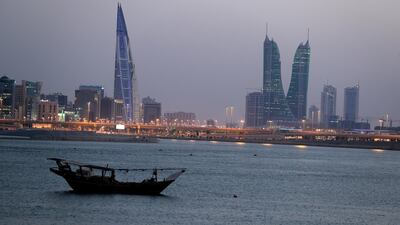
A view of Bahrain’s financial district in the capital city of Manama. Bahrain and Dubai have issued dual tranche bonds and sukuk this year, says Lootah Global Capital's Lim Say Cheong. Reuters

How can sukuk issuers become more relevant in global capital markets?


  • English
  • Arabic

Over a 10-year period between 2009 and 2019, the annual growth rate of sukuk in terms of issuance volume has outstripped conventional bonds. Global sukuk registered a 5.2 per cent compound annual growth rate, compared to 2.3 per cent for conventional bonds. Annual growth rates alone do not convey the full story, though, as the conventional bond market towers over the sukuk market in volume terms.

The global bond market stood at $170 trillion at the end of last year, compared to $490 billion of global sukuk. A quick push of the calculator's buttons shows that the sukuk market is a paltry 0.3 per cent of the conventional bond market, although this is hardly an equitable comparison given the much longer history of conventional bonds and their universal appeal.

While bonds are accepted in every corner of the world, including in the core Islamic finance countries, sukuk remains heavily concentrated in Gulf Cooperation Council countries, Malaysia, Turkey and Indonesia. This brings a sense of reality that for all the much-touted phenomenal growth in Islamic finance, the sukuk market lags far behind conventional bonds, both in terms of issuance volumes and global acceptance.

The sukuk market represents roughly 20 percent of total Islamic finance assets of $2.4tn as of 2019. This is certainly a respectable achievement given that it stood at $25bn in 1995. However, after 25 years, Islamic banking assets continue to dominate the Islamic finance landscape, with a 72 percent share of the industry. Putting this into context, the global conventional bond market is already larger than the total global banking assets. Sukuk clearly has a very high mountain to climb to catch up and with rapid advancements in the technology and digital space, as well as in ESG investing there is a real danger the sukuk market could lose momentum and end up consigned to the margins of the financial markets.

The dual shock of lower oil prices and the economic crisis triggered by the Covid-19 pandemic has dampened sukuk issuance volumes so far this year. Core Islamic finance countries have either not tapped the sukuk market or opted for conventional bonds instead. GCC states have largely given sukuk a miss, with only Dubai and Bahrain issuing sukuk alongside bonds in dual tranche offerings. Between April and September, a total of $34bn in sovereign bonds were raised from the GCC. During the same period, only $2bn worth of sovereign sukuk were sold. Given the difference in these amounts, it is hard not to think of this as a lost opportunity for the sukuk market and the Islamic finance industry.

However, all is not lost as there have been positive developments in the form of the local currency sukuk and green sukuk issuance, as well as advancements in financial technology that could promote sukuk adoption.

Domestic sukuk issuance in Saudi Arabia increased by 45 percent year-on-year to 84 billion Saudi riyals ($22.4bn) in the first nine months of the year, according to Moody’s Investors Service. The government’s efforts to promote a more vibrant local currency sukuk market has yielded results. More efforts are needed to maintain and increase momentum but the Saudi domestic sukuk market seems to be heading in the right direction. The successful development of the domestic market in Saudi Arabia may also spur other GCC states to develop their own local currency sukuk markets.

Another bright spot in Islamic finance is the growth of green sukuk – Sharia-compliant instruments for financing environmentally sustainable projects such as the development of solar plants and other renewable energy schemes.

Green sukuk seems to be gaining traction in the GCC. In May last year, Majid Al Futtaim became the first corporate entity from the GCC to complete a benchmark green sukuk with a $600m ten-year fixed rate issuance and in November, the Islamic Development Bank raised €1bn ($1.19bn) through a five-year green sukuk. More recently, Saudi Electricity Company sold $650m of green sukuk to finance the company’s existing and future green projects.

Islamic FinTech, though still nascent, has the potential to boost Islamic finance growth. The UK currently has the most Sharia-compliant FinTech startups ahead of core Islamic finance countries such as Malaysia, the UAE and Indonesia. Looking further ahead, the growing Muslim population in Europe offers significant opportunities for Islamic challenger banks and FinTech startups. Islamic peer-to-peer (P2P) financing and crowdfunding platforms targeting small and medium-sized enterprises (SMEs) have also emerged in the UK.

In Indonesia, an Islamic microfinance cooperative recently transacted the first ever micro-sukuk through a public blockchain platform. The industry is also looking towards Islamic financial institutions to lead the way by incorporating ESG elements in their business practices with a view to attracting a wave of interest in more ethical investment from conventional customers.

Islamic finance players hope these developments will help the industry to gain the momentum needed to achieve the forecast of $3.8bn of total assets by 2022, as projected by Thomson Reuters.

Lim Say Cheong is chief executive of Lootah Global Capital, a member of The Gulf Bond and Sukuk Association


A meeting of young minds

The 3,494 entries for the 2019 Sharjah Children Biennial come from:

435 – UAE

2,000 – China

808 – United Kingdom

165 – Argentina

38 – Lebanon

16 – Saudi Arabia

16 – Bangladesh

6 – Ireland

3 – Egypt

3 – France

2 – Sudan

1 – Kuwait

1 – Australia
 

COMPANY PROFILE

Name: Grubtech

Founders: Mohamed Al Fayed and Mohammed Hammedi

Launched: October 2019

Employees: 50

Financing stage: Seed round (raised $2 million)


Timeline

2012-2015

The company offers payments/bribes to win key contracts in the Middle East

May 2017

The UK SFO officially opens investigation into Petrofac’s use of agents, corruption, and potential bribery to secure contracts

September 2021

Petrofac pleads guilty to seven counts of failing to prevent bribery under the UK Bribery Act

October 2021

Court fines Petrofac £77 million for bribery. Former executive receives a two-year suspended sentence 

December 2024

Petrofac enters into comprehensive restructuring to strengthen the financial position of the group

May 2025

The High Court of England and Wales approves the company’s restructuring plan

July 2025

The Court of Appeal issues a judgment challenging parts of the restructuring plan

August 2025

Petrofac issues a business update to execute the restructuring and confirms it will appeal the Court of Appeal decision

October 2025

Petrofac loses a major TenneT offshore wind contract worth €13 billion. Holding company files for administration in the UK. Petrofac delisted from the London Stock Exchange

November 2025

180 Petrofac employees laid off in the UAE

UAE currency: the story behind the money in your pockets
Friday's schedule in Madrid

Men's quarter-finals

Novak Djokivic (1) v Marin Cilic (9) from 2pm UAE time

Roger Federer (4) v Dominic Thiem (5) from 7pm

Stefanos Tsitsipas (8) v Alexander Zverev (3) from 9.30pm

Stan Wawrinka v Rafael Nadal (2) from 11.30pm

Women's semi-finals

Belinda Bencic v Simona Halep (3) from 4.30pm

Sloane Stephens (8) v Kiki Bertens (7) from 10pm

Skoda Superb Specs

Engine: 2-litre TSI petrol

Power: 190hp

Torque: 320Nm

Price: From Dh147,000

Available: Now

The specs

Engine: 2.0-litre four-cylinder turbo

Power: 268hp at 5,600rpm

Torque: 380Nm at 4,800rpm

Transmission: CVT auto

Fuel consumption: 9.5L/100km

On sale: now

Price: from Dh195,000 

Takreem Awards winners 2021

Corporate Leadership: Carl Bistany (Lebanon)

Cultural Excellence: Hoor Al Qasimi (UAE)

Environmental Development and Sustainability: Bkerzay (Lebanon)

Environmental Development and Sustainability: Raya Ani (Iraq)

Humanitarian and Civic Services: Women’s Programs Association (Lebanon)

Humanitarian and Civic Services: Osamah Al Thini (Libya)

Excellence in Education: World Innovation Summit for Education (WISE) (Qatar)

Outstanding Arab Woman: Balghis Badri (Sudan)

Scientific and Technological Achievement: Mohamed Slim Alouini (KSA)

Young Entrepreneur: Omar Itani (Lebanon)

Lifetime Achievement: Suad Al Amiry (Palestine)

How to apply for a drone permit
  • Individuals must register on UAE Drone app or website using their UAE Pass
  • Add all their personal details, including name, nationality, passport number, Emiratis ID, email and phone number
  • Upload the training certificate from a centre accredited by the GCAA
  • Submit their request
What are the regulations?
  • Fly it within visual line of sight
  • Never over populated areas
  • Ensure maximum flying height of 400 feet (122 metres) above ground level is not crossed
  • Users must avoid flying over restricted areas listed on the UAE Drone app
  • Only fly the drone during the day, and never at night
  • Should have a live feed of the drone flight
  • Drones must weigh 5 kg or less
Cricket World Cup League 2

UAE results
Lost to Oman by eight runs
Beat Namibia by three wickets
Lost to Oman by 12 runs
Beat Namibia by 43 runs

UAE fixtures
Free admission. All fixtures broadcast live on icc.tv

Tuesday March 15, v PNG at Sharjah Cricket Stadium
Friday March 18, v Nepal at Dubai International Stadium
Saturday March 19, v PNG at Dubai International Stadium
Monday March 21, v Nepal at Dubai International Stadium

Profile

Co-founders of the company: Vilhelm Hedberg and Ravi Bhusari

Launch year: In 2016 ekar launched and signed an agreement with Etihad Airways in Abu Dhabi. In January 2017 ekar launched in Dubai in a partnership with the RTA.

Number of employees: Over 50

Financing stage: Series B currently being finalised

Investors: Series A - Audacia Capital 

Sector of operation: Transport

Conflict, drought, famine

Estimates of the number of deaths caused by the famine range from 400,000 to 1 million, according to a document prepared for the UK House of Lords in 2024.
It has been claimed that the policies of the Ethiopian government, which took control after deposing Emperor Haile Selassie in a military-led revolution in 1974, contributed to the scale of the famine.
Dr Miriam Bradley, senior lecturer in humanitarian studies at the University of Manchester, has argued that, by the early 1980s, “several government policies combined to cause, rather than prevent, a famine which lasted from 1983 to 1985. Mengistu’s government imposed Stalinist-model agricultural policies involving forced collectivisation and villagisation [relocation of communities into planned villages].
The West became aware of the catastrophe through a series of BBC News reports by journalist Michael Buerk in October 1984 describing a “biblical famine” and containing graphic images of thousands of people, including children, facing starvation.

Band Aid

Bob Geldof, singer with the Irish rock group The Boomtown Rats, formed Band Aid in response to the horrific images shown in the news broadcasts.
With Midge Ure of the band Ultravox, he wrote the hit charity single Do They Know it’s Christmas in December 1984, featuring a string of high-profile musicians.
Following the single’s success, the idea to stage a rock concert evolved.
Live Aid was a series of simultaneous concerts that took place at Wembley Stadium in London, John F Kennedy Stadium in Philadelphia, the US, and at various other venues across the world.
The combined event was broadcast to an estimated worldwide audience of 1.5 billion.