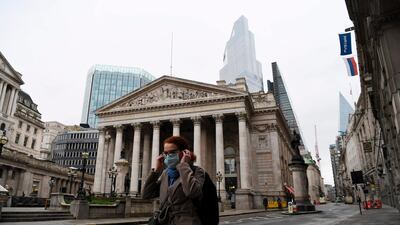
A pedestrian walks past the Bank of England in the City of London. The BoE has ensured the UK banking system “remains resilient” against any serious financial shocks and can continue lending to businesses and households. AFP
A pedestrian walks past the Bank of England in the City of London. The BoE has ensured the UK banking system “remains resilient” against any serious financial shocks and can continue lending to busine

Bank of England: Britain's banks can cope with double hit of Covid and no-deal Brexit


Alice Haine
  • English
  • Arabic

Britain’s biggest banks are strong enough to cope with the Covid-19 pandemic and a no-deal Brexit, the Bank of England concluded in its latest financial health check.

The regulator has ensured that the UK banking system “remains resilient” against any serious financial shocks and can continue to lend to businesses and households during the crisis and absorb any fallout from the risks of a bad exit from the EU.

“This reflects the build-up of substantial buffers of capital since the global financial crisis,” the bank’s Financial Policy Committee, which is tasked with protecting the financial system, said in a report on Friday.

The central bank said the countercyclical capital buffer – extra money banks set aside during good economic times – would be held at zero until at least the last quarter of 2021.

Banks would not need to act on any future changes until the end of 2022 and should use this flexibility to underpin lending to the rest of the economy.

“Cutting support to the economy to avoid the use of capital buffers would be costly for the wider economy and consequently for banks themselves,” the BoE said.

The UK’s economy has been hammered by the pandemic, with output contracting by 19.8 per cent in the second quarter of this year when the country went into lockdown.

Britain’s economy is expected to shrink by 11 per cent this year as a result of Covid-19, according to the BoE’s November forecast, and grow by 7.25 per cent next year, taking until the first three months of 2022 to return to its size before the pandemic.

UK finance minister Rishi Sunak said last month that unemployment is expected to peak at 7.5 per cent in the second quarter of next year.

While the BoE expects more “headwinds” in the coming quarters as unemployment, business insolvencies and risk weights on banks’ exposure increase, it said the country’s major banks were capable of absorbing £200 billion ($265bn) in credit losses.

However, those types of losses would involve “incredibly severe” shocks that are unlikely to occur, such as unemployment rising to 15 per cent or house prices falling by 30 per cent.

The unemployment rate hit 4.8 per cent in the three months through to September, while Britain's house prices are on their strongest run since 2004, increasing by 7.6 per cent in November compared with a month earlier.. The average home now sells for £253,000, according to Halifax's House Price Index.

While the regulator said financial services faced “some disruption” when the Brexit transition ends, the Financial Policy Committee said most risks to the country’s financial stability had already been “mitigated” due to extensive preparations made by authorities and the private sector over the years.

It also said that major banks such as HSBC and Barclays could cope with the fallout from Brexit even if there is no trade agreement in place.

“However, financial stability is not the same as market stability or the avoidance of any disruption to users of financial services," the BoE said.

"Some market volatility and disruption to financial services, particularly to EU-based clients, could arise.

"Market volatility could be reinforced in the event that some derivative users are not fully ready to trade with EU counterparties or on EU or EU-recognised trading venues. Financial institutions should continue taking measures to minimise disruption.”

Former BoE Monetary Policy Committee member Andrew Sentence told the BBC that the bank’s assessment of the economic outlook “makes sense”. However, he said that outside the financial system, a no-deal Brexit would pose big challenges.

“The real economy is going to struggle if we go into a Brexit no-deal,” he said.

The BoE's latest stamp of approval on the industry's financial health comes a day after it said lenders could resume dividends, ending a ban imposed in March to conserve capital during the first wave of the Covid-19 outbreak.

In August, the lender pared back its predictions for loan losses stemming from the pandemic.

The latest analysis comes before today's deadline set by Brexit negotiators to strike a deal amid worries that the talks will end in collapse.

The European Union is strengthening its no-deal contingency plans, while big banks in the City of London are moving hundreds of billions of dollars in assets to the bloc.

The BoE said it did not plan a post-Brexit relaxation of financial standards.

"Irrespective of the particular form of the UK's future relationship with the EU ... the Financial Policy Committee remains committed to the implementation of robust prudential standards in the UK," it said.

The BoE also said it would review the test that borrowers must pass if they want a mortgage, with the FPC recommending limits to the proportion of new mortgages with high loan-to-income ratios.

The lender first unveiled a tougher "affordability" test in 2014 to ensure borrowers do not become overly indebted.

With interest rates currently at record lows, banks have already been reining in high-loan-to-income mortgages since pandemic started, with the number of advertised mortgage products "materially lower" than the start of the year.


UAE SQUAD

Mohammed Naveed (captain), Mohamed Usman (vice captain), Ashfaq Ahmed, Chirag Suri, Shaiman Anwar, Mohammed Boota, Ghulam Shabber, Imran Haider, Tahir Mughal, Amir Hayat, Zahoor Khan, Qadeer Ahmed, Fahad Nawaz, Abdul Shakoor, Sultan Ahmed, CP Rizwan

Benefits of first-time home buyers' scheme
  • Priority access to new homes from participating developers
  • Discounts on sales price of off-plan units
  • Flexible payment plans from developers
  • Mortgages with better interest rates, faster approval times and reduced fees
  • DLD registration fee can be paid through banks or credit cards at zero interest rates
Ways to control drones

Countries have been coming up with ways to restrict and monitor the use of non-commercial drones to keep them from trespassing on controlled areas such as airports.

"Drones vary in size and some can be as big as a small city car - so imagine the impact of one hitting an airplane. It's a huge risk, especially when commercial airliners are not designed to make or take sudden evasive manoeuvres like drones can" says Saj Ahmed, chief analyst at London-based StrategicAero Research.

New measures have now been taken to monitor drone activity, Geo-fencing technology is one.

It's a method designed to prevent drones from drifting into banned areas. The technology uses GPS location signals to stop its machines flying close to airports and other restricted zones.

The European commission has recently announced a blueprint to make drone use in low-level airspace safe, secure and environmentally friendly. This process is called “U-Space” – it covers altitudes of up to 150 metres. It is also noteworthy that that UK Civil Aviation Authority recommends drones to be flown at no higher than 400ft. “U-Space” technology will be governed by a system similar to air traffic control management, which will be automated using tools like geo-fencing.

The UAE has drawn serious measures to ensure users register their devices under strict new laws. Authorities have urged that users must obtain approval in advance before flying the drones, non registered drone use in Dubai will result in a fine of up to twenty thousand dirhams under a new resolution approved by Sheikh Hamdan bin Mohammed, Crown Prince of Dubai.

Mr Ahmad suggest that "Hefty fines running into hundreds of thousands of dollars need to compensate for the cost of airport disruption and flight diversions to lengthy jail spells, confiscation of travel rights and use of drones for a lengthy period" must be enforced in order to reduce airport intrusion.

FIXTURES

December 28
Stan Wawrinka v Pablo Carreno Busta, 5pm
Milos Raonic v Dominic Thiem, no earlier then 7pm

December 29 - semi-finals
Rafael Nadal v Stan Wawrinka / Pablo Carreno Busta, 5pm
Novak Djokovic v Milos Raonic / Dominic Thiem, no earlier then 7pm

December 30
3rd/4th place play-off, 5pm
Final, 7pm

What went into the film

25 visual effects (VFX) studios

2,150 VFX shots in a film with 2,500 shots

1,000 VFX artists

3,000 technicians

10 Concept artists, 25 3D designers

New sound technology, named 4D SRL


Jigra
Director: Vasan Bala
Starring: Alia Bhatt, Vedang Raina, Manoj Pahwa, Harsh Singh
Rated: 3.5/5

Mercer, the investment consulting arm of US services company Marsh & McLennan, expects its wealth division to at least double its assets under management (AUM) in the Middle East as wealth in the region continues to grow despite economic headwinds, a company official said.

Mercer Wealth, which globally has $160 billion in AUM, plans to boost its AUM in the region to $2-$3bn in the next 2-3 years from the present $1bn, said Yasir AbuShaban, a Dubai-based principal with Mercer Wealth.

Within the next two to three years, we are looking at reaching $2 to $3 billion as a conservative estimate and we do see an opportunity to do so,” said Mr AbuShaban.

Mercer does not directly make investments, but allocates clients’ money they have discretion to, to professional asset managers. They also provide advice to clients.

“We have buying power. We can negotiate on their (client’s) behalf with asset managers to provide them lower fees than they otherwise would have to get on their own,” he added.

Mercer Wealth’s clients include sovereign wealth funds, family offices, and insurance companies among others.

From its office in Dubai, Mercer also looks after Africa, India and Turkey, where they also see opportunity for growth.

Wealth creation in Middle East and Africa (MEA) grew 8.5 per cent to $8.1 trillion last year from $7.5tn in 2015, higher than last year’s global average of 6 per cent and the second-highest growth in a region after Asia-Pacific which grew 9.9 per cent, according to consultancy Boston Consulting Group (BCG). In the region, where wealth grew just 1.9 per cent in 2015 compared with 2014, a pickup in oil prices has helped in wealth generation.

BCG is forecasting MEA wealth will rise to $12tn by 2021, growing at an annual average of 8 per cent.

Drivers of wealth generation in the region will be split evenly between new wealth creation and growth of performance of existing assets, according to BCG.

Another general trend in the region is clients’ looking for a comprehensive approach to investing, according to Mr AbuShaban.

“Institutional investors or some of the families are seeing a slowdown in the available capital they have to invest and in that sense they are looking at optimizing the way they manage their portfolios and making sure they are not investing haphazardly and different parts of their investment are working together,” said Mr AbuShaban.

Some clients also have a higher appetite for risk, given the low interest-rate environment that does not provide enough yield for some institutional investors. These clients are keen to invest in illiquid assets, such as private equity and infrastructure.

“What we have seen is a desire for higher returns in what has been a low-return environment specifically in various fixed income or bonds,” he said.

“In this environment, we have seen a de facto increase in the risk that clients are taking in things like illiquid investments, private equity investments, infrastructure and private debt, those kind of investments were higher illiquidity results in incrementally higher returns.”

The Abu Dhabi Investment Authority, one of the largest sovereign wealth funds, said in its 2016 report that has gradually increased its exposure in direct private equity and private credit transactions, mainly in Asian markets and especially in China and India. The authority’s private equity department focused on structured equities owing to “their defensive characteristics.”

Match info

Wolves 0

Arsenal 2 (Saka 43', Lacazette 85')

Man of the match: Shkodran Mustafi (Arsenal)

AI traffic lights to ease congestion at seven points to Sheikh Zayed bin Sultan Street

The seven points are:

Shakhbout bin Sultan Street

Dhafeer Street

Hadbat Al Ghubainah Street (outbound)

Salama bint Butti Street

Al Dhafra Street

Rabdan Street

Umm Yifina Street exit (inbound)