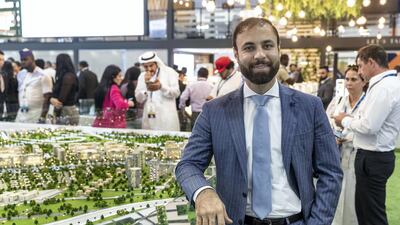
Farhad Azizi, chief executive of Azizi Developments at Cityscape Dubai last year. He is upbeat about a market recovery in early 2021. Antonie Robertson/The National

Azizi Developments sees Dubai property sector recovering in early 2021


Fareed Rahman
  • English
  • Arabic

Dubai developer Azizi expects the emirate’s property market to bounce back early next year, as it looks to raise $300 million (Dh1.1 billion) from a sukuk issue to finance its expansion.

Chief executive Farhad Azizi said there was an increase in the number of inquiries from potential buyers in Dubai.

“We are not just being optimistic out of thin air. We ... are hopeful that [the interest] will increase when it comes to September and October, when schools open.”

The developer claims to be selling five to six apartments a day, compared to just one apartment a week in March and April when movement restrictions to curb the spread of Covid-19 were at their peak.

Most of the buyers are residents but Mr Azizi said inquiries were coming in from Saudi Arabia, Nigeria, India and Pakistan.

Azizi Developments has 54 residential projects with a total investment of Dh5bn across the emirate in districts such as MBR City, Palm Jumeirah, Jebel Ali, Dubai Sports City and Dubai Healthcare City, among others. It plans to deliver 3,000 property units this year.

Mr Azizi said there was a lot of interest in mid-range properties that cost less than Dh1m.

“By next year, hopefully there will be a treatment for Covid-19 and things will come back to normality,” he said.

Expo 2020 Dubai, which was postponed to October next year, is also expected to contribute to the recovery of the property market, he said.

The developer “went through a big panic moment” at the onset of the pandemic, Mr Azizi said, reducing staff salaries by 25 per cent to preserve cash.

“We also reduced our expenses which were non-essential. We have not done layoffs and did not terminate staff.”

The developer recently began to hire staff as demand increased after movement restrictions were eased. It recruited 60 people last month and will hire another 40 by the end of July, Mr Azizi said.

It intends to invest Dh1bn in four new Dubai projects this year if demand continues to grow, and expand into Abu Dhabi where a Dh1bn residential project is on the cards. There are also plans to open an office by the end of this year in the capital.

Mr Azizi said the developer is looking to move into the contracting business, “at a level of managing subcontractors but not deep-diving to the smaller details.”

TTo fund its expansion, the company plans to raise $300m through a bond issuance, Mr Azizi said.

“People feel more comfortable investing in property than investing elsewhere,” he said. “[They] have fear of inflation [and] a fear of investing in the stock market or luxurious products which they may not use, but when it comes to a home, it is an asset they can use it the long term and it gives them a lot of comfort.”

The recent stimulus package announced by the UAE government will also help Dubai’s property sector to recover quickly, he said.

The Emirates introduced Dh256bn in stimulus measures to help offset the impact of Covid-19 on the economy.

The measures consist of zero interest funding to encourage banks to lend more.

The government also launched several other initiatives, including discounted utility bills and waivers of fees.

Dubai’s property market slowed, partly due to the drop in oil prices that began in 2014 and an excess supply of residential units.

The pandemic placed additional pressure on the sector as the number of on-site property viewings dwindled.

However, in an interview with Bloomberg last month, Damac Properties chairman Hussain Sajwani projected a recovery next year on the back of Expo 2020.

Last week, Rizwan Sajan, the chairman of Dubai's Danube Group, also sounded upbeat. He expects the temporary slowdown to lift once oil prices climb above $50 per barrel.

"This drop in oil prices can be ascribed to the world being under partial lockdown," he said. "So, the prices per barrel would soon go higher than $50 once [the] economy of each country is reinstated."

Brent, the international benchmark for crude, closed at $41.02 on Friday, while WTI, the gauge for US oil, closed at $38.49.


KINGDOM%20OF%20THE%20PLANET%20OF%20THE%20APES
%3Cp%3E%3Cstrong%3EDirector%3A%3C%2Fstrong%3E%20Wes%20Ball%3C%2Fp%3E%0A%3Cp%3E%3Cstrong%3EStarring%3A%3C%2Fstrong%3E%20Owen%20Teague%2C%20Freya%20Allen%2C%20Kevin%20Durand%3C%2Fp%3E%0A%3Cp%3E%3Cstrong%3ERating%3A%20%3C%2Fstrong%3E3.5%2F5%3C%2Fp%3E%0A
Profile of Tamatem

Date started: March 2013

Founder: Hussam Hammo

Based: Amman, Jordan

Employees: 55

Funding: $6m

Funders: Wamda Capital, Modern Electronics (part of Al Falaisah Group) and North Base Media

The Florida Project

Director: Sean Baker

Starring: Bria Vinaite, Brooklynn Prince, Willem Dafoe

Four stars

The biog

Favourite food: Tabbouleh, greek salad and sushi

Favourite TV show: That 70s Show

Favourite animal: Ferrets, they are smart, sensitive, playful and loving

Favourite holiday destination: Seychelles, my resolution for 2020 is to visit as many spiritual retreats and animal shelters across the world as I can

Name of first pet: Eddy, a Persian cat that showed up at our home

Favourite dog breed: I love them all - if I had to pick Yorkshire terrier for small dogs and St Bernard's for big

Ten tax points to be aware of in 2026

1. Domestic VAT refund amendments: request your refund within five years

If a business does not apply for the refund on time, they lose their credit.

2. E-invoicing in the UAE

Businesses should continue preparing for the implementation of e-invoicing in the UAE, with 2026 a preparation and transition period ahead of phased mandatory adoption. 

3. More tax audits

Tax authorities are increasingly using data already available across multiple filings to identify audit risks. 

4. More beneficial VAT and excise tax penalty regime

Tax disputes are expected to become more frequent and more structured, with clearer administrative objection and appeal processes. The UAE has adopted a new penalty regime for VAT and excise disputes, which now mirrors the penalty regime for corporate tax.

5. Greater emphasis on statutory audit

There is a greater need for the accuracy of financial statements. The International Financial Reporting Standards standards need to be strictly adhered to and, as a result, the quality of the audits will need to increase.

6. Further transfer pricing enforcement

Transfer pricing enforcement, which refers to the practice of establishing prices for internal transactions between related entities, is expected to broaden in scope. The UAE will shortly open the possibility to negotiate advance pricing agreements, or essentially rulings for transfer pricing purposes. 

7. Limited time periods for audits

Recent amendments also introduce a default five-year limitation period for tax audits and assessments, subject to specific statutory exceptions. While the standard audit and assessment period is five years, this may be extended to up to 15 years in cases involving fraud or tax evasion. 

8. Pillar 2 implementation 

Many multinational groups will begin to feel the practical effect of the Domestic Minimum Top-Up Tax (DMTT), the UAE's implementation of the OECD’s global minimum tax under Pillar 2. While the rules apply for financial years starting on or after January 1, 2025, it is 2026 that marks the transition to an operational phase.

9. Reduced compliance obligations for imported goods and services

Businesses that apply the reverse-charge mechanism for VAT purposes in the UAE may benefit from reduced compliance obligations. 

10. Substance and CbC reporting focus

Tax authorities are expected to continue strengthening the enforcement of economic substance and Country-by-Country (CbC) reporting frameworks. In the UAE, these regimes are increasingly being used as risk-assessment tools, providing tax authorities with a comprehensive view of multinational groups’ global footprints and enabling them to assess whether profits are aligned with real economic activity. 

Contributed by Thomas Vanhee and Hend Rashwan, Aurifer