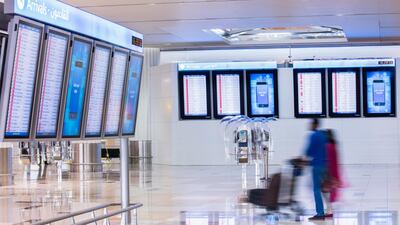
Passengers heading for Dubai can now be tested for Covid-19 at a greater number of facilities. Getty Images

Midde East air passenger traffic to more than halve this year due to virus, Iata says


Sarmad Khan
  • English
  • Arabic

Middle East air passenger traffic is expected to fall by about 56 per cent, or by more than 113 million passenger journeys, and demand is not expected to return to pre-coronavirus levels until 2024, the International Air Transport Association said in its revised five-year forecast.

Passenger demand, which is measured in revenue passenger kilometres – an industry metric that shows the distance travelled by paying passengers – is down by about 60 per cent, Muhammad Albakri, Iata’s regional vice president for Africa and the Middle East, told a virtual conference yesterday.

Globally, the number of flights fell by 50 per cent in late July, compared to the early January period. The number of flights dipped by 80 per cent in April – the lowest point so far.

In the Middle East, flights are currently down about 70 per cent, compared to the beginning of the year, Iata said.

“We [Middle Eastern airlines] are still struggling and recovery is quite slow in our region, compared to the global average,” Mr Albakri said.

Profit margins for aviation operators globally, including airlines in the region that have depended on premium travellers to fill first- and business-class seats, have come under severe stress.

Governments around the world are easing travel restrictions gradually as they reopen their economies. However, demand for travel has not picked up as fast as industry experts anticipated.

Operators in the Middle East are expected to suffer a cumulative loss of $4.8 billion (Dh17.61bn) this year. Asia Pacific will be the hardest hit worldwide, with airlines projected to lose $29bn, according to Iata.

Mr Albakri said this was among the reasons why “we continue as an association to advocate and to plead the case of airlines worldwide and, specifically in the Middle East, to governments to come forward and put on the table financial aid, tools and packages to help airlines”.

“They [airlines] have depleted all their cash reserves, and [rescue measures are needed] to protect them from going completely under [and] to protect all the associated jobs.”

Over the period through to 2025, Iata expects passenger numbers in the Middle East to grow by 1.6 per cent each year on average, which is slower than the growth figures before the pandemic and below the global average of 2.8 per cent.

The cumulative growth over the five-year period will result in 21 million additional journeys in 2025, compared to 2019 figures, it said.

However, the near-term outlook remains highly uncertain and the risks are “firmly on the downside over the next five years”, Mr Albakri said.

Iata also called on regional governments to harmonise biosafety measures for passengers across the region as aviation operations restart.

However, inconsistent testing procedures and border constraints in some countries have deterred passengers and hampered a quicker resumption of air travel in the wider region.

Twenty-eight countries in the Middle East still have quarantine measures in place while 80 per cent of passengers avoid travel to countries where such restrictions are in place, Iata said.

“Imposing quarantine measures on arriving passengers keeps countries in isolation and the travel and tourism sector in lockdown,” said Mr Albakri.

“We are proposing a framework with layers of protection to keep sick people from travelling and to mitigate the risk of transmission should a traveller discover they were infected after arrival.”


Who was Alfred Nobel?

The Nobel Prize was created by wealthy Swedish chemist and entrepreneur Alfred Nobel.

  • In his will he dictated that the bulk of his estate should be used to fund "prizes to those who, during the preceding year, have conferred the greatest benefit to humankind".
  • Nobel is best known as the inventor of dynamite, but also wrote poetry and drama and could speak Russian, French, English and German by the age of 17. The five original prize categories reflect the interests closest to his heart.
  • Nobel died in 1896 but it took until 1901, following a legal battle over his will, before the first prizes were awarded.
Long read

Mageed Yahia, director of WFP in UAE: Coronavirus knows no borders, and neither should the response

Mercer, the investment consulting arm of US services company Marsh & McLennan, expects its wealth division to at least double its assets under management (AUM) in the Middle East as wealth in the region continues to grow despite economic headwinds, a company official said.

Mercer Wealth, which globally has $160 billion in AUM, plans to boost its AUM in the region to $2-$3bn in the next 2-3 years from the present $1bn, said Yasir AbuShaban, a Dubai-based principal with Mercer Wealth.

Within the next two to three years, we are looking at reaching $2 to $3 billion as a conservative estimate and we do see an opportunity to do so,” said Mr AbuShaban.

Mercer does not directly make investments, but allocates clients’ money they have discretion to, to professional asset managers. They also provide advice to clients.

“We have buying power. We can negotiate on their (client’s) behalf with asset managers to provide them lower fees than they otherwise would have to get on their own,” he added.

Mercer Wealth’s clients include sovereign wealth funds, family offices, and insurance companies among others.

From its office in Dubai, Mercer also looks after Africa, India and Turkey, where they also see opportunity for growth.

Wealth creation in Middle East and Africa (MEA) grew 8.5 per cent to $8.1 trillion last year from $7.5tn in 2015, higher than last year’s global average of 6 per cent and the second-highest growth in a region after Asia-Pacific which grew 9.9 per cent, according to consultancy Boston Consulting Group (BCG). In the region, where wealth grew just 1.9 per cent in 2015 compared with 2014, a pickup in oil prices has helped in wealth generation.

BCG is forecasting MEA wealth will rise to $12tn by 2021, growing at an annual average of 8 per cent.

Drivers of wealth generation in the region will be split evenly between new wealth creation and growth of performance of existing assets, according to BCG.

Another general trend in the region is clients’ looking for a comprehensive approach to investing, according to Mr AbuShaban.

“Institutional investors or some of the families are seeing a slowdown in the available capital they have to invest and in that sense they are looking at optimizing the way they manage their portfolios and making sure they are not investing haphazardly and different parts of their investment are working together,” said Mr AbuShaban.

Some clients also have a higher appetite for risk, given the low interest-rate environment that does not provide enough yield for some institutional investors. These clients are keen to invest in illiquid assets, such as private equity and infrastructure.

“What we have seen is a desire for higher returns in what has been a low-return environment specifically in various fixed income or bonds,” he said.

“In this environment, we have seen a de facto increase in the risk that clients are taking in things like illiquid investments, private equity investments, infrastructure and private debt, those kind of investments were higher illiquidity results in incrementally higher returns.”

The Abu Dhabi Investment Authority, one of the largest sovereign wealth funds, said in its 2016 report that has gradually increased its exposure in direct private equity and private credit transactions, mainly in Asian markets and especially in China and India. The authority’s private equity department focused on structured equities owing to “their defensive characteristics.”

Company profile

Name:​ One Good Thing ​

Founders:​ Bridgett Lau and Micheal Cooke​

Based in:​ Dubai​​ 

Sector:​ e-commerce​

Size: 5​ employees

Stage: ​Looking for seed funding

Investors:​ ​Self-funded and seeking external investors

Mobile phone packages comparison
UAE currency: the story behind the money in your pockets