Live updates: Follow the latest on Israel-Gaza
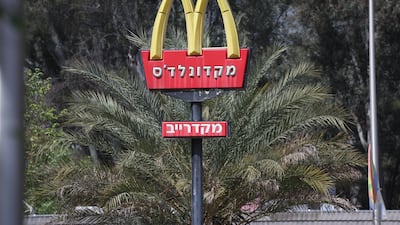
McDonald's has announced it will buy back its Israeli franchise Alonyal Limited, reclaiming its 225 restaurants in Israel after the franchise became a flashpoint at the start of the war in Gaza.
The company said the franchise's 5,000 employees will keep their jobs.
“For more than 30 years, Alonyal Limited has been proud to bring the Golden Arches to Israel and serve our communities,” said Omri Padan, Alonyal's chief executive and owner.
The fast food chain has faced protests and boycott calls after Alonyal claimed to have provided free meals to the Israeli military shortly after the October 7 attack by Hamas on southern Israel.
McDonald's Corporation said the Israeli franchise had acted without headquarters' approval.
McDonald's at the time rejected what it called “inaccurate reports” over its stance on Gaza. The company and its Middle East operators – including in the UAE, Saudi Arabia, Bahrain and Kuwait – said it was not supporting any governments in the conflict.
In a statement released on Thursday, McDonald's said it “remains committed to the Israeli market and to ensuring a positive employee and customer experience in the market going forward”.
“We thank Alonyal Limited for building the McDonald’s business and brand in Israel over the past 30 years,” said Jo Sempels, president of international developmental licensed markets at McDonald’s Corporation.
The conflict in the Middle East contributed to the US burger company missing its sales expectations in the fourth quarter last year.
But with more than 40,000 restaurants worldwide, the fate of the 225 locations in Israel “will likely not be a needle mover to the bottom line”, said Art Hogan, B Riley Wealth's chief market strategist.
“The company made the decision to try to remove the appearance politics out of their fast-food restaurants. The McDonald’s Corporation has been clear that it has never taken a position in this or any conflicts in the Middle East,” Mr Hogan told The National.
“As a template for other multinational franchise companies, McDonalds has just set the bar for appropriate behaviour.”
McDonald's said it had “nothing more to share beyond what’s been included in the press release” when asked if the agreement was because of sales in the region, or because of concerns that Alonyal was being too political.
Other US-based companies have faced similar protests and calls for boycotts over the war.
Coffee chain Starbucks, which has bumped down its annual sales forecast, has blamed “misrepresentation on social media” for the protests at its outlets.
The Seattle-based company was drawn into the debate over the Israel-Gaza war after one of its unions' social media posts expressing “solidarity” with Palestine was taken down.
Drinks giant Coca-Cola and pizza chain Dominos have also experienced protests and calls for boycotts.
In February, McDonald's chief executive Chris Kempczinski said the conflict was having a “meaningful” impact on some markets in the Middle East, as well as in Malaysia and Indonesia.
“Our outlook is, so long as this conflict, this war, is going on … we’re not expecting to see any significant improvement in this,” he said in a conference call.
McDonald's said the sale is subject to certain conditions and is expected to close in the coming months. It did not disclose the terms of the deal.
More than 33,000 people have been killed in Gaza since war broke out, according to local health authorities.
The UN food agency has warned that famine is imminent in northern Gaza. The same report found that half the Gaza population is experiencing “catastrophic food insecurity”.

Common OCD symptoms and how they manifest
Checking: the obsession or thoughts focus on some harm coming from things not being as they should, which usually centre around the theme of safety. For example, the obsession is “the building will burn down”, therefore the compulsion is checking that the oven is switched off.
Contamination: the obsession is focused on the presence of germs, dirt or harmful bacteria and how this will impact the person and/or their loved ones. For example, the obsession is “the floor is dirty; me and my family will get sick and die”, the compulsion is repetitive cleaning.
Orderliness: the obsession is a fear of sitting with uncomfortable feelings, or to prevent harm coming to oneself or others. Objectively there appears to be no logical link between the obsession and compulsion. For example,” I won’t feel right if the jars aren’t lined up” or “harm will come to my family if I don’t line up all the jars”, so the compulsion is therefore lining up the jars.
Intrusive thoughts: the intrusive thought is usually highly distressing and repetitive. Common examples may include thoughts of perpetrating violence towards others, harming others, or questions over one’s character or deeds, usually in conflict with the person’s true values. An example would be: “I think I might hurt my family”, which in turn leads to the compulsion of avoiding social gatherings.
Hoarding: the intrusive thought is the overvaluing of objects or possessions, while the compulsion is stashing or hoarding these items and refusing to let them go. For example, “this newspaper may come in useful one day”, therefore, the compulsion is hoarding newspapers instead of discarding them the next day.
Source: Dr Robert Chandler, clinical psychologist at Lighthouse Arabia
Killing of Qassem Suleimani
LUKA CHUPPI
Director: Laxman Utekar
Producer: Maddock Films, Jio Cinema
Cast: Kartik Aaryan, Kriti Sanon, Pankaj Tripathi, Vinay Pathak, Aparshakti Khurana
Rating: 3/5
COMPANY%20PROFILE
%3Cp%3E%3Cstrong%3EName%3A%3C%2Fstrong%3E%20PlanRadar%3Cbr%3E%3Cstrong%3EStarted%3A%20%3C%2Fstrong%3E2013%3Cbr%3E%3Cstrong%3ECo-founders%3A%20%3C%2Fstrong%3EIbrahim%20Imam%2C%20Sander%20van%20de%20Rijdt%2C%20Constantin%20K%C3%B6ck%2C%20Clemens%20Hammerl%2C%20Domagoj%20Dolinsek%3Cbr%3E%3Cstrong%3EBased%3A%20%3C%2Fstrong%3EVienna%2C%20Austria%3Cbr%3E%3Cstrong%3ESector%3A%20%3C%2Fstrong%3EConstruction%20and%20real%20estate%3Cbr%3E%3Cstrong%3ECurrent%20number%20of%20staff%3A%20%3C%2Fstrong%3E400%2B%3Cbr%3E%3Cstrong%3EInvestment%20stage%3A%20%3C%2Fstrong%3ESeries%20B%3Cbr%3E%3Cstrong%3EInvestors%3A%3C%2Fstrong%3E%20Headline%2C%20Berliner%20Volksbank%20Ventures%2C%20aws%20Gr%C3%BCnderfonds%2C%20Cavalry%20Ventures%2C%20Proptech1%2C%20Russmedia%2C%20GR%20Capital%3C%2Fp%3E%0A
Visit Abu Dhabi culinary team's top Emirati restaurants in Abu Dhabi
Yadoo’s House Restaurant & Cafe
For the karak and Yoodo's house platter with includes eggs, balaleet, khamir and chebab bread.
Golden Dallah
For the cappuccino, luqaimat and aseeda.
Al Mrzab Restaurant
For the shrimp murabian and Kuwaiti options including Kuwaiti machboos with kebab and spicy sauce.
Al Derwaza
For the fish hubul, regag bread, biryani and special seafood soup.
The story of Edge
Sheikh Mohamed bin Zayed, Crown Prince of Abu Dhabi and Deputy Supreme Commander of the Armed Forces, established Edge in 2019.
It brought together 25 state-owned and independent companies specialising in weapons systems, cyber protection and electronic warfare.
Edge has an annual revenue of $5 billion and employs more than 12,000 people.
Some of the companies include Nimr, a maker of armoured vehicles, Caracal, which manufactures guns and ammunitions company, Lahab
Tamkeen's offering
- Option 1: 70% in year 1, 50% in year 2, 30% in year 3
- Option 2: 50% across three years
- Option 3: 30% across five years
The burning issue
The internal combustion engine is facing a watershed moment – major manufacturer Volvo is to stop producing petroleum-powered vehicles by 2021 and countries in Europe, including the UK, have vowed to ban their sale before 2040. The National takes a look at the story of one of the most successful technologies of the last 100 years and how it has impacted life in the UAE.
Read part four: an affection for classic cars lives on
Read part three: the age of the electric vehicle begins
Read part one: how cars came to the UAE
UAE currency: the story behind the money in your pockets
