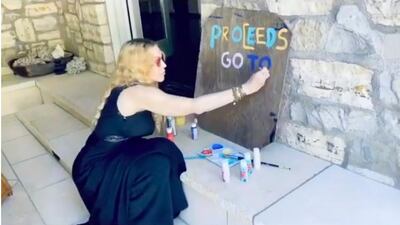
Singer Madonna has raised money and awareness for the NGO Impact Lebanon. Instagram / Madonna

Madonna hosts family art sale to raise money for Lebanese charity following Beirut explosion


Farah Andrews
  • English
  • Arabic

Madonna hosted an art sale to raise money to donate to Lebanon. Together with two of her children, David Banda and Mercy James, the singer is selling art with the proceeds going to Impact Lebanon, a foundation working to support victims of the Beirut explosion.

In videos and images shared to the Material Girl's Instagram Stories, she can be seen painting a sign that reads, "Proceeds go to Impact Lebanon".

Madonna paints a sign for her family's art sale, which is raising money for Impact Lebanon. Instagram / Madonna

At the time of writing, the Beirut port blast on Tuesday, August 4, has killed more than 170 people, injured thousands and left up to 300,000 homeless. Following the disaster, the government of Prime Minister Hassan Diab resigned on Monday, August 10.

Impact Lebanon is a non-profit organisation that has been helping victims of the deadly blast.

"From looking at the horrific videos of the blast, we knew that the destruction was massive and we needed to mobilise as many resources as possible to meet the growing needs on the ground as they became more evident," the NGO's website reads. "Our commitment to transparency and accountability is our core value."

Madonna has posted photos of two of her children, David Banda and Mercy James, with works of art they are selling to raise money for Impact Lebanon. Instagram / Madonna

Mercy James, 14, was seen posing with tie-dyed T-shirts, while David Banda, also 14, posed with a portrait of an unidentified person, whose face is obscured by small hand prints. She also shared a floral piece that read, "E & S Love Chains", presumably in reference to her 7-year-old twin daughters, Estere and Stella Ciccone.

Madonna is not the only star who has drawn attention to the work of Impact Lebanon.

Dutch-Palestinian model Bella Hadid shared a list of ways to donate to people in the country following the disaster, including Impact Lebanon, as well as the Lebanese Red Cross, Bank to School and Bassma, among the foundations.

Hadid posted a viral video of an older Lebanese woman playing the piano amid the destruction and rubble in her home.

She captioned the video with a heartfelt message that read: “My eyes and heart are crying for you Lebanon … I am sorry you have to endure this kind of disaster my brothers and sisters … I will be sending donations to the Lebanese Red Cross, as well as all of the smaller organisations in Beirut.”

George and Amal Clooney have donated $100,000 (Dh367,000) to three charities in Lebanon, one of which is Impact Lebanon. Amal is a British-Lebanese human rights lawyer who was born in Beirut.

In a statement shared with People, the couple said: "We're both deeply concerned for the people of Beirut and the devastation they've faced in the last few days. Three charitable organisations we've found are providing essential relief on the ground: the Lebanese Red Cross, Impact Lebanon, and Baytna Baytak."


Ten tax points to be aware of in 2026

1. Domestic VAT refund amendments: request your refund within five years

If a business does not apply for the refund on time, they lose their credit.

2. E-invoicing in the UAE

Businesses should continue preparing for the implementation of e-invoicing in the UAE, with 2026 a preparation and transition period ahead of phased mandatory adoption. 

3. More tax audits

Tax authorities are increasingly using data already available across multiple filings to identify audit risks. 

4. More beneficial VAT and excise tax penalty regime

Tax disputes are expected to become more frequent and more structured, with clearer administrative objection and appeal processes. The UAE has adopted a new penalty regime for VAT and excise disputes, which now mirrors the penalty regime for corporate tax.

5. Greater emphasis on statutory audit

There is a greater need for the accuracy of financial statements. The International Financial Reporting Standards standards need to be strictly adhered to and, as a result, the quality of the audits will need to increase.

6. Further transfer pricing enforcement

Transfer pricing enforcement, which refers to the practice of establishing prices for internal transactions between related entities, is expected to broaden in scope. The UAE will shortly open the possibility to negotiate advance pricing agreements, or essentially rulings for transfer pricing purposes. 

7. Limited time periods for audits

Recent amendments also introduce a default five-year limitation period for tax audits and assessments, subject to specific statutory exceptions. While the standard audit and assessment period is five years, this may be extended to up to 15 years in cases involving fraud or tax evasion. 

8. Pillar 2 implementation 

Many multinational groups will begin to feel the practical effect of the Domestic Minimum Top-Up Tax (DMTT), the UAE's implementation of the OECD’s global minimum tax under Pillar 2. While the rules apply for financial years starting on or after January 1, 2025, it is 2026 that marks the transition to an operational phase.

9. Reduced compliance obligations for imported goods and services

Businesses that apply the reverse-charge mechanism for VAT purposes in the UAE may benefit from reduced compliance obligations. 

10. Substance and CbC reporting focus

Tax authorities are expected to continue strengthening the enforcement of economic substance and Country-by-Country (CbC) reporting frameworks. In the UAE, these regimes are increasingly being used as risk-assessment tools, providing tax authorities with a comprehensive view of multinational groups’ global footprints and enabling them to assess whether profits are aligned with real economic activity. 

Contributed by Thomas Vanhee and Hend Rashwan, Aurifer

Feeding the thousands for iftar

Six industrial scale vats of 500litres each are used to cook the kanji or broth 

Each vat contains kanji or porridge to feed 1,000 people

The rice porridge is poured into a 500ml plastic box

350 plastic tubs are placed in one container trolley

Each aluminium container trolley weighing 300kg is unloaded by a small crane fitted on a truck