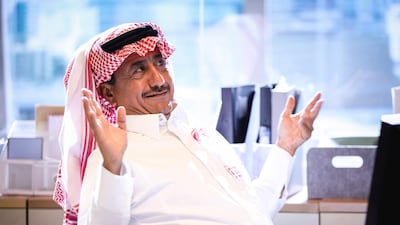
The future of Arabic-language cinema and television is in Saudi Arabia, according to one of the kingdom’s leading actors.
Nasser Al Qasabi, known for his seminal television shows Tash Ma Tash and Selfie, posted this message on Twitter this week, triggering a spirited discussion with Saudi followers and cultural figures.
In a thread that is both whimsical and optimistic, he predicted that within the next 20 to 30 years, Saudi Arabia will be leading the Middle East’s film and TV scene, in the way that Egypt, Lebanon and Syria have done over the past century.
The reason for his confidence, he said, is down to the bold vision laid out by Saudi Arabia's Minister of Culture Prince Badr bin Abdullah bin Farhan for evolving the kingdom's creative industries.
Al Qasabi suggested that if the country's music artists and composers had already achieved regional popularity without official governmental support, the future is bright for film and TV creatives as the nation attempts to position itself as a regional production hub.
“Due to individual creativity, Saudi music has been able during the past 50 years (by self-effort) to achieve milestones and reach the Arab listener, unlike theatre and television drama, which has remained weak,” he wrote.
“And, as Egyptian cinema dominated throughout the last century, Lebanese TV drama shone during the '60s and '70s, and Syrian drama flourished in the '90s, I see Saudi drama will be the most prominent and dominating the Arab street in the '40s and '50s of this century.”
Local and timely content
Al Qasabi's tweets set off a flurry of debate, with more than 300 posts discussing ways to elevate Saudi Arabia's entertainment industry.
Saudi actor Badr Khaled saluted his colleague's optimism. "God willing, it will come true," he said. "With our leader, the change and the renewed revival is possible."
Meanwhile, Saudi cultural commentator Abdul Rahman Al Naser said Al Qasabi's vision doesn’t go far enough.
“Long years away and an alarming distance of time,” he said. “Let us dream in the present rather than the future.”
Some of the more insightful commentary came from Al Qasabi’s Saudi followers, who provided suggestions for improving the quality of content created in the kingdom.
“Saudi cinema and television cannot develop without making plans and not following through on them,” said Nouf, a self-described film and book lover.
“We need batches of trained actors to create new characters with different personalities. The reason why Egyptian and Lebanese cinema and television succeed is due to their arts institutes and inquiry into the art form. The Saudi drama remains unfocused.”
Twitter user Neiallo stated that for Saudi Arabian productions to resonate with viewers, the material needs to be polished and timely.
“In order for the Saudi drama to succeed, we must return to reality (based stories),” she said. “Most successful global productions are fictional and this requires enormous (financial and creative) resources. This is difficult at the present time, but returning to reality – local and folk stories – is a fertile field for creative Saudi drama.”
Education at the heart
Al Qasabi's initial tweet was inspired by the Saudi Culture Minister's column for Arabic newspaper Asharq Al Awsat, where he laid out his plans to strengthen the industry output, both quantitative and qualitative, as part of the Saudi Vision 2030 strategy.
Education, said Prince Badr, will be at the forefront when it comes to raising the next generation of Saudi creatives.
“We are also working on the 'learn for life' policy that aims to develop cultural capabilities,” he said.
“The effort is taking place in cooperation with several partners in all fields and cultural bodies will indeed march forward to continue to create teaching and training opportunities in all cultural specialties in order to develop the rich talents in our country and offer the highest quality options to our citizens.”

Command%20Z
%3Cp%3E%3Cstrong%3EDirector%3A%C2%A0%3C%2Fstrong%3ESteven%20Soderbergh%3C%2Fp%3E%0A%3Cp%3E%3Cstrong%3EStars%3A%C2%A0%3C%2Fstrong%3EMichael%20Cera%2C%20Liev%20Schreiber%2C%20Chloe%20Radcliffe%3C%2Fp%3E%0A%3Cp%3E%3Cstrong%3ERating%3A%3C%2Fstrong%3E%C2%A03%2F5%3C%2Fp%3E%0A
Milestones on the road to union
1970
October 26: Bahrain withdraws from a proposal to create a federation of nine with the seven Trucial States and Qatar.
December: Ahmed Al Suwaidi visits New York to discuss potential UN membership.
1971
March 1: Alex Douglas Hume, Conservative foreign secretary confirms that Britain will leave the Gulf and “strongly supports” the creation of a Union of Arab Emirates.
July 12: Historic meeting at which Sheikh Zayed and Sheikh Rashid make a binding agreement to create what will become the UAE.
July 18: It is announced that the UAE will be formed from six emirates, with a proposed constitution signed. RAK is not yet part of the agreement.
August 6: The fifth anniversary of Sheikh Zayed becoming Ruler of Abu Dhabi, with official celebrations deferred until later in the year.
August 15: Bahrain becomes independent.
September 3: Qatar becomes independent.
November 23-25: Meeting with Sheikh Zayed and Sheikh Rashid and senior British officials to fix December 2 as date of creation of the UAE.
November 29: At 5.30pm Iranian forces seize the Greater and Lesser Tunbs by force.
November 30: Despite a power sharing agreement, Tehran takes full control of Abu Musa.
November 31: UK officials visit all six participating Emirates to formally end the Trucial States treaties
December 2: 11am, Dubai. New Supreme Council formally elects Sheikh Zayed as President. Treaty of Friendship signed with the UK. 11.30am. Flag raising ceremony at Union House and Al Manhal Palace in Abu Dhabi witnessed by Sheikh Khalifa, then Crown Prince of Abu Dhabi.
December 6: Arab League formally admits the UAE. The first British Ambassador presents his credentials to Sheikh Zayed.
December 9: UAE joins the United Nations.
WHAT%20ARE%20THE%20PRODUCTS%20WITHIN%20THE%20THREE%20MAJOR%20CATEGORIES%3F
%3Cp%3E%3Cstrong%3EAdvanced%20materials%3A%3C%2Fstrong%3E%20specifically%20engineered%20to%20exhibit%20novel%20or%20enhanced%20properties%2C%20that%20confer%20superior%20performance%20relative%20to%20conventional%20materials%3C%2Fp%3E%0A%3Cp%3E%3Cstrong%3EAdvanced%20components%3A%3C%2Fstrong%3E%20includes%20semiconductor%20components%2C%20such%20as%20microprocessors%20and%20other%20computer%20chips%2C%20and%20computer%20vision%20components%20such%20as%20lenses%20and%20image%20sensors%3C%2Fp%3E%0A%3Cp%3E%3Cstrong%3EAdvanced%20products%3A%3C%2Fstrong%3E%20includes%20personal%20electronics%2C%20smart%20home%20devices%20and%20space%20technologies%2C%20along%20with%20industry-enabling%20products%20such%20as%20robots%2C%203D%20printing%20equipment%20and%20exoskeletons%3C%2Fp%3E%0A%3Cp%3E%3Cem%3ESource%3A%20Strategy%26amp%3B%3C%2Fem%3E%3C%2Fp%3E%0A
SECRET%20INVASION
%3Cp%3E%3Cstrong%3EDirector%3A%3C%2Fstrong%3E%20Ali%20Selim%20%3Cbr%3E%3Cstrong%3EStars%3A%3C%2Fstrong%3E%20Samuel%20L%20Jackson%2C%20Olivia%20Coleman%2C%20Kingsley%20Ben-Adir%2C%20Emilia%20Clarke%20%3Cbr%3E%3Cstrong%3ERating%3A%3C%2Fstrong%3E%203%2F5%26nbsp%3B%3C%2Fp%3E%0A
The specs
Engine: 2.0-litre 4-cylturbo
Transmission: seven-speed DSG automatic
Power: 242bhp
Torque: 370Nm
Price: Dh136,814
Mercer, the investment consulting arm of US services company Marsh & McLennan, expects its wealth division to at least double its assets under management (AUM) in the Middle East as wealth in the region continues to grow despite economic headwinds, a company official said.
Mercer Wealth, which globally has $160 billion in AUM, plans to boost its AUM in the region to $2-$3bn in the next 2-3 years from the present $1bn, said Yasir AbuShaban, a Dubai-based principal with Mercer Wealth.
“Within the next two to three years, we are looking at reaching $2 to $3 billion as a conservative estimate and we do see an opportunity to do so,” said Mr AbuShaban.
Mercer does not directly make investments, but allocates clients’ money they have discretion to, to professional asset managers. They also provide advice to clients.
“We have buying power. We can negotiate on their (client’s) behalf with asset managers to provide them lower fees than they otherwise would have to get on their own,” he added.
Mercer Wealth’s clients include sovereign wealth funds, family offices, and insurance companies among others.
From its office in Dubai, Mercer also looks after Africa, India and Turkey, where they also see opportunity for growth.
Wealth creation in Middle East and Africa (MEA) grew 8.5 per cent to $8.1 trillion last year from $7.5tn in 2015, higher than last year’s global average of 6 per cent and the second-highest growth in a region after Asia-Pacific which grew 9.9 per cent, according to consultancy Boston Consulting Group (BCG). In the region, where wealth grew just 1.9 per cent in 2015 compared with 2014, a pickup in oil prices has helped in wealth generation.
BCG is forecasting MEA wealth will rise to $12tn by 2021, growing at an annual average of 8 per cent.
Drivers of wealth generation in the region will be split evenly between new wealth creation and growth of performance of existing assets, according to BCG.
Another general trend in the region is clients’ looking for a comprehensive approach to investing, according to Mr AbuShaban.
“Institutional investors or some of the families are seeing a slowdown in the available capital they have to invest and in that sense they are looking at optimizing the way they manage their portfolios and making sure they are not investing haphazardly and different parts of their investment are working together,” said Mr AbuShaban.
Some clients also have a higher appetite for risk, given the low interest-rate environment that does not provide enough yield for some institutional investors. These clients are keen to invest in illiquid assets, such as private equity and infrastructure.
“What we have seen is a desire for higher returns in what has been a low-return environment specifically in various fixed income or bonds,” he said.
“In this environment, we have seen a de facto increase in the risk that clients are taking in things like illiquid investments, private equity investments, infrastructure and private debt, those kind of investments were higher illiquidity results in incrementally higher returns.”
The Abu Dhabi Investment Authority, one of the largest sovereign wealth funds, said in its 2016 report that has gradually increased its exposure in direct private equity and private credit transactions, mainly in Asian markets and especially in China and India. The authority’s private equity department focused on structured equities owing to “their defensive characteristics.”
Wallabies
Updated team: 15-Israel Folau, 14-Dane Haylett-Petty, 13-Reece Hodge, 12-Matt Toomua, 11-Marika Koroibete, 10-Kurtley Beale, 9-Will Genia, 8-Pete Samu, 7-Michael Hooper (captain), 6-Lukhan Tui, 5-Adam Coleman, 4-Rory Arnold, 3-Allan Alaalatoa, 2-Tatafu Polota-Nau, 1-Scott Sio.
Replacements: 16-Folau Faingaa, 17-Tom Robertson, 18-Taniela Tupou, 19-Izack Rodda, 20-Ned Hanigan, 21-Joe Powell, 22-Bernard Foley, 23-Jack Maddocks.
RESULTS
%3Cp%3E%0D5pm%3A%20Al%20Bateen%20%E2%80%93%20Maiden%20(PA)%20Dh80%2C000%20(Turf)%202%2C200m%0D%3Cbr%3EWinner%3A%20Ma%E2%80%99Aly%20Al%20Shahania%2C%20Bernardo%20Pinheiro%20(jockey)%2C%20Mohamed%20Daggash%20(trainer)%0D%3Cbr%3E5.30pm%3A%20Al%20Khaleej%20%E2%80%93%20Maiden%20(PA)%20Dh80%2C000%20(T)%201%2C400m%0D%3Cbr%3EWinner%3A%20AF%20Rami%2C%20Tadhg%20O%E2%80%99Shea%2C%20Ernst%20Oertel%0D%3Cbr%3E6pm%3A%20Wathba%20Stallions%20Cup%20%E2%80%93%20Handicap%20(PA)%20Dh70%2C000%20(T)%201%2C400m%0D%3Cbr%3EWinner%3A%20Bant%20Al%20Emarat%2C%20Bernardo%20Pinheiro%2C%20Qaiss%20Aboud%0D%3Cbr%3E6.30pm%3A%20Al%20Nahyan%20%E2%80%93%20Handicap%20(PA)%20Dh80%2C000%20(T)%201%2C600m%0D%3Cbr%3EWinner%3A%20AF%20Rasam%2C%20Marcelino%20Rodrigues%2C%20Ernst%20Oertel%0D%3Cbr%3E7pm%3A%20Al%20Karamah%20%E2%80%93%20Handicap%20(PA)%20Dh80%2C000%20(T)%201%2C600m%0D%3Cbr%3EWinner%3A%20Zafaranah%2C%20Bernardo%20Pinheiro%2C%20Musabah%20Al%20Muhairi%0D%3Cbr%3E7.30pm%3A%20Al%20Salam%20%E2%80%93%20Handicap%20(TB)%20Dh80%2C000%20(T)%201%2C400m%0D%3Cbr%3EWinner%3A%20Nibras%20Passion%2C%20Tadhg%20O%E2%80%99Shea%2C%20Ismail%20Mohammed%3C%2Fp%3E%0A
Key products and UAE prices
iPhone XS
With a 5.8-inch screen, it will be an advance version of the iPhone X. It will be dual sim and comes with better battery life, a faster processor and better camera. A new gold colour will be available.
Price: Dh4,229
iPhone XS Max
It is expected to be a grander version of the iPhone X with a 6.5-inch screen; an inch bigger than the screen of the iPhone 8 Plus.
Price: Dh4,649
iPhone XR
A low-cost version of the iPhone X with a 6.1-inch screen, it is expected to attract mass attention. According to industry experts, it is likely to have aluminium edges instead of stainless steel.
Price: Dh3,179
Apple Watch Series 4
More comprehensive health device with edge-to-edge displays that are more than 30 per cent bigger than displays on current models.
Gender pay parity on track in the UAE
The UAE has a good record on gender pay parity, according to Mercer's Total Remuneration Study.
"In some of the lower levels of jobs women tend to be paid more than men, primarily because men are employed in blue collar jobs and women tend to be employed in white collar jobs which pay better," said Ted Raffoul, career products leader, Mena at Mercer. "I am yet to see a company in the UAE – particularly when you are looking at a blue chip multinationals or some of the bigger local companies – that actively discriminates when it comes to gender on pay."
Mr Raffoul said most gender issues are actually due to the cultural class, as the population is dominated by Asian and Arab cultures where men are generally expected to work and earn whereas women are meant to start a family.
"For that reason, we see a different gender gap. There are less women in senior roles because women tend to focus less on this but that’s not due to any companies having a policy penalising women for any reasons – it’s a cultural thing," he said.
As a result, Mr Raffoul said many companies in the UAE are coming up with benefit package programmes to help working mothers and the career development of women in general.
Abu Dhabi Sustainability Week
SUZUME
%3Cp%3EDirector%3A%20Makoto%20Shinkai%3C%2Fp%3E%0A%3Cp%3EStars%3A%20Nanoka%20Hara%2C%20Hokuto%20Matsumura%2C%20Eri%20Fukatsu%3C%2Fp%3E%0A%3Cp%3ERating%3A%204%2F5%3C%2Fp%3E%0A
ALRAWABI%20SCHOOL%20FOR%20GIRLS
%3Cp%3ECreator%3A%20Tima%20Shomali%3C%2Fp%3E%0A%3Cp%3EStarring%3A%C2%A0Tara%20Abboud%2C%C2%A0Kira%20Yaghnam%2C%20Tara%20Atalla%3C%2Fp%3E%0A%3Cp%3ERating%3A%204%2F5%3C%2Fp%3E%0A
Who has lived at The Bishops Avenue?
- George Sainsbury of the supermarket dynasty, sugar magnate William Park Lyle and actress Dame Gracie Fields were residents in the 1930s when the street was only known as ‘Millionaires’ Row’.
- Then came the international super rich, including the last king of Greece, Constantine II, the Sultan of Brunei and Indian steel magnate Lakshmi Mittal who was at one point ranked the third richest person in the world.
- Turkish tycoon Halis Torprak sold his mansion for £50m in 2008 after spending just two days there. The House of Saud sold 10 properties on the road in 2013 for almost £80m.
- Other residents have included Iraqi businessman Nemir Kirdar, singer Ariana Grande, holiday camp impresario Sir Billy Butlin, businessman Asil Nadir, Paul McCartney’s former wife Heather Mills.
Hunting park to luxury living
- Land was originally the Bishop of London's hunting park, hence the name
- The road was laid out in the mid 19th Century, meandering through woodland and farmland
- Its earliest houses at the turn of the 20th Century were substantial detached properties with extensive grounds
