
As the last of the cherry blossoms fall in Tokyo, the Japanese gaze will turn to the Chrysanthemum, the elegant emblem of the Imperial Family. Today, the Chrysanthemum curtain will be lifted as a new Emperor succeeds his father – an all but unbroken male succession of more than fifteen centuries, ever since there was an emperor in Rome. Crown Prince Naruhito has become the 126th emperor in a dynasty that has endured since 660 BC.
After thirty years, 85-year-old Emperor Akihito has been allowed to abdicate, the first emperor to do so in two centuries. For Japan's iron-clad Imperial Household Law and its all-powerful Agency, the Kunaicho, the resignation of their Mikado, a descendant of the Sun Goddess, Amaterasu, was momentous and it has taken two years to allow the succession to take place.
On the stroke of midnight, the first day of the first year of a new era, Reiwa (Beautiful Harmony) marked the accession of 59-year-old Naruhito as the new emperor.
What do we know of the new Mikado? The Australian journalist and foreign correspondent, Ben Hills, has given an illuminating account in his sensational biography, Princess Masako: Prisoner of the Chrysanthemum Throne (Random House Australia, 2011). The first born of a love match between then Crown Prince Akihito and the beautiful commoner Michiko Shoda, Naruhito (vast virtue) arrived in a hastily converted hospital in the grounds of the Imperial Palace.
“I was born in a barn inside a moat,” he would joke. Unlike his father and forebears, who were taken from their parents by the age of three and reared by their own court, Naruhito was suckled and raised by his mother. Doting, conscientious Michiko embraced the teachings of the American guru Dr Benjamin Spock, and published a guide to raising a rising prince (with advise such as “only one toy at a time”, “give him a proper hug at least once a day”). Still, life in the East Palace was like a goldfish bowl – with eight chamberlains, three doctors, three chefs and servants dedicated to brushing clothes, cleaning shoes and polishing silver.
He and his violin (later a viola) would join his father on the cello and his mother on the harp or piano playing a Schuman quintet or Mozart quartet. His father lectured him on avoiding “a lifestyle which is above the clouds and divorced from the citizens”, yet his favourite pastime, since childhood, has been mountaineering – more as a trekker than alpinist.
The young prince was, like his father, spared military service. Any thought of conflict or combat has been anathema to Akihito, whose raison d'etre has been peace. After all, especially in the wake of the woeful years of the Second World War, Akihito's era has been Heisei – "abounding peace" – a vision he has pursued with subtle, self-effacing yet steely determination. The closest Naruhito was allowed to get to the martial arts was his school's annual kendo fencing tournament and watching sumo wrestling.
Emperor Naruhito ascends throne:
-
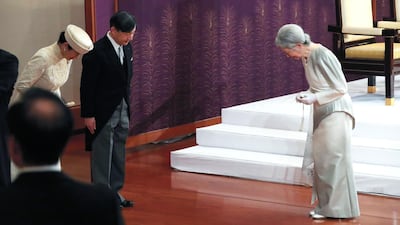
Japan’s Empress Michiko (R) bows to Crown Prince Naruhito (C) and his wife Crown Princess Masako (L) as she leaves at the end of the abdication ceremony of Emperor Akihito at the Matsu-no-Ma state room inside the Imperial Palace in Tokyo. Emperor Akihito of Japan formally stepped down on April 30, 2019, the first abdication for 200 years in the world's oldest monarchy, as his son Naruhito prepared to take the Chrysanthemum Throne and usher in a new imperial era. AFP -
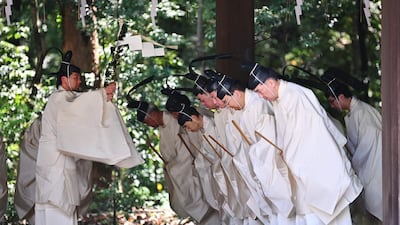
Shinto priests recite religious words before entering the main building to conduct a festive ceremony to report the enthronement of the new emperor to the royal family's ancestors at Meiji Shrine in Tokyo.. Japan's new Emperor Naruhito formally ascended the Chrysanthemum Throne, a day after his father abdicated from the world's oldest monarchy and ushered in a new imperial era. -
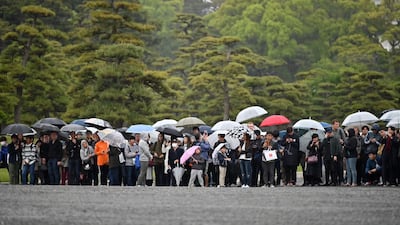
People gather outside the Imperial Palace, where the abdication ceremony for Japan's Emperor Akihito is taking place, in Tokyo. Emperor Akihito is handing over the Chrysanthemum Throne to his eldest son, 59-year-old Crown Prince Naruhito, in a series of solemn rituals that also usher in the new imperial era named "Reiwa" -- meaning beautiful harmony -- that will last throughout the new monarch's reign. AFP -
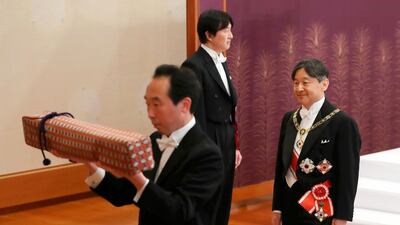
Japan's new Emperor Naruhito, right, leaves after the ceremony to receive the Imperial regalia of sword and jewel as proof of succession at Imperial Palace in Tokyo. Standing at back is Crown Prince Akishino. AP -
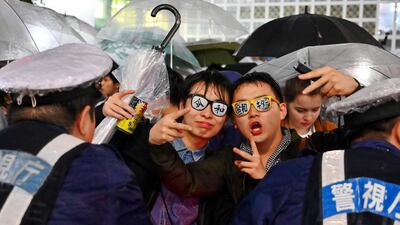
People gesture standing on the streets under the rain as the new era of Japan's emperor called the Reiwa Era begins, and the Heisei Era ends, in Shibuya district in Tokyo. Japan's new emperor Crown Prince Naruhito faces the delicate task of balancing tradition within the world's oldest monarchy and his own modern values, including protecting his family from the palace's rigid rules AFP -
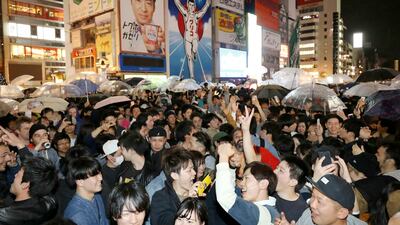
People celebrate as new Emperor Naruhito's era of Reiwa, or "beautiful harmony" began early Wednesda, in Osaka, western Japan. Emperor Akihito announced his abdication at a palace ceremony Tuesday in his final address. AP -
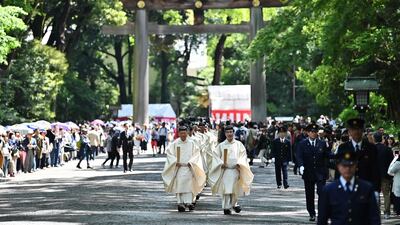
Shinto priests walk towards the main building to conduct a festive ceremony to report the enthronement of the new emperor to the royal family's ancesters at Meiji Shrine in Tokyo. Japan's new Emperor Naruhito formally ascended the Chrysanthemum Throne, a day after his father abdicated from the world's oldest monarchy and ushered in a new imperial era. AFP -
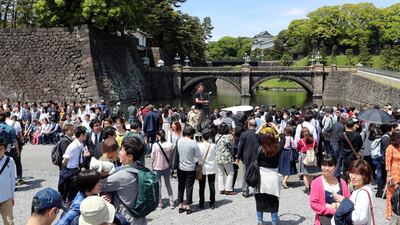
People gather in the compound near Imperial Palace in Tokyo. Japan has new Emperor Naruhito to perform his first ritual after succeeding the Chrysanthemum Throne from his father Akihito who abdicated the night before. AP -
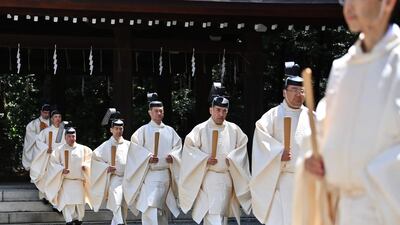
Shinto priests walk towards the main building to conduct a festive ceremony to report the enthronement of the new emperor to the royal family's ancestors at Meiji Shrine in Tokyo.. Japan's new Emperor Naruhito formally ascended the Chrysanthemum Throne, a day after his father abdicated from the world's oldest monarchy and ushered in a new imperial era. AFP -
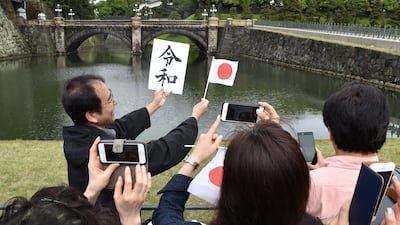
Visitors take photos of a man holding up a Japanese flag along with a card showing the characters for the new "Reiwa" era to mark the new emperor's reign, outside the grounds of the Imperial Palace in Tokyo. Japan's new Emperor Naruhito formally ascended the Chrysanthemum Throne on May 1, a day after his father abdicated from the world's oldest monarchy and ushered in a new imperial era. AFP -
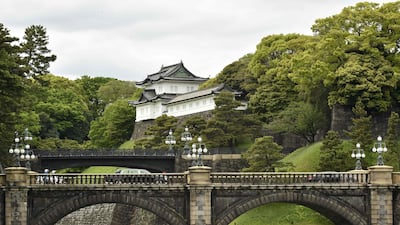
A motorcade (C) carrying Japan's new Emperor Naruhito crosses a bridge as he leaves the grounds of the Imperial Palace in Tokyo. Japan's new Emperor Naruhito formally ascended the Chrysanthemum Throne on May 1, a day after his father abdicated from the world's oldest monarchy and ushered in a new imperial era. AFP -
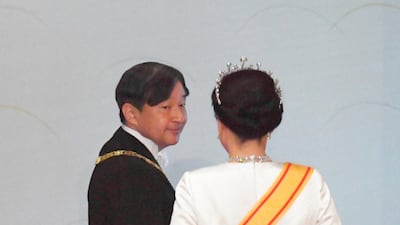
Japan's new Emperor Naruhito, accompanied by new Empress Masako, leaves after making his first address during a ritual after succeeding his father Akihito at Imperial Palace in Tokyo. AP -
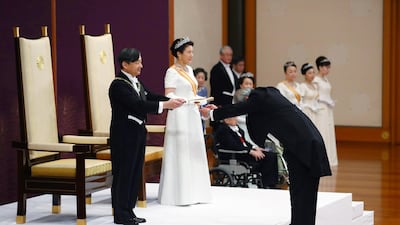
epa07539231 Japan's new Emperor Naruhito (L) and Empress Masako (2-L) attend the 'Sokui-go-Choken-no-gi', or First Audience after the Accession to the Throne, at the Imperial Palace in Tokyo, Japan. Japan's new Emperor Naruhito, 59, succeeded to his father Akihito who abdicated on 30 April. The ascension to the Chrysanthemum throne of Emperor Naruhito marks the beginning of the Reiwa era. EPA -
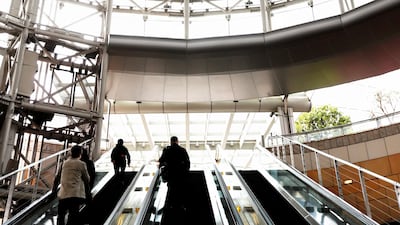
A huge banner celebrating Reiwa, Japan's new imperial era, is displayed on the first day of the Emperor Naruhito’s accession to the throne at a business district in Tokyo. Reuters


A diligent if not brilliant student, Naruhito ate with his contemporaries and chose a pedestrian, uncontentious subject for his thesis: "A Tentative Review of Maritime Transportation in the Seto Inland Sea in the Medieval Period". Rather poignantly, Naruhito shared with a press conference the reasons for his choice: "I have had a keen interest in roads since childhood. On roads you can go to the unknown world. Since I have been leading a life where I have few chances to go out freely, roads are a precious bridge to the unknown world, so to speak."
Hills also reveals the Prince's entry under "Ambition" in his university yearbook was: "To teach English history at university". Another poignant glimpse into the life of a reluctant prince? His academic journey continued from Gakushuin for two liberating years at Oxford where he studied 18th-century transportation on the Upper Thames. In his slight, pleasant, discreet memoir The Thames and I (1993, translated 2006) the prince wrote of his time at Merton College, saying he washed his own clothes, learnt to iron a shirt, cycled, went on pub crawls, played inter-college tennis and scaled Britain's three highest peaks. He made friends and also spent time with fellow royals – fly-fishing with Charles, skiing with Hans-Adam, sailing the fjords with Harald, cruising the canals with Beatrix.
A few years after his return to Japan and the East Palace, his grandfather Hirohito died, after 62 years as Emperor, his father succeeded, and two years later, at the age of 31, Naruhito was invested as Crown Prince. The Kunaicho had been searching for a match since his teens and the bride-hunting committee kept pushing brown envelopes with suitable names into his hands. But in November 1986, he had met young, clever, multi-lingual diplomat, Masako Owada, at a palace reception and he recalled: "Something shot through me the moment I met her". Overcoming Kunaicho resistance and Masako's reluctance, they finally wed in June 1993.
What followed were a hellish 15 years – a denial of any diplomatic role for the young couple; an eight-year wait for a child; and then, as they had a daughter, faced pressure to produce a son. Debilitating bouts of depression followed for the then princess. Following the birth of a son, Hisahito, to Naruhito’s younger brother in 2006, and years of treatment, Masako is at last, and slowly, emerging to take her place beside her steadfast husband. “I will strive to do my best so that I can contribute to the happiness of the people.”
One can only wish that the beautiful harmony this dutiful, devoted couple hope to bestow on their subjects will also rest on them.

