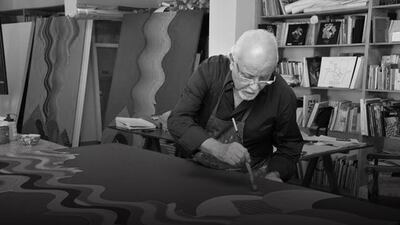
Mohamed Melehi, 84, was one of Morocco’s most significant modernist figures. H. Chergui

Obituary: Moroccan artist Mohamed Melehi leaves a legacy of optimism


Melissa Gronlund
  • English
  • Arabic

Every death comes too soon, but the news of Mohamed Melehi's passing away feels especially painful. The 84-year-old Moroccan artist was in the midst of enjoying a spate of opportunities and attention that had resulted in new paintings. A solo exhibition of his bright, graphic paintings opened last year at the Mosaic Rooms in London then travelled to the Museum of Contemporary African Art Al Maaden in Marrakech and is currently on show at Concrete in Alserkal Avenue. He was taken on by the Dubai gallery Lawrie Shabibi, who brought his work to their presentation at Cromwell Place in London earlier this month. A show about the Casablanca Group, which he was part of, was co-organised by the Sharjah Art Foundation and the kW Institute for Contemporary Art earlier this year.

His bright, signature waves were back across the canvasses, in overlapping, undulating stripes of colour that spoke of the joy of sun and sea and a thrilling to colour and design. Like so many in 2020, Melehi fell ill with coronavirus. He was admitted to a hospital in Paris and did not recover.

New Waves: Mohamed Melehi and the Casablanca Art School Archives opens in Concrete, Alserkal Avenue. Seeing Thing

Melehi was born in Asilah, a small coastal town near Tangier in Morocco. He studied via scholarships at a number of institutions: first at the National Institute of Fine Arts in Tétouan, in northern Morocco, and then at fine arts academies in Seville, Madrid, Rome, and Paris. In 1962, he was invited to teach at the Minneapolis Institute of Art. The cold Midwestern city must not have been for him; he transplanted quickly to New York after scooping a scholarship to Columbia University, where he stayed for two years. The city was immensely influential on his work. Paintings from that time memorialise New York’s music and artistic scene, but at the same time accounts state that Melehi also remained convinced of the exceptionality of Morocco. The country was on the verge of remaking itself and, Melehi felt, had an opportunity to follow a non-European model.

A Casablanca full of energy

Melehi returned to a Casablanca full of energy. Unsplash

When he returned from his studies, according to the Cold War terms of the Rockefeller Foundation scholarship, he found a Casablanca full of energy. Politically, the city oscillated between a feeling of the freedom of a newly independent country – having left the French in 1956 – and the unpopularity of King Hassan II. A spirit of political engagement, cultural nationalism, and excitement prevailed.

In his own work, Melehi married the hard-edged geometric painting of New York with traditional Amazigh motifs. His signature waves, in a variety of colours, were also deeply spiritual in nature.

A school of fashion designers emerged, updating tribal designs in new fabrics, tweaking traditionally male designs to allow women to wear them, and helping to establish the kaftan as an international trend in the decades to come. Fareed Belkahia, at the head of the Casablanca School of Fine Arts, moved the French-established institution away from easel painting and towards techniques and styles drawn from vernacular visual culture. Melehi joined the faculty as professor from 1964 to 1969, and he, Belkahia and Mohamed Chabaa became known as the Casablanca Group. Inspired by the Bauhaus in Germany, the three pushed forward interdisciplinary ideas of pedagogy and creation, integrating painting, craft, architecture and design.

In his own work, Melehi married the hard-edged geometric painting of New York with traditional Amazigh motifs. His signature waves, in a variety of colours, were also deeply spiritual in nature. They reflected his interest in the four elements of earth, water, air and fire, as well as the movement of the beaches in Morocco, the undulation of Arabic calligraphy, and offered in their repetition, as Holiday Powers writes in the Mathaf Encyclopedia entry on his work, a route towards transcendental meditation and prayer.

Famously, the Casablanca Group brought art out of the studio and gallery and on to the street. In 1969, snubbing an art salon elsewhere in the city, the group assembled an exhibition in Marrakech's Jemaa el-Fna Square, hanging their paintings outside for a week so they could be seen directly and easily by the public. Melehi's democratic beliefs extended even to his choice of materials: in the 1960s he swapped the painterly acrylic for cellulose car paint. And he pursued graphic design and publishing as means to reach new and wider audiences. He created the first, iconic cover of a sun for Souffles, the radical journal that ran from 1966–72, amid the heights of radical solidarity movements, and in the mid-70s he directed the journal Intégral. His publishing imprint, Shoof, created commercial graphic design work and art books throughout the 1970s.

He also contributed to the art infrastructure in Morocco. In the late 1970s he and the politician Mohamed Benaissa, who was also born in Asilah, established the Al Mouhit Cultural Association and the Asilah Moussem Festival of the Arts, in the pair’s home town, known for its murals and youth engagement. (The festival is still running.) In the 1980s and 90s, he was the director of arts for the Ministry of Culture and later a cultural consultant to the Ministry of Foreign Affairs and Cooperation.

His recent success returned international focus to his artwork. The paintings he newly created retain the verve and energy of his early work, reflect the joy that the addition of colour to the world can produce: a message of optimism that is the legacy of the extraordinary artist’s career.


The flights: South African Airways flies from Dubai International Airport with a stop in Johannesburg, with prices starting from around Dh4,000 return. Emirates can get you there with a stop in Lusaka from around Dh4,600 return.
The details: Visas are available for 247 Zambian kwacha or US$20 (Dh73) per person on arrival at Livingstone Airport. Single entry into Victoria Falls for international visitors costs 371 kwacha or $30 (Dh110). Microlight flights are available through Batoka Sky, with 15-minute flights costing 2,265 kwacha (Dh680).
Accommodation: The Royal Livingstone Victoria Falls Hotel by Anantara is an ideal place to stay, within walking distance of the falls and right on the Zambezi River. Rooms here start from 6,635 kwacha (Dh2,398) per night, including breakfast, taxes and Wi-Fi. Water arrivals cost from 587 kwacha (Dh212) per person.

The biog

Name: Mariam Ketait

Emirate: Dubai

Hobbies: I enjoy travelling, experiencing new things, painting, reading, flying, and the French language

Favourite quote: "Be the change you wish to see" - unknown

Favourite activity: Connecting with different cultures

What is type-1 diabetes

Type 1 diabetes is a genetic and unavoidable condition, rather than the lifestyle-related type 2 diabetes.

It occurs mostly in people under 40 and a result of the pancreas failing to produce enough insulin to regulate blood sugars.

Too much or too little blood sugar can result in an attack where sufferers lose consciousness in serious cases.

Being overweight or obese increases the chances of developing the more common type 2 diabetes.

UAE currency: the story behind the money in your pockets
Your rights as an employee

The government has taken an increasingly tough line against companies that fail to pay employees on time. Three years ago, the Cabinet passed a decree allowing the government to halt the granting of work permits to companies with wage backlogs.

The new measures passed by the Cabinet in 2016 were an update to the Wage Protection System, which is in place to track whether a company pays its employees on time or not.

If wages are 10 days late, the new measures kick in and the company is alerted it is in breach of labour rules. If wages remain unpaid for a total of 16 days, the authorities can cancel work permits, effectively shutting off operations. Fines of up to Dh5,000 per unpaid employee follow after 60 days.

Despite those measures, late payments remain an issue, particularly in the construction sector. Smaller contractors, such as electrical, plumbing and fit-out businesses, often blame the bigger companies that hire them for wages being late.

The authorities have urged employees to report their companies at the labour ministry or Tawafuq service centres — there are 15 in Abu Dhabi.

The nine articles of the 50-Year Charter

1. Dubai silk road

2.  A geo-economic map for Dubai

3. First virtual commercial city

4. A central education file for every citizen

5. A doctor to every citizen

6. Free economic and creative zones in universities

7. Self-sufficiency in Dubai homes

8. Co-operative companies in various sectors

­9: Annual growth in philanthropy

The President's Cake

Director: Hasan Hadi

Starring: Baneen Ahmad Nayyef, Waheed Thabet Khreibat, Sajad Mohamad Qasem 

Rating: 4/5

RESULTS
%3Cp%3E%3Cstrong%3E6pm%3A%20Baniyas%20%E2%80%93%20Group%202%20(PA)%20Dh97%2C500%20(Dirt)%201%2C400m%3C%2Fstrong%3E%3Cbr%3EWinner%3A%20AF%20Alajaj%2C%20Tadhg%20O%E2%80%99Shea%20(jockey)%2C%20Ernst%20Oertel%20(trainer)%3C%2Fp%3E%0A%3Cp%3E%3Cstrong%3E6.35pm%3A%20The%20Pointe%20%E2%80%93%20Maiden%20(TB)%20Dh82%2C500%20(D)%201%2C200m%3C%2Fstrong%3E%3Cbr%3EWinner%3A%20Awasef%2C%20Pat%20Dobbs%2C%20Doug%20Watson%3C%2Fp%3E%0A%3Cp%3E%3Cstrong%3E7.10pm%3A%20Palm%20West%20Beach%20%E2%80%93%20Maiden%20(TB)%20Dh82%2C500%20(D)%201%2C400m%3C%2Fstrong%3E%3Cbr%3EWinner%3A%20Long%20Kiss%2C%20Jose%20da%20Silva%2C%20Antonio%20Cintra%3C%2Fp%3E%0A%3Cp%3E%3Cstrong%3E7.45pm%3A%20The%20View%20at%20the%20Palm%20%E2%80%93%20Handicap%20(TB)%20Dh87%2C500%20(D)%201%2C200m%3C%2Fstrong%3E%3Cbr%3EWinner%3A%20Ranaan%2C%20Tadhg%20O%E2%80%99Shea%2C%20Bhupat%20Seemar%3C%2Fp%3E%0A%3Cp%3E%3Cstrong%3E8.20pm%3A%20Nakheel%20%E2%80%93%20Handicap%20(TB)%20Dh105%2C000%20(D)%201%2C400m%3C%2Fstrong%3E%3Cbr%3EWinner%3A%20Raaeb%2C%20Antonio%20Fresu%2C%20Musabah%20Al%20Muhairi%3C%2Fp%3E%0A%3Cp%3E%3Cstrong%3E8.55pm%3A%20The%20Club%20%E2%80%93%20Handicap%20(TB)%20Dh95%2C000%20(D)%201%2C900m%3C%2Fstrong%3E%3Cbr%3EWinner%3A%20Qareeb%2C%20Sam%20Hitchcock%2C%20Doug%20Watson%3C%2Fp%3E%0A%3Cp%3E%3Cstrong%3E9.30pm%3A%20Palm%20Beach%20Towers%20%E2%80%93%20Handicap%20(TB)%20Dh87%2C500%20(D)%201%2C600m%3C%2Fstrong%3E%3Cbr%3EWinner%3A%20Falsehood%2C%20Adrie%20de%20Vries%2C%20Musabah%20Al%20Muhairi%3C%2Fp%3E%0A
Moon Music

Artist: Coldplay

Label: Parlophone/Atlantic

Number of tracks: 10

Rating: 3/5

MATCH INFO

Uefa Champions League quarter-final, second leg (first-leg score):

Manchester City (0) v Tottenham Hotspur (1), Wednesday, 11pm UAE

Match is on BeIN Sports

COMPANY PROFILE
Name: HyperSpace
 
Started: 2020
 
Founders: Alexander Heller, Rama Allen and Desi Gonzalez
 
Based: Dubai, UAE
 
Sector: Entertainment 
 
Number of staff: 210 
 
Investment raised: $75 million from investors including Galaxy Interactive, Riyadh Season, Sega Ventures and Apis Venture Partners
UAE squad

Humaira Tasneem (c), Chamani Senevirathne (vc), Subha Srinivasan, NIsha Ali, Udeni Kuruppuarachchi, Chaya Mughal, Roopa Nagraj, Esha Oza, Ishani Senevirathne, Heena Hotchandani, Keveesha Kumari, Judith Cleetus, Chavi Bhatt, Namita D’Souza.

The Saga Continues

Wu-Tang Clan

(36 Chambers / Entertainment One)