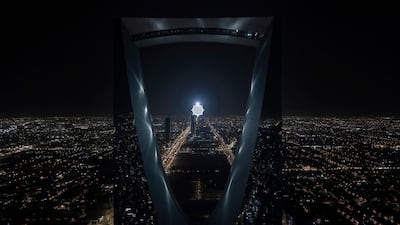
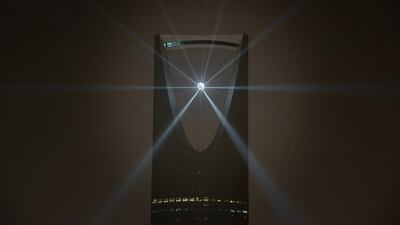
An enormous, nearly five-tonne, eight-point star has been suspended from Riyadh’s renowned Kingdom Tower, the 300-metre-tall building that dominates the city’s landscape.
Hanging 256 metres high in the sky, Star in Motion lights up on the hour in a dramatic display of light. The work's artist, Koert Vermeulen, says it simulates the birth and extinction of a star, condensed into a one-minute display.
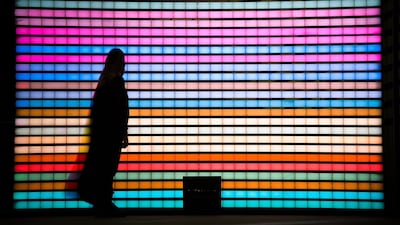
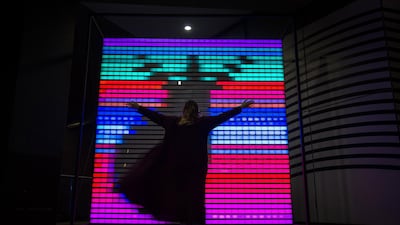
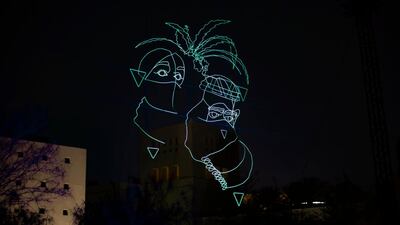
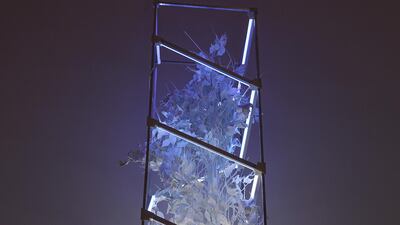
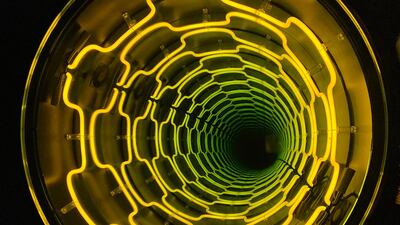
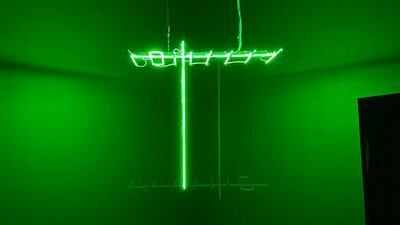
The installation is part of the city's Noor Riyadh festival, a vast, multi-venue exhibition that is devoted to the artistic play with light, which runs until April 3. The event has brought in major international artists, such as Daniel Buren, Yayoi Kusama and Dan Flavin, as well as some 20 artists from Saudi Arabia's burgeoning art scene.
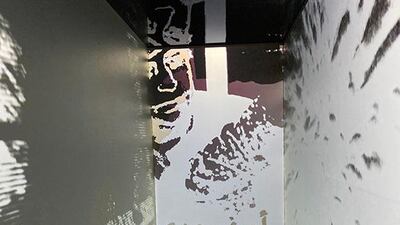
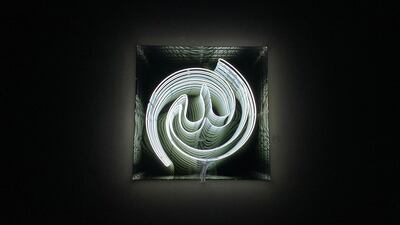
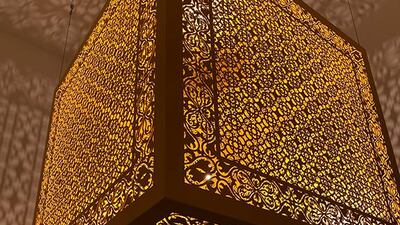
To see images from the Noor Riyadh festival, take a look through the gallery below:
Vermeulen got his start designing light shows for electronic music DJs in the 1990s. With a 22-person studio in Brussels, he now straddles the worlds of commercial lighting design and art, making displays for major events as well as creative projects.
This is his third work in Saudi Arabia; last year, he created the performance Leila: The Land of Imagination, via the use of light.
For this new project, he says: "The title of the show is Under One Sky, and I immediately knew that the light festival needed to have a star in the sky – and in the middle of the most iconic building.
"I've made a sun and a moon for other projects, so it made sense for me to make a star now. The sun [I made] is in India, the moon is in Belgium and the star is here.”
Far from being a static object overlooking the city, the star shimmers and glows, with reflective surfaces and moving light patterns. As well as its explosive birth and rebirth on the hour – like a rather more dramatic Big Ben – more subtle light effects occur every 15 minutes to emphasise how stars are actively changing in the sky.
The sun I made is in India, the moon is in Belgium and the star is here in Saudi Arabia
“I wanted people to have the patience to wait and watch it for a little while longer, to see how things change,” Vermeulen explains. “It becomes like a clock for the city.”
It was also a logistical feat. Vermeulen originally planned to make it nine metres across, but engineers warned him that a structure of that size would be too heavy to withstand the 160-kilometre-per-hour winds that can race through the desert city.
He and his team scaled it down to six metres, a size that still requires cables 80 millimetres in diameter – about the size of an upper arm – to hold it in place.
The star was produced in Belgium, and then dismantled and flown to Saudi Arabia. Its 317 parts were brought up the Kingdom Tower in a lift, and then carried by hand up the remaining two floors to a platform that had been constructed at the base of the tower's U-shaped void.
There, more than 200 metres above the city, the star was put back together. It was then winched up via rigging, and affixed to cables attached to the tower's sky bridge and other points in the gap.
The process was enough to impress even the lighting design veteran.
“Being more than 25 years in the entertainment industry, and seeing all those things that have been done before, I've never seen rigging like this,” he says. “Even performances for the Rolling Stones didn’t use that kind of rigging. I saw rigging elements that you only see in the shipping industry.”
The star is visible across Riyadh. In the day it resembles a necklace, hanging prettily down in the centre of the tower. At night, it becomes a dramatic feature of the city. The work will be up for the 17 days of the festival, and then dismantled and brought back down to Earth.
Noor Riyadh runs until Saturday, April 3.
More information is available at www.noorriyadh.sa

more from Janine di Giovanni
THE BIO
Favourite author - Paulo Coelho
Favourite holiday destination - Cuba
New York Times or Jordan Times? NYT is a school and JT was my practice field
Role model - My Grandfather
Dream interviewee - Che Guevara
THE BIO
Ms Davison came to Dubai from Kerala after her marriage in 1996 when she was 21-years-old
Since 2001, Ms Davison has worked at many affordable schools such as Our Own English High School in Sharjah, and The Apple International School and Amled School in Dubai
Favourite Book: The Alchemist
Favourite quote: Failing to prepare is preparing to fail
Favourite place to Travel to: Vienna
Favourite cuisine: Italian food
Favourite Movie : Scent of a Woman
Ten tax points to be aware of in 2026
1. Domestic VAT refund amendments: request your refund within five years
If a business does not apply for the refund on time, they lose their credit.
2. E-invoicing in the UAE
Businesses should continue preparing for the implementation of e-invoicing in the UAE, with 2026 a preparation and transition period ahead of phased mandatory adoption.
3. More tax audits
Tax authorities are increasingly using data already available across multiple filings to identify audit risks.
4. More beneficial VAT and excise tax penalty regime
Tax disputes are expected to become more frequent and more structured, with clearer administrative objection and appeal processes. The UAE has adopted a new penalty regime for VAT and excise disputes, which now mirrors the penalty regime for corporate tax.
5. Greater emphasis on statutory audit
There is a greater need for the accuracy of financial statements. The International Financial Reporting Standards standards need to be strictly adhered to and, as a result, the quality of the audits will need to increase.
6. Further transfer pricing enforcement
Transfer pricing enforcement, which refers to the practice of establishing prices for internal transactions between related entities, is expected to broaden in scope. The UAE will shortly open the possibility to negotiate advance pricing agreements, or essentially rulings for transfer pricing purposes.
7. Limited time periods for audits
Recent amendments also introduce a default five-year limitation period for tax audits and assessments, subject to specific statutory exceptions. While the standard audit and assessment period is five years, this may be extended to up to 15 years in cases involving fraud or tax evasion.
8. Pillar 2 implementation
Many multinational groups will begin to feel the practical effect of the Domestic Minimum Top-Up Tax (DMTT), the UAE's implementation of the OECD’s global minimum tax under Pillar 2. While the rules apply for financial years starting on or after January 1, 2025, it is 2026 that marks the transition to an operational phase.
9. Reduced compliance obligations for imported goods and services
Businesses that apply the reverse-charge mechanism for VAT purposes in the UAE may benefit from reduced compliance obligations.
10. Substance and CbC reporting focus
Tax authorities are expected to continue strengthening the enforcement of economic substance and Country-by-Country (CbC) reporting frameworks. In the UAE, these regimes are increasingly being used as risk-assessment tools, providing tax authorities with a comprehensive view of multinational groups’ global footprints and enabling them to assess whether profits are aligned with real economic activity.
Contributed by Thomas Vanhee and Hend Rashwan, Aurifer
Mohammed bin Zayed Majlis
Sri Lanka-India Test series schedule
1st Test July 26-30 in Galle
2nd Test August 3-7 in Colombo
3rd Test August 12-16 in Pallekele
Fines for littering
In Dubai:
Dh200 for littering or spitting in the Dubai Metro
Dh500 for throwing cigarette butts or chewing gum on the floor, or littering from a vehicle.
Dh1,000 for littering on a beach, spitting in public places, throwing a cigarette butt from a vehicle
In Sharjah and other emirates
Dh500 for littering - including cigarette butts and chewing gum - in public places and beaches in Sharjah
Dh2,000 for littering in Sharjah deserts
Dh500 for littering from a vehicle in Ras Al Khaimah
Dh1,000 for littering from a car in Abu Dhabi
Dh1,000 to Dh100,000 for dumping waste in residential or public areas in Al Ain
Dh10,000 for littering at Ajman's beaches
MATCH SCHEDULE
Uefa Champions League semi-final, first leg
Tuesday, April 24 (10.45pm)
Liverpool v Roma
Wednesday, April 25
Bayern Munich v Real Madrid (10.45pm)
Europa League semi-final, first leg
Thursday, April 26
Arsenal v Atletico Madrid (11.05pm)
Marseille v Salzburg (11.05pm)
Mercer, the investment consulting arm of US services company Marsh & McLennan, expects its wealth division to at least double its assets under management (AUM) in the Middle East as wealth in the region continues to grow despite economic headwinds, a company official said.
Mercer Wealth, which globally has $160 billion in AUM, plans to boost its AUM in the region to $2-$3bn in the next 2-3 years from the present $1bn, said Yasir AbuShaban, a Dubai-based principal with Mercer Wealth.
“Within the next two to three years, we are looking at reaching $2 to $3 billion as a conservative estimate and we do see an opportunity to do so,” said Mr AbuShaban.
Mercer does not directly make investments, but allocates clients’ money they have discretion to, to professional asset managers. They also provide advice to clients.
“We have buying power. We can negotiate on their (client’s) behalf with asset managers to provide them lower fees than they otherwise would have to get on their own,” he added.
Mercer Wealth’s clients include sovereign wealth funds, family offices, and insurance companies among others.
From its office in Dubai, Mercer also looks after Africa, India and Turkey, where they also see opportunity for growth.
Wealth creation in Middle East and Africa (MEA) grew 8.5 per cent to $8.1 trillion last year from $7.5tn in 2015, higher than last year’s global average of 6 per cent and the second-highest growth in a region after Asia-Pacific which grew 9.9 per cent, according to consultancy Boston Consulting Group (BCG). In the region, where wealth grew just 1.9 per cent in 2015 compared with 2014, a pickup in oil prices has helped in wealth generation.
BCG is forecasting MEA wealth will rise to $12tn by 2021, growing at an annual average of 8 per cent.
Drivers of wealth generation in the region will be split evenly between new wealth creation and growth of performance of existing assets, according to BCG.
Another general trend in the region is clients’ looking for a comprehensive approach to investing, according to Mr AbuShaban.
“Institutional investors or some of the families are seeing a slowdown in the available capital they have to invest and in that sense they are looking at optimizing the way they manage their portfolios and making sure they are not investing haphazardly and different parts of their investment are working together,” said Mr AbuShaban.
Some clients also have a higher appetite for risk, given the low interest-rate environment that does not provide enough yield for some institutional investors. These clients are keen to invest in illiquid assets, such as private equity and infrastructure.
“What we have seen is a desire for higher returns in what has been a low-return environment specifically in various fixed income or bonds,” he said.
“In this environment, we have seen a de facto increase in the risk that clients are taking in things like illiquid investments, private equity investments, infrastructure and private debt, those kind of investments were higher illiquidity results in incrementally higher returns.”
The Abu Dhabi Investment Authority, one of the largest sovereign wealth funds, said in its 2016 report that has gradually increased its exposure in direct private equity and private credit transactions, mainly in Asian markets and especially in China and India. The authority’s private equity department focused on structured equities owing to “their defensive characteristics.”
'C'mon C'mon'
Director:Mike Mills
Stars:Joaquin Phoenix, Gaby Hoffmann, Woody Norman
Rating: 4/5
Moon Music
Artist: Coldplay
Label: Parlophone/Atlantic
Number of tracks: 10
Rating: 3/5