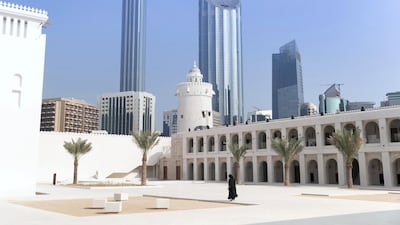
A new exhibition showcasing the evolution of fashion trends in Abu Dhabi from the 1940s to 1980s is coming to Qasr Al Hosn.
Titled Fashion Through the Years, the show will explore the emirate’s history and stories of its people through clothing and accessories, as well as celebrate the heritage, craftsmanship and beauty of fashion. It runs from Wednesday, December 16, to Tuesday, February 16.
Items on display include more than 30 artefacts and garments of cultural importance, including necklaces gifted by Mother of the Nation Sheikha Fatima bint Mubarak and an ornate burqa belonging to Fatima bint Mohamed bin Thani Al Mehairi.
Other highlights include a family album showing fashion trends from the 1960s to the 1980s and different types of traditional embroidery. There will also be intricate headpieces, early 20th-century sewing machines and more on display.
Traditional Emirati garments were often hand-sewed and hand-embroidered, and the exhibition will explore changes in social practices over the years.
“Fashion Through the Years is a fascinating exhibition providing a unique opportunity to explore clothing trends and methods of personal expression from decades ago. Visitors will be transported back in time to connect with the experiences of our ancestors and gain deeper insight into the UAE’s rich heritage,” says Salama Al Shamsi, director of Qasr Al Hosn.
“From burqas worn by women as they travelled from Al Wathba to Al Ain, to the historical significance of family men carrying a dagger and the surprising influence of the European fashion scene on gowns, the exhibition showcases the cultural significance of fashion in the emirate during the crucial four decades of development and nation-building.”
The exhibition is open Saturday to Thursday, 10am-7pm and on Friday, 2pm-7pm. Tickets cost Dh30.
More information is at qasralhosn.ae

Stamp duty timeline
December 2014: Former UK finance minister George Osbourne reforms stamp duty, replacing the slab system with a blended rate scheme, with the top rate increasing to 12 per cent from 10 per cent:
Up to £125,000 - 0%; £125,000 to £250,000 – 2%; £250,000 to £925,000 – 5%; £925,000 to £1.5m: 10%; Over £1.5m – 12%
April 2016: New 3% surcharge applied to any buy-to-let properties or additional homes purchased.
July 2020: Rishi Sunak unveils SDLT holiday, with no tax to pay on the first £500,000, with buyers saving up to £15,000.
March 2021: Mr Sunak decides the fate of SDLT holiday at his March 3 budget, with expectations he will extend the perk unti June.
April 2021: 2% SDLT surcharge added to property transactions made by overseas buyers.
More coverage from the Future Forum
The five pillars of Islam
WHAT ARE NFTs?
Non-fungible tokens (NFTs) are tokens that represent ownership of unique items. They allow the tokenisation of things such as art, collectibles and even real estate.
An NFT can have only one official owner at one time. And since they're minted and secured on the Ethereum blockchain, no one can modify the record of ownership, not even copy-paste it into a new one.
This means NFTs are not interchangeable and cannot be exchanged with other items. In contrast, fungible items, such as fiat currencies, can be exchanged because their value defines them rather than their unique properties.
Key findings of Jenkins report
- Founder of the Muslim Brotherhood, Hassan al Banna, "accepted the political utility of violence"
- Views of key Muslim Brotherhood ideologue, Sayyid Qutb, have “consistently been understood” as permitting “the use of extreme violence in the pursuit of the perfect Islamic society” and “never been institutionally disowned” by the movement.
- Muslim Brotherhood at all levels has repeatedly defended Hamas attacks against Israel, including the use of suicide bombers and the killing of civilians.
- Laying out the report in the House of Commons, David Cameron told MPs: "The main findings of the review support the conclusion that membership of, association with, or influence by the Muslim Brotherhood should be considered as a possible indicator of extremism."
Who has lived at The Bishops Avenue?
- George Sainsbury of the supermarket dynasty, sugar magnate William Park Lyle and actress Dame Gracie Fields were residents in the 1930s when the street was only known as ‘Millionaires’ Row’.
- Then came the international super rich, including the last king of Greece, Constantine II, the Sultan of Brunei and Indian steel magnate Lakshmi Mittal who was at one point ranked the third richest person in the world.
- Turkish tycoon Halis Torprak sold his mansion for £50m in 2008 after spending just two days there. The House of Saud sold 10 properties on the road in 2013 for almost £80m.
- Other residents have included Iraqi businessman Nemir Kirdar, singer Ariana Grande, holiday camp impresario Sir Billy Butlin, businessman Asil Nadir, Paul McCartney’s former wife Heather Mills.
Hunting park to luxury living
- Land was originally the Bishop of London's hunting park, hence the name
- The road was laid out in the mid 19th Century, meandering through woodland and farmland
- Its earliest houses at the turn of the 20th Century were substantial detached properties with extensive grounds
The%20specs
%3Cp%3E%3Cstrong%3EEngine%3A%3C%2Fstrong%3E%206.5-litre%20V12%20and%20three%20electric%20motors%0D%3Cbr%3E%3Cstrong%3EPower%3A%20%3C%2Fstrong%3E1%2C015hp%0D%3Cbr%3E%3Cstrong%3ETorque%3A%20%3C%2Fstrong%3E1%2C500Nm%20(estimate)%0D%3Cbr%3E%3Cstrong%3ETransmission%3A%3C%2Fstrong%3E%20Eight-speed%20dual-clutch%20auto%0D%3Cbr%3E%3Cstrong%3EOn%20sale%3A%3C%2Fstrong%3E%20Early%202024%0D%3Cbr%3E%3Cstrong%3EPrice%3A%20%3C%2Fstrong%3EFrom%20Dh2%20million%20(estimate)%3C%2Fp%3E%0A
