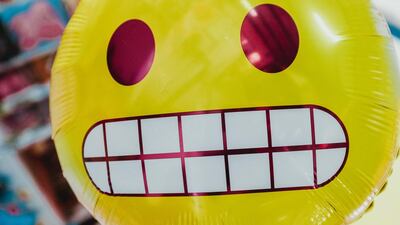
If you have a smartphone, chances are you use emoji.
How many of us turn to these ideograms when we want to make a point or soften the blow of a harsh text? And how many times have we tried to interpret a seemingly random arrangement of “heart, unicorn, palm tree and prayer hands”?
Friday marks World Emoji Day, an unofficial celebration of the little pictograms that play such a big role in our daily lives.
So what has made the emoji so popular?
What you write is your word, but with emoji, you can say 'that's not what I meant'
The ease and speed of emoji use, along with the ability to wield it in these layered ways adds to the appeal, says Goffredo Puccetti, a professor of the practice of visual arts at New York University Abu Dhabi (NYUAD). “I would say that the massive success of emoji, making it so rapid and widespread, clearly suggests that there was a need to be more comfortable in this over-connected universe we live in,” he says.
“What you write is your word, but with emoji, you can say ‘that’s not what I meant’. It would be too much, too painful, too personal, too dangerous to say these things in person. Emojis offer a shortcut, but they also allow some kind of cover,” he adds.
The invention of the emoji
It’s easy to think that the creation of emoji came alongside the invention of the smartphone, but they’ve been around since the 1990s as a more evolved rendering of the emoticon, which used colons, dashes and parenthesis.
The emoji’s origins can be traced to Japan: the word comes from two Japanese words – “e” for picture and “moji”, which means character.
In 1997, Japanese network carrier SoftBank released a set of 90 unique emoji, which were black and white pixelated line designs. Their characters included the thumbs up, heart, and smiley faces. Two years later, another Japanese telecom company, NTT Docomo, released 176 original emoji in colour, designed by engineer Shigetaka Kurita.
The 1997 SoftBank designs:
Though emoji were used on webpages and online messaging over the years, it was in the 2010s that the use exploded, after a set of around 700 emoji were internationally standardised in 2009 and Apple added an emoji keyboard to its operating system in 2011.
“When it was adopted by other platforms, notably Apple and the Android system, plus the use of Facebook and Twitter… that’s where it really started to be used as the language they are now,” Puccetti says.
The 1999 Docomo designs:
Why emoji are so important now
Today, there are 3,304 pictograms available in the Unicode Standard.
The triumph of emoji can also be attributed to how adaptable they are to those who use them.
“It allowed a specific group or subgroup to communicate with themselves. It’s a way to spot who’s in the group and who’s outside the group. This is a dynamic that is very powerful, especially among young people,” Puccetti explains.
Emoji are so deeply embedded in our daily communications that they have found their way into visual culture: from art to movies to marketing.
Puccetti argues that emoji, apart from just being a technological invention, draws from the history of modern design.
Take the smiley with the yellow face, created in 1963 by commercial artist Harvey Ball, for example, which has become ubiquitous in music, movies and art.
"I want to emphasise the role of the designer rather than IT gurus. They say that the emoji started in 1999, but one of the most powerful and most used emoji now is the heart. And that started with I Love New York," he says, referring to Milton Glasner's 1976 creation that became the basis of a tourism campaign for New York.
With their simplicity and ability to cross linguistic and cultural boundaries, emoji also proved to be suitable for awareness campaigns. In 2015, the World Wildlife Fund (WWF) launched their #EndangeredEmoji online fundraising campaign on Twitter which featured a set of 17 emoji that represented endangered species. Domino’s Pizza ran a less altruistic campaign with its ‘tweet ordering’, where customers in the US could simply text the pizza emoji to instigate an order.
Also in 2015, Oxford Dictionaries announced their Word of the Year was a pictograph – “Face with Tears of Joy”, the one we may call the lol emoji.
Two years later, Sony Pictures released the widely panned The Emoji Movie where all of the characters were based on emoji faces and graphics. There's also Emojiland, a 2018 stage musical that imagines emoji as having inner lives and their own dramas.
Such is the cultural impact of emoji that the Museum of Modern Art’s architecture and design department acquired the 1999 set of emoji by Kurita, citing the importance of the invention in visual language as the driving force for their decision. The museum exhibited an installation displaying the set from 2016 to 2017.
How artists use emoji
Artists have turned to emoji in various ways, some using it as material, as in the case of Yung Jake, who makes portraits of figures such as Breonna Taylor and George Floyd through an assembly of emoji. Then there’s New York artist Tre Reising who has created glittering sculptures of face emojis and a wooden sculpture of the “poop emoji”.
American conceptual artist John Baldessari, who died in January, often contemplated visual representation and imagery in his work. He developed a series of emoji paintings that played with the scale of these tiny characters, which we typically only see on screens, blowing them up onto large canvasses.
How they respond to, or reflect, our times
Today, the language of emoji continues to grow, with smartphone operating systems continually adding new characters to its database. On Friday, Apple previewed an upcoming emoji pack of 117 characters that it will add to its iOS this year. These include a babushka doll, ninja, dodo bird, heart and lungs.
Emoji have also proven themselves to readily respond to or simply reflect our times. In the midst of the pandemic, Facebook rolled out new reactions on the platform, including a hug and pulsating heart to allow for more virtually shows of support.
After the resurgence of the Black Lives Matter movement this year, Apple’s iOS keyboard now auto-suggests the black first emoji when you type “BLM” or “Black Lives Matter”.
With the ever-evolving use, is it possible to predict what’s next for the emoji? “I would say there’s a lot of scope. I can see emoji, again, filling a void here and there,” Puccetti says, adding that a language like Arabic, which is more “difficult” and “time-demanding” to use electronically may develop shortcuts in the form of emoji.
“With communication, we just don’t know what’s going to happen next. I think the emoji demonstrates that. It will be fascinating to have these kinds of conversations five years from now because everything is changing,” he says.

ICC T20 Team of 2021
Jos Buttler, Mohammad Rizwan, Babar Azam, Aiden Markram, Mitchell Marsh, David Miller, Tabraiz Shamsi, Josh Hazlewood, Wanindu Hasaranga, Mustafizur Rahman, Shaheen Afridi
More from Janine di Giovanni
What the law says
Micro-retirement is not a recognised concept or employment status under Federal Decree Law No. 33 of 2021 on the Regulation of Labour Relations (as amended) (UAE Labour Law). As such, it reflects a voluntary work-life balance practice, rather than a recognised legal employment category, according to Dilini Loku, senior associate for law firm Gateley Middle East.
“Some companies may offer formal sabbatical policies or career break programmes; however, beyond such arrangements, there is no automatic right or statutory entitlement to extended breaks,” she explains.
“Any leave taken beyond statutory entitlements, such as annual leave, is typically regarded as unpaid leave in accordance with Article 33 of the UAE Labour Law. While employees may legally take unpaid leave, such requests are subject to the employer’s discretion and require approval.”
If an employee resigns to pursue micro-retirement, the employment contract is terminated, and the employer is under no legal obligation to rehire the employee in the future unless specific contractual agreements are in place (such as return-to-work arrangements), which are generally uncommon, Ms Loku adds.
Director: Laxman Utekar
Cast: Vicky Kaushal, Akshaye Khanna, Diana Penty, Vineet Kumar Singh, Rashmika Mandanna
Rating: 1/5
ROUTE%20TO%20TITLE
%3Cp%3E%3Cstrong%3ERound%201%3A%3C%2Fstrong%3E%20Beat%20Leolia%20Jeanjean%206-1%2C%206-2%3Cbr%3E%3Cstrong%3ERound%202%3A%20%3C%2Fstrong%3EBeat%20Naomi%20Osaka%207-6%2C%201-6%2C%207-5%3Cbr%3E%3Cstrong%3ERound%203%3A%20%3C%2Fstrong%3EBeat%20Marie%20Bouzkova%206-4%2C%206-2%3Cbr%3E%3Cstrong%3ERound%204%3A%3C%2Fstrong%3E%20Beat%20Anastasia%20Potapova%206-0%2C%206-0%3Cbr%3E%3Cstrong%3EQuarter-final%3A%20%3C%2Fstrong%3EBeat%20Marketa%20Vondrousova%206-0%2C%206-2%3Cbr%3E%3Cstrong%3ESemi-final%3A%20%3C%2Fstrong%3EBeat%20Coco%20Gauff%206-2%2C%206-4%3Cbr%3E%3Cstrong%3EFinal%3A%3C%2Fstrong%3E%20Beat%20Jasmine%20Paolini%206-2%2C%206-2%3C%2Fp%3E%0A
Married Malala
Malala Yousafzai is enjoying married life, her father said.
The 24-year-old married Pakistan cricket executive Asser Malik last year in a small ceremony in the UK.
Ziauddin Yousafzai told The National his daughter was ‘very happy’ with her husband.
Living in...
This article is part of a guide on where to live in the UAE. Our reporters will profile some of the country’s most desirable districts, provide an estimate of rental prices and introduce you to some of the residents who call each area home.
FIXTURES
December 28
Stan Wawrinka v Pablo Carreno Busta, 5pm
Milos Raonic v Dominic Thiem, no earlier then 7pm
December 29 - semi-finals
Rafael Nadal v Stan Wawrinka / Pablo Carreno Busta, 5pm
Novak Djokovic v Milos Raonic / Dominic Thiem, no earlier then 7pm
December 30
3rd/4th place play-off, 5pm
Final, 7pm
How to protect yourself when air quality drops
Install an air filter in your home.
Close your windows and turn on the AC.
Shower or bath after being outside.
Wear a face mask.
Stay indoors when conditions are particularly poor.
If driving, turn your engine off when stationary.
COMPANY%20PROFILE%20
%3Cp%3E%3Cstrong%3ECompany%20name%3A%20%3C%2Fstrong%3EAlmouneer%3Cbr%3E%3Cstrong%3EStarted%3A%3C%2Fstrong%3E%202017%3Cbr%3E%3Cstrong%3EFounders%3A%3C%2Fstrong%3E%20Dr%20Noha%20Khater%20and%20Rania%20Kadry%3Cbr%3E%3Cstrong%3EBased%3A%20%3C%2Fstrong%3EEgypt%3Cbr%3E%3Cstrong%3ENumber%20of%20staff%3A%20%3C%2Fstrong%3E120%3Cbr%3E%3Cstrong%3EInvestment%3A%20%3C%2Fstrong%3EBootstrapped%2C%20with%20support%20from%20Insead%20and%20Egyptian%20government%2C%20seed%20round%20of%20%3Cbr%3E%243.6%20million%20led%20by%20Global%20Ventures%3Cbr%3E%3C%2Fp%3E%0A
'Moonshot'
Director: Chris Winterbauer
Stars: Lana Condor and Cole Sprouse
Rating: 3/5
Infiniti QX80 specs
Engine: twin-turbocharged 3.5-liter V6
Power: 450hp
Torque: 700Nm
Price: From Dh450,000, Autograph model from Dh510,000
Available: Now
Results
Stage 7:
1. Caleb Ewan (AUS) Lotto Soudal - 3:18:29
2. Sam Bennett (IRL) Deceuninck-QuickStep - same time
3. Phil Bauhaus (GER) Bahrain Victorious
4. Michael Morkov (DEN) Deceuninck-QuickStep
5. Cees Bol (NED) Team DSM
General Classification:
1. Tadej Pogacar (SLO) UAE Team Emirates - 24:00:28
2. Adam Yates (GBR) Ineos Grenadiers - 0:00:35
3. Joao Almeida (POR) Deceuninck-QuickStep - 0:01:02
4. Chris Harper (AUS) Jumbo-Visma - 0:01:42
5. Neilson Powless (USA) EF Education-Nippo - 0:01:45
THE%C2%A0SPECS
%3Cp%3E%3Cstrong%3EEngine%3A%20%3C%2Fstrong%3E2.4-litre%20four-cylinder%0D%3Cbr%3E%3Cstrong%3EPower%3A%3C%2Fstrong%3E%20210hp%0D%3Cbr%3E%3Cstrong%3ETorque%3A%3C%2Fstrong%3E%20320Nm%0D%3Cbr%3E%3Cstrong%3EPrice%3A%3C%2Fstrong%3E%20Starting%20from%20Dh89%2C900%0D%3Cbr%3E%3Cstrong%3EOn%20sale%3A%20%3C%2Fstrong%3ENow%0D%3Cbr%3E%3C%2Fp%3E%0A
GIANT REVIEW
Starring: Amir El-Masry, Pierce Brosnan
Director: Athale
Rating: 4/5
The specs: 2019 Lincoln MKC
Price, base / as tested: Dh169,995 / Dh192,045
Engine: Turbocharged, 2.0-litre, in-line four-cylinder
Transmission: Six-speed automatic
Power: 253hp @ 5,500rpm
Torque: 389Nm @ 2,500rpm
Fuel economy, combined: 10.7L / 100km
Engine: 80 kWh four-wheel-drive
Transmission: eight-speed automatic
Power: 402bhp
Torque: 760Nm
Price: From Dh280,000
Fines for littering
In Dubai:
Dh200 for littering or spitting in the Dubai Metro
Dh500 for throwing cigarette butts or chewing gum on the floor, or littering from a vehicle.
Dh1,000 for littering on a beach, spitting in public places, throwing a cigarette butt from a vehicle
In Sharjah and other emirates
Dh500 for littering - including cigarette butts and chewing gum - in public places and beaches in Sharjah
Dh2,000 for littering in Sharjah deserts
Dh500 for littering from a vehicle in Ras Al Khaimah
Dh1,000 for littering from a car in Abu Dhabi
Dh1,000 to Dh100,000 for dumping waste in residential or public areas in Al Ain
Dh10,000 for littering at Ajman's beaches
What is the FNC?
The Federal National Council is one of five federal authorities established by the UAE constitution. It held its first session on December 2, 1972, a year to the day after Federation.
It has 40 members, eight of whom are women. The members represent the UAE population through each of the emirates. Abu Dhabi and Dubai have eight members each, Sharjah and Ras al Khaimah six, and Ajman, Fujairah and Umm Al Quwain have four.
They bring Emirati issues to the council for debate and put those concerns to ministers summoned for questioning.
The FNC’s main functions include passing, amending or rejecting federal draft laws, discussing international treaties and agreements, and offering recommendations on general subjects raised during sessions.
Federal draft laws must first pass through the FNC for recommendations when members can amend the laws to suit the needs of citizens. The draft laws are then forwarded to the Cabinet for consideration and approval.
Since 2006, half of the members have been elected by UAE citizens to serve four-year terms and the other half are appointed by the Ruler’s Courts of the seven emirates.
In the 2015 elections, 78 of the 252 candidates were women. Women also represented 48 per cent of all voters and 67 per cent of the voters were under the age of 40.
Company profile
Name: One Good Thing
Founders: Bridgett Lau and Micheal Cooke
Based in: Dubai
Sector: e-commerce
Size: 5 employees
Stage: Looking for seed funding
Investors: Self-funded and seeking external investors
ABU DHABI ORDER OF PLAY
Starting at 10am:
Daria Kasatkina v Qiang Wang
Veronika Kudermetova v Annet Kontaveit (10)
Maria Sakkari (9) v Anastasia Potapova
Anastasia Pavlyuchenkova v Ons Jabeur (15)
Donna Vekic (16) v Bernarda Pera
Ekaterina Alexandrova v Zarina Diyas
KLOPP%20AT%20LIVERPOOL
%3Cp%3EYears%3A%20October%202015%20-%20June%202024%3Cbr%3ETotal%20games%3A%20491%3Cbr%3EWin%20percentage%3A%2060.9%25%3Cbr%3EMajor%20trophies%3A%206%20(Premier%20League%20x%201%2C%20Champions%20League%20x%201%2C%20FA%20Cup%20x%201%2C%20League%20Cup%20x%202%2C%20Fifa%20Club%20World%20Cup%20x1)%3C%2Fp%3E%0A
Read more about the coronavirus
