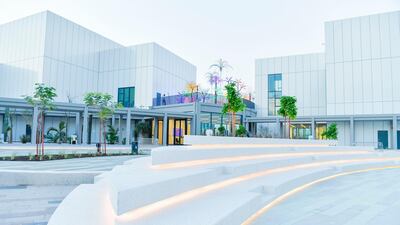
Earlier this month, Art Jameel launched a Dh550,000 grant programme called the Art Jameel Research and Practice Platform to provide micro-funds to artists, writers and curators in the Mena region.
The initiative from the Saudi Arabian foundation, which runs Jameel Art Centre in Dubai, was created for practitioners whose projects have been affected by the cancellation of art exhibitions, art fairs and cultural events amid the coronavirus pandemic.
It's affirming to see such incredible diversity and quality of projects being produced by individual artists, curators, writers and others, often against all the odds
Now, Dubai Culture has announced its support of the platform through a UAE version, aimed at artists, creatives and collectives (of up to five people) living and working in the Emirates. Awarded applicants will receive micro-grants ranging from $1,000 to $3,000 (Dh3,600 to Dh11,000) to help them start or continue work. Up to 20 practitioners will be supported, depending on the submissions.
Globally and regionally, the arts and culture industry continues to be vulnerable in the wake of the pandemic. Dubai Culture’s collaboration with Art Jameel marks the first government-associated grant in the UAE specifically targeted towards artists and cultural practitioners during the Covid-19 crisis.
Applications for the grant can be made by filling out an online form, in English or Arabic, and will be accepted until Wednesday, May 13. An independent jury will consider both the originality of the submission, but also the impact closures and cancellations have had on the applicants.
In a statement, Dubai Culture director general Hala Badri said, “with this support, we intend to broaden the scope of grants given to the entire creative landscape in the UAE, including small-scale organisations, freelancers and independent artists.”
The Art Jameel Research and Practice Platform will continue to accept applications alongside the UAE initiative, with one of its three cycles of funding recently closed.
160 applications from 17 countries, including Algeria and Yemen
According to Antonia Carver, director of Art Jameel, the first round – which was open for a week – received 160 applications from 17 countries, including Morocco, Algeria and Yemen, which she says are "underrepresented in typical arts programming".
So far, 20 applicants have been awarded and 30 shortlisted candidates will be included the second cycle for further consideration.
"The response brings on a mix of emotions – it's affirming to see such incredible diversity and quality of projects being produced by individual artists, curators, writers and others, often against all the odds," she tells The National, noting that the selection process has been highly competitive.
“We hope [that] by working together with other organisations and patrons, we might be able to increase the capacity: every bit counts at this time,” she adds.
Carver highlighted that Dubai Culture’s contribution to the platform will help artists from around the region, too: “not only does it mean increased and broader support for the UAE creative scene, but it also means that Art Jameel is able to allocate funds originally earmarked for UAE artists towards practitioners in other regional countries, some of whom are suffering from deep economic woes and the scars of war, as well as Covid-19.”
Deadlines for Art Jameel’s next two cycles are on Thursday, April 30 and Sunday, June 7.
More information on the UAE version of the platform is available at Art Jameel website.

Kandahar%20
%3Cp%3E%3Cstrong%3EDirector%3A%3C%2Fstrong%3E%20Ric%20Roman%20Waugh%3C%2Fp%3E%0A%3Cp%3E%3Cstrong%3EStars%3A%C2%A0%3C%2Fstrong%3EGerard%20Butler%2C%20Navid%20Negahban%2C%20Ali%20Fazal%3C%2Fp%3E%0A%3Cp%3E%3Cstrong%3ERating%3A%3C%2Fstrong%3E%202.5%2F5%3C%2Fp%3E%0A
Company%20profile
%3Cp%3E%3Cstrong%3ECompany%20name%3A%20%3C%2Fstrong%3EHakbah%0D%3Cbr%3E%3Cstrong%3EStarted%3A%20%3C%2Fstrong%3E2018%0D%3Cbr%3E%3Cstrong%3EFounder%3A%20%3C%2Fstrong%3ENaif%20AbuSaida%0D%3Cbr%3E%3Cstrong%3EBased%3A%20%3C%2Fstrong%3ESaudi%20Arabia%0D%3Cbr%3E%3Cstrong%3ESector%3A%20%3C%2Fstrong%3EFinTech%0D%3Cbr%3E%3Cstrong%3ECurrent%20number%20of%20staff%3A%20%3C%2Fstrong%3E22%20%0D%3Cbr%3E%3Cstrong%3EInitial%20investment%3A%20%3C%2Fstrong%3E%24200%2C000%0D%3Cbr%3E%3Cstrong%3EInvestment%20stage%3A%20%3C%2Fstrong%3Epre-Series%20A%0D%3Cbr%3E%3Cstrong%3EInvestors%3A%20%3C%2Fstrong%3EGlobal%20Ventures%20and%20Aditum%20Investment%20Management%0D%3Cbr%3E%3Cbr%3E%3C%2Fp%3E%0A
Mercer, the investment consulting arm of US services company Marsh & McLennan, expects its wealth division to at least double its assets under management (AUM) in the Middle East as wealth in the region continues to grow despite economic headwinds, a company official said.
Mercer Wealth, which globally has $160 billion in AUM, plans to boost its AUM in the region to $2-$3bn in the next 2-3 years from the present $1bn, said Yasir AbuShaban, a Dubai-based principal with Mercer Wealth.
“Within the next two to three years, we are looking at reaching $2 to $3 billion as a conservative estimate and we do see an opportunity to do so,” said Mr AbuShaban.
Mercer does not directly make investments, but allocates clients’ money they have discretion to, to professional asset managers. They also provide advice to clients.
“We have buying power. We can negotiate on their (client’s) behalf with asset managers to provide them lower fees than they otherwise would have to get on their own,” he added.
Mercer Wealth’s clients include sovereign wealth funds, family offices, and insurance companies among others.
From its office in Dubai, Mercer also looks after Africa, India and Turkey, where they also see opportunity for growth.
Wealth creation in Middle East and Africa (MEA) grew 8.5 per cent to $8.1 trillion last year from $7.5tn in 2015, higher than last year’s global average of 6 per cent and the second-highest growth in a region after Asia-Pacific which grew 9.9 per cent, according to consultancy Boston Consulting Group (BCG). In the region, where wealth grew just 1.9 per cent in 2015 compared with 2014, a pickup in oil prices has helped in wealth generation.
BCG is forecasting MEA wealth will rise to $12tn by 2021, growing at an annual average of 8 per cent.
Drivers of wealth generation in the region will be split evenly between new wealth creation and growth of performance of existing assets, according to BCG.
Another general trend in the region is clients’ looking for a comprehensive approach to investing, according to Mr AbuShaban.
“Institutional investors or some of the families are seeing a slowdown in the available capital they have to invest and in that sense they are looking at optimizing the way they manage their portfolios and making sure they are not investing haphazardly and different parts of their investment are working together,” said Mr AbuShaban.
Some clients also have a higher appetite for risk, given the low interest-rate environment that does not provide enough yield for some institutional investors. These clients are keen to invest in illiquid assets, such as private equity and infrastructure.
“What we have seen is a desire for higher returns in what has been a low-return environment specifically in various fixed income or bonds,” he said.
“In this environment, we have seen a de facto increase in the risk that clients are taking in things like illiquid investments, private equity investments, infrastructure and private debt, those kind of investments were higher illiquidity results in incrementally higher returns.”
The Abu Dhabi Investment Authority, one of the largest sovereign wealth funds, said in its 2016 report that has gradually increased its exposure in direct private equity and private credit transactions, mainly in Asian markets and especially in China and India. The authority’s private equity department focused on structured equities owing to “their defensive characteristics.”
UAE currency: the story behind the money in your pockets
