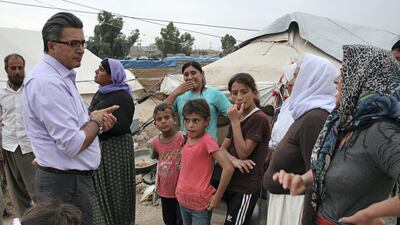
Yazidi campaigners are urging Iraq to implement a national suicide prevention strategy after 11 genocide survivors killed themselves in 10 days.
Psychologist Dr Jan Ilhan Kizilhan was joined by NGOs, including the UK’s Yazda charity, to call for help for Yazidi survivors.
In January, 11 people took their own lives in a 10-day period, while about 250 Yazidis took their lives in 2020, the majority of them women.
"The genocide of the Yazidis in 2014 by ISIS cost thousands of lives and traumatised the community in the long term," Dr Kizilhan told The National.
“Life in the refugee camps, the political unsettled perspective for a better life, as well as the economic and social problems – also the restrictions associated with the current Covid-19 pandemic – increase the psychological stress, which is why some people, especially young women, commit suicide.
“The Yazidi have not recovered from the genocide and are facing a break in their community, which is also evident in the increase in suicides. It is a signal, a cry for help that is not being heard. Every suicide is a tragedy and suicides are preventable.”
Dr Kizilhan runs a £1 million ($1.3m) project in Iraq, training psychologists to support survivors.
In 2018, he helped 1,100 Yazidis, including Nobel laureate Nadia Murad, to move to Germany for psychological help.
Dr Kizilhan is now calling on Iraq to address the mental health crisis.
“Urgent action is needed. Unfortunately, suicidality is rarely identified as a major public health problem by governments,” he said.
“In addition to a national strategy to prevent suicide, the Yazidi must be given the opportunity to return to their settlement areas and rebuild. They need political, social, religious and legal status with rights as a distinct group in order to rebuild their country and have hope that they can live in Iraq.
“Currently, mental health professionals and care for the people in the refugee camps are needed to treat the mental illnesses and stresses to decrease the number of suicides. Regional health authorities and NGOs must respond and help now.
“Every single life lost to suicide is one life too many.”
His calls for help were echoed by the Coalition for Just Reparations, an alliance of 27 Iraqi NGOs calling for comprehensive reparations for civilian victims of crimes committed during the ISIS conflict in Iraq. It includes the support of Ms Murad's non-profit organisation, Nadia's Initiative.
“The entire Yazidi population is experiencing mental trauma caused by the acts of genocide, and some are displaying severe psychological difficulties,” the coalition said.
“Among those at heightened risk are the women and girls who experienced systemic sexual violence, and the boys who were forcibly recruited by ISIS.
“We are now seeing the tragic results of the failure to address these warnings. The impact of suicide on families and communities is devastating and long lasting.
“We support the calls for the government of Iraq and the Kurdish regional government to expedite the establishment and implementation of a national suicide prevention strategy.
“The underlying risk factors that lead to suicidal acts must be addressed. This includes bringing ISIS to justice for their crimes and ensuring that survivors receive comprehensive reparations.
“We all have a collective moral responsibility to help survivors of genocide and other atrocity crimes by supporting those struggling with mental illness and by working to prevent suicides. Every life is precious.”
Doctors Without Borders had previously raised the issue of a debilitating mental health crisis among Yazidis in Iraq, including the rising number of suicides.
Last year, exhumation of more than 200 mass graves containing about 12,000 victims of the ISIS genocide of Yazidis began.
The first victims identified are due to be returned to their families for burial.

The smuggler
Eldarir had arrived at JFK in January 2020 with three suitcases, containing goods he valued at $300, when he was directed to a search area.
Officers found 41 gold artefacts among the bags, including amulets from a funerary set which prepared the deceased for the afterlife.
Also found was a cartouche of a Ptolemaic king on a relief that was originally part of a royal building or temple.
The largest single group of items found in Eldarir’s cases were 400 shabtis, or figurines.
Khouli conviction
Khouli smuggled items into the US by making false declarations to customs about the country of origin and value of the items.
According to Immigration and Customs Enforcement, he provided “false provenances which stated that [two] Egyptian antiquities were part of a collection assembled by Khouli's father in Israel in the 1960s” when in fact “Khouli acquired the Egyptian antiquities from other dealers”.
He was sentenced to one year of probation, six months of home confinement and 200 hours of community service in 2012 after admitting buying and smuggling Egyptian antiquities, including coffins, funerary boats and limestone figures.
For sale
A number of other items said to come from the collection of Ezeldeen Taha Eldarir are currently or recently for sale.
Their provenance is described in near identical terms as the British Museum shabti: bought from Salahaddin Sirmali, "authenticated and appraised" by Hossen Rashed, then imported to the US in 1948.
- An Egyptian Mummy mask dating from 700BC-30BC, is on offer for £11,807 ($15,275) online by a seller in Mexico
- A coffin lid dating back to 664BC-332BC was offered for sale by a Colorado-based art dealer, with a starting price of $65,000
- A shabti that was on sale through a Chicago-based coin dealer, dating from 1567BC-1085BC, is up for $1,950
Museum of the Future in numbers
- 78 metres is the height of the museum
- 30,000 square metres is its total area
- 17,000 square metres is the length of the stainless steel facade
- 14 kilometres is the length of LED lights used on the facade
- 1,024 individual pieces make up the exterior
- 7 floors in all, with one for administrative offices
- 2,400 diagonally intersecting steel members frame the torus shape
- 100 species of trees and plants dot the gardens
- Dh145 is the price of a ticket
Our legal columnist
Name: Yousef Al Bahar
Advocate at Al Bahar & Associate Advocates and Legal Consultants, established in 1994
Education: Mr Al Bahar was born in 1979 and graduated in 2008 from the Judicial Institute. He took after his father, who was one of the first Emirati lawyers
Pakistanis%20at%20the%20ILT20%20
%3Cp%3EThe%20new%20UAE%20league%20has%20been%20boosted%20this%20season%20by%20the%20arrival%20of%20five%20Pakistanis%2C%20who%20were%20not%20released%20to%20play%20last%20year.%20%0D%3Cbr%3E%0D%0D%0D%3Cbr%3E%3Cstrong%3EShaheen%20Afridi%20(Desert%20Vipers)%20%3C%2Fstrong%3E%0D%3Cbr%3ESet%20for%20at%20least%20four%20matches%2C%20having%20arrived%20from%20New%20Zealand%20where%20he%20captained%20Pakistan%20in%20a%20series%20loss.%20%0D%3C%2Fp%3E%0A%3Cp%3E%3Cstrong%3EShadab%20Khan%20(Desert%20Vipers)%20%3C%2Fstrong%3E%0D%3Cbr%3E%0DThe%20leg-spin%20bowling%20allrounder%20missed%20the%20tour%20of%20New%20Zealand%20after%20injuring%20an%20ankle%20when%20stepping%20on%20a%20ball.%20%0D%3C%2Fp%3E%0A%3Cp%3E%3Cstrong%3EAzam%20Khan%20(Desert%20Vipers)%20%3C%2Fstrong%3E%0D%3Cbr%3EPowerhouse%20wicketkeeper%20played%20three%20games%20for%20Pakistan%20on%20tour%20in%20New%20Zealand.%20He%20was%20the%20first%20Pakistani%20recruited%20to%20the%20ILT20.%20%0D%3C%2Fp%3E%0A%3Cp%3E%3Cstrong%3EMohammed%20Amir%20(Desert%20Vipers)%20%3C%2Fstrong%3E%0D%3Cbr%3EHas%20made%20himself%20unavailable%20for%20national%20duty%2C%20meaning%20he%20will%20be%20available%20for%20the%20entire%20ILT20%20campaign.%20%0D%3C%2Fp%3E%0A%3Cp%3E%3Cstrong%3EImad%20Wasim%20(Abu%20Dhabi%20Knight%20Riders)%20%3C%2Fstrong%3E%0D%3Cbr%3EThe%20left-handed%20allrounder%2C%2035%2C%20retired%20from%20international%20cricket%20in%20November%20and%20was%20subsequently%20recruited%20by%20the%20Knight%20Riders.%26nbsp%3B%3C%2Fp%3E%0A
