• Ashraf Ghani, a former professor and World Bank employee, was declared President this week after disputed results dragged out the final election outcome for months. He narrowly secured his win in the contested race by garnering 50.6 per cent of the disputed vote. He will serve five more years as President. After being excluded from last year’s failed US-Taliban peace negotiations, the Pashtun politician demanded to play a bigger role in this year’s talks. But at the behest of the Taliban he was not invited to participate in the discussions. The reasons for his exclusion are two-fold, first, the Taliban does not recognise the legitimacy of the Afghan government. Second, the Taliban’s priority in the negotiations is the removal of foreign forces from the country, which can only be promised by American negotiators. As a result, Mr Ghani remains sceptical of the deal’s success. Being one step removed from the process, and having few other options available to him, Mr Ghani finds himself in a position where he must acquiesce to the final deal without providing much input into the terms. Mr Ghani's position is shaky going into the proposed intra-Afghan negotiations as both the Taliban and Mr Ghani's opponent Abdullah Abdullah are refusing to accept his presidential win. Photo: EPA
    Ashraf Ghani, a former professor and World Bank employee, was declared President this week after disputed results dragged out the final election outcome for months. He narrowly secured his win in the contested race by garnering 50.6 per cent of the disputed vote. He will serve five more years as President. After being excluded from last year’s failed US-Taliban peace negotiations, the Pashtun politician demanded to play a bigger role in this year’s talks. But at the behest of the Taliban he was not invited to participate in the discussions. The reasons for his exclusion are two-fold, first, the Taliban does not recognise the legitimacy of the Afghan government. Second, the Taliban’s priority in the negotiations is the removal of foreign forces from the country, which can only be promised by American negotiators. As a result, Mr Ghani remains sceptical of the deal’s success. Being one step removed from the process, and having few other options available to him, Mr Ghani finds himself in a position where he must acquiesce to the final deal without providing much input into the terms. Mr Ghani's position is shaky going into the proposed intra-Afghan negotiations as both the Taliban and Mr Ghani's opponent Abdullah Abdullah are refusing to accept his presidential win. Photo: EPA
  • Abdullah Abdullah, a former eye surgeon, serves as the country’s Chief Executive. He is the only person to ever hold the title, which brings with it prime ministerial duties. The newly created post was the result of the US mediating an awkward power-sharing deal after the 2014 elections. Dr Abdullah has unsuccessfully sought the presidency three times. After losing the election to Mr Ghani this week, Dr Abdullah decried that he would form his own government and boycott the election results. He went so far as to call the country’s independent election commissions “unlawful.” With the peace deal aiming to ending a tense political stand-off between the Afghan government and the Taliban, it seems frictions within the Afghan government could lead to a new stand-off, one between Mr Ghani and his opponents, putting at risk the intra-Afghan discussions that are baked into the trade agreement. Photo: AP
    Abdullah Abdullah, a former eye surgeon, serves as the country’s Chief Executive. He is the only person to ever hold the title, which brings with it prime ministerial duties. The newly created post was the result of the US mediating an awkward power-sharing deal after the 2014 elections. Dr Abdullah has unsuccessfully sought the presidency three times. After losing the election to Mr Ghani this week, Dr Abdullah decried that he would form his own government and boycott the election results. He went so far as to call the country’s independent election commissions “unlawful.” With the peace deal aiming to ending a tense political stand-off between the Afghan government and the Taliban, it seems frictions within the Afghan government could lead to a new stand-off, one between Mr Ghani and his opponents, putting at risk the intra-Afghan discussions that are baked into the trade agreement. Photo: AP
  • Gen Abdul Rashid Dostum was controversially chosen as Mr Ghani’s vice-president in the 2014 election. But after a falling out, Gen Dostum decided to put his support behind Mr Ghani’s opponent Dr Abdullah in the latest election. The Uzbek former warlord has been the target of several assassination attempts and faces a litany of human rights accusations against him, which include claims of torture and rape. The Afghan army general has fleed to Turkey when accusations mounted against him in the past. In 2017, Gen Dostum's political rival Ahmad Ishchi said he had been abducted, tortured and raped by Gen Dostum. Several people came forward to say they witnessed the abuse, prompting Gen Dostum to flee to Turkey. Gen Dostum could interfere in the pending intra-Afghan talks, as he's expressed discontent with the election results and threatened to form a “parallel government.” No stranger to extremity, his erratic behaviour threatens the stability of Afghanistan’s government during this crucial peace process. Photo: Getty Images
    Gen Abdul Rashid Dostum was controversially chosen as Mr Ghani’s vice-president in the 2014 election. But after a falling out, Gen Dostum decided to put his support behind Mr Ghani’s opponent Dr Abdullah in the latest election. The Uzbek former warlord has been the target of several assassination attempts and faces a litany of human rights accusations against him, which include claims of torture and rape. The Afghan army general has fleed to Turkey when accusations mounted against him in the past. In 2017, Gen Dostum's political rival Ahmad Ishchi said he had been abducted, tortured and raped by Gen Dostum. Several people came forward to say they witnessed the abuse, prompting Gen Dostum to flee to Turkey. Gen Dostum could interfere in the pending intra-Afghan talks, as he's expressed discontent with the election results and threatened to form a “parallel government.” No stranger to extremity, his erratic behaviour threatens the stability of Afghanistan’s government during this crucial peace process. Photo: Getty Images
  • Amrullah Saleh was Mr Ghani’s running mate in the 2019 election, and is set to take on the role of vice-president. Mr Saleh is an ex-intelligence chief who has not shied away from doling out fierce criticisms against the president. The Tajik politician enjoys grass roots support among young people, which provided an advantage to Mr Ghani’s campaign. Mr Saleh was the target of an attack against his office within the Kabul headquarters of the Green Trend party during the summer of 2019. The attack killed 20 people and injured 50, resulting in a six-hour operation to rescue more than 150 civilians trapped in the aftermath of the blast. The attack came just hours after Mr Ghani and Mr Saleh launched their election campaign. Photo: REUTERS
    Amrullah Saleh was Mr Ghani’s running mate in the 2019 election, and is set to take on the role of vice-president. Mr Saleh is an ex-intelligence chief who has not shied away from doling out fierce criticisms against the president. The Tajik politician enjoys grass roots support among young people, which provided an advantage to Mr Ghani’s campaign. Mr Saleh was the target of an attack against his office within the Kabul headquarters of the Green Trend party during the summer of 2019. The attack killed 20 people and injured 50, resulting in a six-hour operation to rescue more than 150 civilians trapped in the aftermath of the blast. The attack came just hours after Mr Ghani and Mr Saleh launched their election campaign. Photo: REUTERS
  • Sarwar Danish, a Hazara politician, was chosen for the role of second vice-president during Mr Ghani’s 2014 campaign. He retained the position in the latest election. Mr Danish has been strongly critical of the peace negotiations, emphasising that peace cannot be achieved by sidelining the government from talks. He called the reduction in violence agreement a “vague proposal” intended to deceive citizens and the international community. Photo: REUTERS
    Sarwar Danish, a Hazara politician, was chosen for the role of second vice-president during Mr Ghani’s 2014 campaign. He retained the position in the latest election. Mr Danish has been strongly critical of the peace negotiations, emphasising that peace cannot be achieved by sidelining the government from talks. He called the reduction in violence agreement a “vague proposal” intended to deceive citizens and the international community. Photo: REUTERS
  • Hamid Karzai was the first elected President of Afghanistan and held the role for almost 10 years, reigning during much of the US war in Afghanistan. The Pashtun tribal leader was the first Afghan official to work alongside the Americans in attempting to forge a peace deal with the Taliban. In 2010, during his presidency, Mr Karzai made peace negotiations a priority. Unlike today’s negotiations, Mr Karzai attempted to negotiate directly with the Taliban, and invited a wide range of actors to the table, including the Americans, the Taliban, tribal leaders and other influential members of Afghan society. Photo: Reuters
    Hamid Karzai was the first elected President of Afghanistan and held the role for almost 10 years, reigning during much of the US war in Afghanistan. The Pashtun tribal leader was the first Afghan official to work alongside the Americans in attempting to forge a peace deal with the Taliban. In 2010, during his presidency, Mr Karzai made peace negotiations a priority. Unlike today’s negotiations, Mr Karzai attempted to negotiate directly with the Taliban, and invited a wide range of actors to the table, including the Americans, the Taliban, tribal leaders and other influential members of Afghan society. Photo: Reuters
  • As the leader of the Taliban, Mawlawi Hibatullah Akhundzada agreed to bring the insurgent group to the negotiation table. He is acting in an advisory role throughout the discussions, serving as the steering force for chief negotiator Mr Baradar. But it falls upon Mawlawi Akhundzada to make the final decision when it comes to whether the Taliban will accept the final deal. Last week, he threatened to pull out of the negotiations if the Americans did not respond formally to the Taliban’s seven-day offer for a reduction of violence. AFP PHOTO / AFGHAN TALIBAN
    As the leader of the Taliban, Mawlawi Hibatullah Akhundzada agreed to bring the insurgent group to the negotiation table. He is acting in an advisory role throughout the discussions, serving as the steering force for chief negotiator Mr Baradar. But it falls upon Mawlawi Akhundzada to make the final decision when it comes to whether the Taliban will accept the final deal. Last week, he threatened to pull out of the negotiations if the Americans did not respond formally to the Taliban’s seven-day offer for a reduction of violence. AFP PHOTO / AFGHAN TALIBAN
  • Abdul Ghani Baradar runs the Taliban’s political office in Doha and has taken on the role of chief negotiator for the insurgent group during these negotiations. He’s credited with helping to establish the group’s strong position in the country, having served as the number two in command for the group’s founding leader Mohammed Omar. He was a key senior operative for the group, who once held a reputation for being even-keeled, before he fled to Pakistan when the Americans arrived in 2001. Mr Baradar was arrested in a 2010 raid and remained in a Pakistani prison for eight years. His release is believed to have been a part of a deal struck between the Americans and the Taliban. Photo: AFP
    Abdul Ghani Baradar runs the Taliban’s political office in Doha and has taken on the role of chief negotiator for the insurgent group during these negotiations. He’s credited with helping to establish the group’s strong position in the country, having served as the number two in command for the group’s founding leader Mohammed Omar. He was a key senior operative for the group, who once held a reputation for being even-keeled, before he fled to Pakistan when the Americans arrived in 2001. Mr Baradar was arrested in a 2010 raid and remained in a Pakistani prison for eight years. His release is believed to have been a part of a deal struck between the Americans and the Taliban. Photo: AFP
  • Abdul Salam Hanafi is one of the central negotiators at the table representing the Taliban. He serves as deputy head of the group’s political office in Doha. On Monday, he said the Americans and the Taliban were already drafting the final peace agreement. He added that representatives from all neighbours of Afghanistan, the United Nations Security Council, Islamic countries and European Union would be invited to the ceremony that would be held in Doha if the deal is finalised. Mr Hanafi previously served as the Taliban’s deputy minister of education and held leadership positions in the country’s northern territories. As a senior member of the group, he was added to the United Nations sanctions list in 2001, accused of being involved in drug trafficking. Photo: AP
    Abdul Salam Hanafi is one of the central negotiators at the table representing the Taliban. He serves as deputy head of the group’s political office in Doha. On Monday, he said the Americans and the Taliban were already drafting the final peace agreement. He added that representatives from all neighbours of Afghanistan, the United Nations Security Council, Islamic countries and European Union would be invited to the ceremony that would be held in Doha if the deal is finalised. Mr Hanafi previously served as the Taliban’s deputy minister of education and held leadership positions in the country’s northern territories. As a senior member of the group, he was added to the United Nations sanctions list in 2001, accused of being involved in drug trafficking. Photo: AP
  • Suhail Shaheen has served as a public figurehead for the insurgent group throughout the negotiations. He is a fluent English speaker known to give interviews to international media outlets. During the Taliban’s rule in the country, which lasted from 1996 to 2001, Mr Shaheen served as the editor of the English-language Kabul Times newspaper. He's also held senior roles within the Taliban, such as deputy ambassador at the Afghan embassy in Pakistan. Many of the statements regarding the Taliban’s position in the negotiations are delivered through Mr Shaheen. Photo: AFP
    Suhail Shaheen has served as a public figurehead for the insurgent group throughout the negotiations. He is a fluent English speaker known to give interviews to international media outlets. During the Taliban’s rule in the country, which lasted from 1996 to 2001, Mr Shaheen served as the editor of the English-language Kabul Times newspaper. He's also held senior roles within the Taliban, such as deputy ambassador at the Afghan embassy in Pakistan. Many of the statements regarding the Taliban’s position in the negotiations are delivered through Mr Shaheen. Photo: AFP
  • US President Donald Trump is serving as the “closer” in the negotiations. In 2019’s negotiations, he took on a similar role by inviting the Taliban to Camp David to close the deal. Amid strife between his top advisers and the death of an American soldier in Afghanistan, Mr Trump abruptly declared the peace talks "dead." Mr Trump has proven to be more patient and flexible during this round of negotiations. If the withdrawal is accomplished, the American negotiators would have fulfilled a Trump campaign promise to withdraw US troops from Afghanistan, well-timed before the presidential election in November. Photo: EPA
    US President Donald Trump is serving as the “closer” in the negotiations. In 2019’s negotiations, he took on a similar role by inviting the Taliban to Camp David to close the deal. Amid strife between his top advisers and the death of an American soldier in Afghanistan, Mr Trump abruptly declared the peace talks "dead." Mr Trump has proven to be more patient and flexible during this round of negotiations. If the withdrawal is accomplished, the American negotiators would have fulfilled a Trump campaign promise to withdraw US troops from Afghanistan, well-timed before the presidential election in November. Photo: EPA
  • US envoy Zalmay Khalilzad is the chief negotiator on the American side, colloquially referred to as “Zal,” he was the only Afghan working in the White House during the September 11 attacks. This is his second attempt to help US President Donald Trump finalise a peace deal with the Taliban. The Afghan-born diplomat, who serves as the main intermediary between the Americans and the Taliban, nearly finalised a peace agreement last year, before Trump abruptly cancelled the deal. While the heavy lifting of the negotiations is being led by Mr Khalilzad, the diplomat is working on behalf of the White House, the Pentagon and the US intelligence community, who must all agree to the final terms of the deal. Photo: AFP
    US envoy Zalmay Khalilzad is the chief negotiator on the American side, colloquially referred to as “Zal,” he was the only Afghan working in the White House during the September 11 attacks. This is his second attempt to help US President Donald Trump finalise a peace deal with the Taliban. The Afghan-born diplomat, who serves as the main intermediary between the Americans and the Taliban, nearly finalised a peace agreement last year, before Trump abruptly cancelled the deal. While the heavy lifting of the negotiations is being led by Mr Khalilzad, the diplomat is working on behalf of the White House, the Pentagon and the US intelligence community, who must all agree to the final terms of the deal. Photo: AFP
  • US Secretary of State Mike Pompeo has served in many capacities throughout the negotiations, most notably acting as the US spokesman, delivering major updates about the US position to both the public and to Afghan officials. At the Munich Security Conference in February, Mr Pompeo held sideline meetings with key Afghan officials, including Mr Ghani and Mr Abdullah to discuss the negotiation process that appeared close to finalisation. Photo: AFP
    US Secretary of State Mike Pompeo has served in many capacities throughout the negotiations, most notably acting as the US spokesman, delivering major updates about the US position to both the public and to Afghan officials. At the Munich Security Conference in February, Mr Pompeo held sideline meetings with key Afghan officials, including Mr Ghani and Mr Abdullah to discuss the negotiation process that appeared close to finalisation. Photo: AFP
  • US Defence Secretary Mark Esper has operated throughout these discussions on behalf of the 3,500 American and Nato service members that have been killed since 2001. His position remains cautiously optimistic. He called the reduction in violence proposal “very promising,” but holds on to scepticism regarding the success of its implementation. “The best if not the only way forward in Afghanistan is through a political agreement and that means taking some risk,” he said. Photo: REUTERS
    US Defence Secretary Mark Esper has operated throughout these discussions on behalf of the 3,500 American and Nato service members that have been killed since 2001. His position remains cautiously optimistic. He called the reduction in violence proposal “very promising,” but holds on to scepticism regarding the success of its implementation. “The best if not the only way forward in Afghanistan is through a political agreement and that means taking some risk,” he said. Photo: REUTERS
  • US Army General Austin Scott Miller took over the post of commander of American and coalition forces in Afghanistan in 2018. During his tenure, Mr Miller ramped up air strikes in the country in the hopes of forcing the Taliban to the negotiation table. But it’s led to a further escalation as the Taliban responded with increasing violence in the country. Gen Miller has previously advocated for a smaller American presence in Afghanistan, stating that he does not require tens of thousands of US troops in the country to successfully fulfill the US combat and training operations. Photo: AFP
    US Army General Austin Scott Miller took over the post of commander of American and coalition forces in Afghanistan in 2018. During his tenure, Mr Miller ramped up air strikes in the country in the hopes of forcing the Taliban to the negotiation table. But it’s led to a further escalation as the Taliban responded with increasing violence in the country. Gen Miller has previously advocated for a smaller American presence in Afghanistan, stating that he does not require tens of thousands of US troops in the country to successfully fulfill the US combat and training operations. Photo: AFP
  • Qater is hosting the peace talks, with Sheikh Mohammed bin Abdulrahman Al Thani, the deputy prime minister and minister of foreign affairs, playing a mediating role in the negotiations. Sheikh Al Thani has been a liaison between the Americans and the Taliban from the beginning of the negotiations, sitting in on several of the key discussions. When the Taliban’s chief negotiator Mr Baradar delivered an ultimatum to the Americans, demanding they accept the offered seven-day reduction in violence, rather than the American’s requested 10-days, it was Sheikh Al Thani that mediated the deadlock, according to pro-Taliban media. Photo: AFP
    Qater is hosting the peace talks, with Sheikh Mohammed bin Abdulrahman Al Thani, the deputy prime minister and minister of foreign affairs, playing a mediating role in the negotiations. Sheikh Al Thani has been a liaison between the Americans and the Taliban from the beginning of the negotiations, sitting in on several of the key discussions. When the Taliban’s chief negotiator Mr Baradar delivered an ultimatum to the Americans, demanding they accept the offered seven-day reduction in violence, rather than the American’s requested 10-days, it was Sheikh Al Thani that mediated the deadlock, according to pro-Taliban media. Photo: AFP

US-Taliban deal: who said what?


  • English
  • Arabic

The United States signed a deal with Taliban insurgents on Saturday that could pave the way toward a full withdrawal of foreign soldiers from Afghanistan over the next 14 months and represent a step toward ending the 18-year-war in the nation.

Here is what all sides involved in securing peace in Afghanistan say on the deal.

United States

President Donald Trump says: "There hasn't been a moment like this. We've had very successful negotiations. We think they'll be successful in the end."

"The other side is tired of war. Everybody is tired of war...I'll be meeting personally with Taliban leaders in the not-too-distant future. And we'll be very much hoping that they will be doing what they say they are going to be doing. They will be killing terrorists."

Secretary of State Mike Pompeo says the US is "realistic" about the peace deal it signed with the Taliban, but is "seizing the best opportunity for peace in a generation."

The secretary of state said he told the Taliban to keep their promise to cut ties with Al Qaeda and keep fighting ISIS.

“Today, we’re realistic. We are seizing the best opportunity for peace in a generation built on the hard work of our soldiers, diplomats, businessmen, aid workers, friends and the Afghans themselves. Today, we’re restrained. We recognize America shouldn’t fight in perpetuity in the graveyard of empires, if we could help Afghans forge peace. And we have respect. We believe that the Afghan people are ready to start their own course forward. Today, following the first ever week-long break in fighting in nearly 19 years, I’m proud to announce that the United States has secured separate commitments from the Islamic Republic of Afghanistan and the Taliban to hold negotiations for peace. Very importantly, the US-Taliban agreement entails a promise from the Taliban that terrorists can never again operate from Afghan soil.”

Secretary of Defence Mark Esper says the US is committed to relations with the Afghan security forces. "This is a hopeful moment, but it is only the beginning. The road ahead will not be easy. Achieving lasting peace in Afghanistan will require patience and compromise among all parties,"  he said.

The US Embassy in Kabul says, "Today is a monumental day for Afghanistan… it is about making peace and crafting a common brighter future. We stand with Afghanistan.

US Republican Senator Lindsey Graham says, "I am very suspect of the Taliban ever accepting the Afghan constitution and honouring the rights of religious minorities and women. Time will tell if reconciliation in Afghanistan can be accomplished with honour and security, but after more than 18 years of war, it is time to try."

Afghan government

President Ashraf Ghani says, "We hope the US-Taliban peace will lead to a permanent ceasefire...The nation is looking forward to a full ceasefire."

"All the materials of the ... deal are based on condition, it depends on the Taliban's commitment to the peace deal…There are several points in the deal needs consideration which can be discussed in the talks with the Taliban…Our negotiating team, under the framework of the Afghan government, will be inclusive."

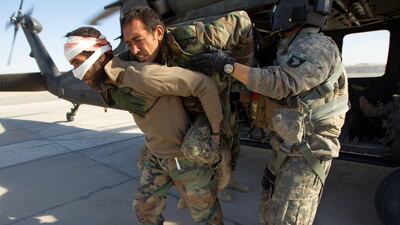
  • Sergeant Jay Kenney, 26, with the 101st Airborne Division, Task Force Destiny, assists wounded Afghan National Army (ANA) soldiers off the Blackhawk UH-60A helicopter after they were rescued in an air mission in Kandahar on December 12, 2010 in Kandahar province, Afghanistan. Getty Images
    Sergeant Jay Kenney, 26, with the 101st Airborne Division, Task Force Destiny, assists wounded Afghan National Army (ANA) soldiers off the Blackhawk UH-60A helicopter after they were rescued in an air mission in Kandahar on December 12, 2010 in Kandahar province, Afghanistan. Getty Images
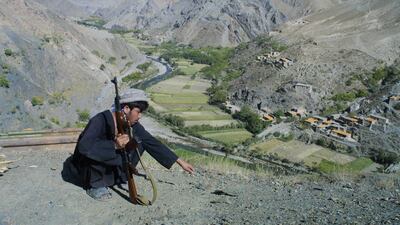
  • An Afghan Northern Alliance fighter mans the front line against the Taliban on October 2, 2001 near Jabul os Sarache, 30 miles north of Kabul. Getty Images
    An Afghan Northern Alliance fighter mans the front line against the Taliban on October 2, 2001 near Jabul os Sarache, 30 miles north of Kabul. Getty Images
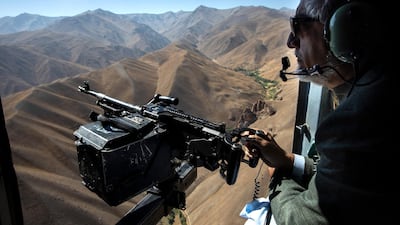
  • Abdullah Abdullah, chief executive of Afghanistan travelling via helicopter for the final campaign rally in Bamiyan, Afghanistan on September 25, 2019. Afghans will head to the polls on Saturday, September 28th. Getty Images
    Abdullah Abdullah, chief executive of Afghanistan travelling via helicopter for the final campaign rally in Bamiyan, Afghanistan on September 25, 2019. Afghans will head to the polls on Saturday, September 28th. Getty Images
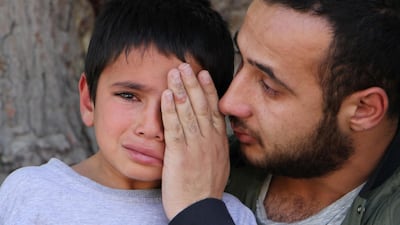
  • Mustafa Tamanna, 10, son of Afghan reporter Zabihullah Tamanna, weeps during the funeral ceremony in Kabul, Afghanistan on June 7, 2016. Tamanna was killed by a rocket-propelled grenade fired by the Taliban. Getty Images
    Mustafa Tamanna, 10, son of Afghan reporter Zabihullah Tamanna, weeps during the funeral ceremony in Kabul, Afghanistan on June 7, 2016. Tamanna was killed by a rocket-propelled grenade fired by the Taliban. Getty Images
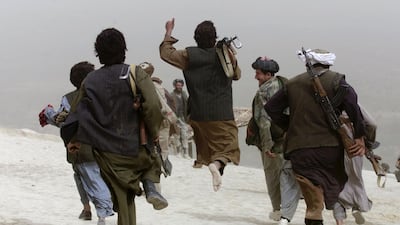
  • Northern Alliance soldiers come back from the front line after a battle near Charatoy town in the north of Afghanistan on October 10, 2001. REUTERS
    Northern Alliance soldiers come back from the front line after a battle near Charatoy town in the north of Afghanistan on October 10, 2001. REUTERS
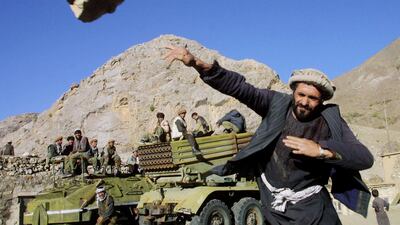
  • A Northern Alliance fighter throwing rocks as part of a popular national game yards away from a multiple Grad missile launcher in October 12, 2001 in the Salang Gorge in Northern Afghanistan. Getty Images
    A Northern Alliance fighter throwing rocks as part of a popular national game yards away from a multiple Grad missile launcher in October 12, 2001 in the Salang Gorge in Northern Afghanistan. Getty Images
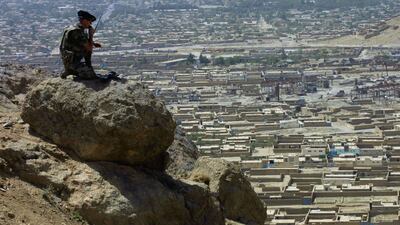
  • A French soldier from the 7th Mountain Regiment, part of the International Security and Assistance Force (ISAF) stands on a boulder overlooking Kabul during a patrol August 3, 2002 in Afghanistan. The ISAF has been patrolling Kabul since January 2002, working with the government and a new police force to prevent the violence and lawlessness that threatened to engulf the city after a U.S.-led coalition forced the Taliban from power. Getty Images
    A French soldier from the 7th Mountain Regiment, part of the International Security and Assistance Force (ISAF) stands on a boulder overlooking Kabul during a patrol August 3, 2002 in Afghanistan. The ISAF has been patrolling Kabul since January 2002, working with the government and a new police force to prevent the violence and lawlessness that threatened to engulf the city after a U.S.-led coalition forced the Taliban from power. Getty Images
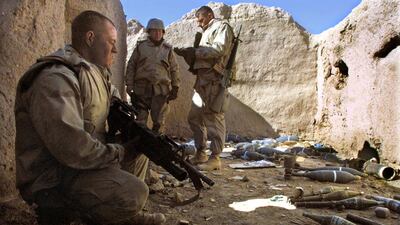
  • US Marine Sgt. Jerry Brown (L) of Jacksonville, North Carolina watches over a weapons cache found during a patrol near the American military compound at Kandahar Airport in January 16, 2002 in Kandahar, Afghanistan. The Marines recovered mortars, rockets, rocket-propelled grenades and artillery rounds discovered in various caches near the base while on the patrol. Getty Images)
    US Marine Sgt. Jerry Brown (L) of Jacksonville, North Carolina watches over a weapons cache found during a patrol near the American military compound at Kandahar Airport in January 16, 2002 in Kandahar, Afghanistan. The Marines recovered mortars, rockets, rocket-propelled grenades and artillery rounds discovered in various caches near the base while on the patrol. Getty Images)
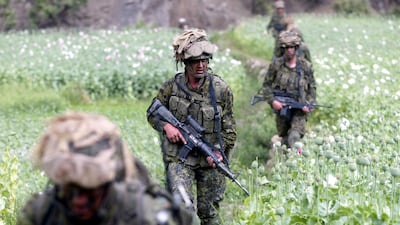
  • Members of the Princess Patricia's Canadian Light Infantry patrol through poppy fields in the village of Markhanai in May 6, 2002 in the Tora Bora valley region of Afghanistan. Getty Images
    Members of the Princess Patricia's Canadian Light Infantry patrol through poppy fields in the village of Markhanai in May 6, 2002 in the Tora Bora valley region of Afghanistan. Getty Images
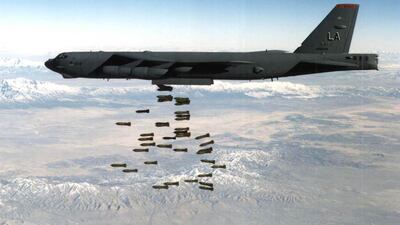
  • The United States and Britain on October 7, 2001 launched a first wave of air strikes against Afghanistan. President George W. Bush said the action heralded a "sustained, comprehensive and relentless" campaign against terrorism. REUTERS
    The United States and Britain on October 7, 2001 launched a first wave of air strikes against Afghanistan. President George W. Bush said the action heralded a "sustained, comprehensive and relentless" campaign against terrorism. REUTERS
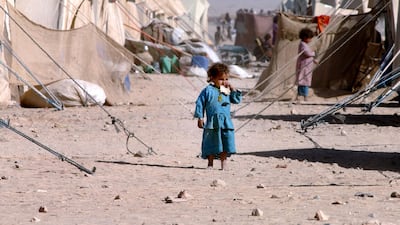
  • A young Afghan girl eats a piece of bread at the Chaman refugee camp on November 8, 2001 on the Pakistan border with Afghanistan. The UNHCR has estimated that since September 11, 2001 over 135,000 Afghans have crossed the border into Pakistan, adding to the already millions of refugees living in the country. Getty Images
    A young Afghan girl eats a piece of bread at the Chaman refugee camp on November 8, 2001 on the Pakistan border with Afghanistan. The UNHCR has estimated that since September 11, 2001 over 135,000 Afghans have crossed the border into Pakistan, adding to the already millions of refugees living in the country. Getty Images
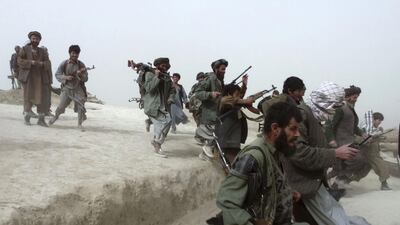
  • Afghan opposition Northern Alliance soldiers leap over a trench as they return from front line positions after battle near the town of Charatoy in the north of Afghanistan October 10, 2001. REUTERS
    Afghan opposition Northern Alliance soldiers leap over a trench as they return from front line positions after battle near the town of Charatoy in the north of Afghanistan October 10, 2001. REUTERS
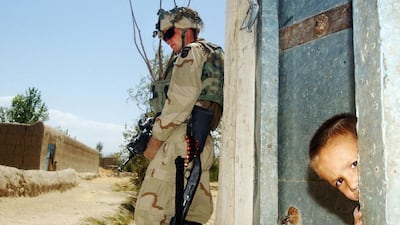
  • An Afghan child peeks out from the doorway of his family's home as a US Army soldier from the 101st Airborne stands guard in the eastern Afghan village of Hesarak on July 16, 2002 during what the Army refers to as a 'sensitive site exploitation' mission or 'SSE'. Getty Images
    An Afghan child peeks out from the doorway of his family's home as a US Army soldier from the 101st Airborne stands guard in the eastern Afghan village of Hesarak on July 16, 2002 during what the Army refers to as a 'sensitive site exploitation' mission or 'SSE'. Getty Images
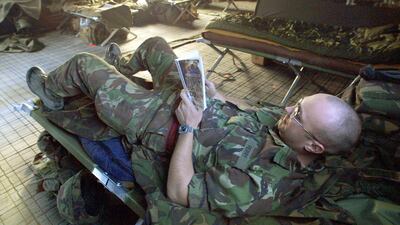
  • Fred Perry, a British Royal Engineer soldier, reads the book "Black Hawk Down" inside his tent after a day of work on January 29, 2002 at the International Security Assistance Force (ISAF) barracks at the Kabul airport in Kabul, Afghanistan. Getty Images
    Fred Perry, a British Royal Engineer soldier, reads the book "Black Hawk Down" inside his tent after a day of work on January 29, 2002 at the International Security Assistance Force (ISAF) barracks at the Kabul airport in Kabul, Afghanistan. Getty Images
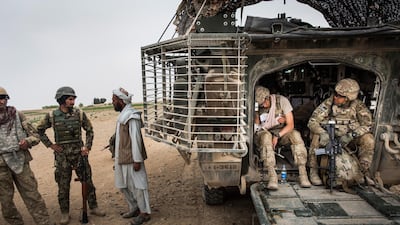
  • Afghan soldiers (L) speak to a local Afghan, while a medic in the U.S. Army's 1st Battalion, 36th Infantry Regiment, Charlie Company (R) monitors a soldier who has just survived a blast from an improvised explosive device (IED) while driving a vehicle during a mission near Command Outpost Pa'in Kalay, on March 19, 2013 in Kandahar Province, Maiwand District, Afghanistan. Getty Images
    Afghan soldiers (L) speak to a local Afghan, while a medic in the U.S. Army's 1st Battalion, 36th Infantry Regiment, Charlie Company (R) monitors a soldier who has just survived a blast from an improvised explosive device (IED) while driving a vehicle during a mission near Command Outpost Pa'in Kalay, on March 19, 2013 in Kandahar Province, Maiwand District, Afghanistan. Getty Images
  • Marines on a light armored vehicle prepare for patrol as an AH1W "Super Cobra" helicopter flies by on December 28, 2001 at the U.S. Marine Corps Base in Kandahar, Afghanistan. Getty Images
    Marines on a light armored vehicle prepare for patrol as an AH1W "Super Cobra" helicopter flies by on December 28, 2001 at the U.S. Marine Corps Base in Kandahar, Afghanistan. Getty Images
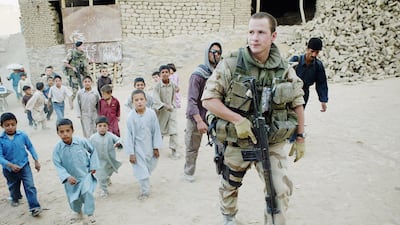
  • A Norwegian ISAF (International Security Assistance Force)soldier from Recce Squadron 3 patrols on October 4, 2004 in Kabul, Afghanistan as election officials get ready for the Presidential elections. Getty Images
    A Norwegian ISAF (International Security Assistance Force)soldier from Recce Squadron 3 patrols on October 4, 2004 in Kabul, Afghanistan as election officials get ready for the Presidential elections. Getty Images
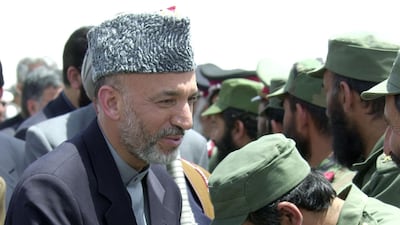
  • Interim Afghan leader Hamid Karzai (L) is greeted by a group of Afghan military officers on his arrival to Kandahar airbase on May 04, 2002 in Southern Afghanistan. Getty Images
    Interim Afghan leader Hamid Karzai (L) is greeted by a group of Afghan military officers on his arrival to Kandahar airbase on May 04, 2002 in Southern Afghanistan. Getty Images
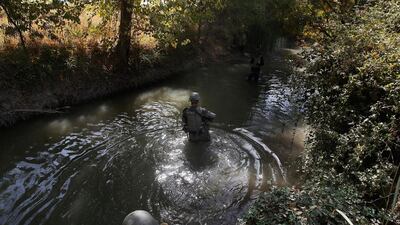
  • Soldiers in the U.S. Army's 101st Airborne Division wade though a creek to avoid buried insurgent bombs while on patrol October 16, 2010 in Zhari district west of Kandahar, Afghanistan. Getty Images
    Soldiers in the U.S. Army's 101st Airborne Division wade though a creek to avoid buried insurgent bombs while on patrol October 16, 2010 in Zhari district west of Kandahar, Afghanistan. Getty Images
  • British commandos descend from a mountain observation post overlooking the beginning of the Helmand River at the Kajaki hydroelectric dam on March 13, 2007 in Afghanistan's southern Helmand province. Getty Images
    British commandos descend from a mountain observation post overlooking the beginning of the Helmand River at the Kajaki hydroelectric dam on March 13, 2007 in Afghanistan's southern Helmand province. Getty Images
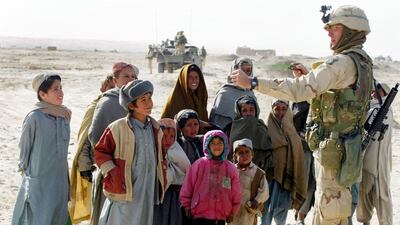
  • 101st Airbornes 1st Sgt. Kerry Black from Westmoreland, Tennessee uses an Afghan child's sling shot on February 6, 2002 as children crowd around him while he patrols on the outskirts of Kandahar, Afghanistan. Getty Images
    101st Airbornes 1st Sgt. Kerry Black from Westmoreland, Tennessee uses an Afghan child's sling shot on February 6, 2002 as children crowd around him while he patrols on the outskirts of Kandahar, Afghanistan. Getty Images
  • Marine Cpl. Jonathan Eckert of Oak Lawn, IL attached to India Battery, 3rd Battalion, 12th Marine Regiment works his improvised explosive device (IED) sniffing dog Bee as they secure a compound during a patrol near Forward Operating Base (FOB) Zeebrugge on October 11, 2010 in Kajaki, Afghanistan. Getty Images
    Marine Cpl. Jonathan Eckert of Oak Lawn, IL attached to India Battery, 3rd Battalion, 12th Marine Regiment works his improvised explosive device (IED) sniffing dog Bee as they secure a compound during a patrol near Forward Operating Base (FOB) Zeebrugge on October 11, 2010 in Kajaki, Afghanistan. Getty Images
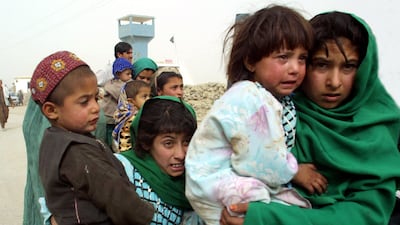
  • Afghan refugees walk across the border into Pakistan on October 11, 2001 as they leave Afghanistan at the Chaman crossing point on the 4th day of U.S.-led air strikes against the ruling Taliban and terrorist networks in the country. Getty Images
    Afghan refugees walk across the border into Pakistan on October 11, 2001 as they leave Afghanistan at the Chaman crossing point on the 4th day of U.S.-led air strikes against the ruling Taliban and terrorist networks in the country. Getty Images
  • Anti-Taliban Afghan fighters watch several explosions from U.S. bombings in the Tora Bora mountains in Afghanistan on December 16, 2001.
    Anti-Taliban Afghan fighters watch several explosions from U.S. bombings in the Tora Bora mountains in Afghanistan on December 16, 2001.
  • British Marines run under fire from the Taliban during a morning operation on March 18, 2007 near Kajaki in the Afghan province of Helmand. Getty Images
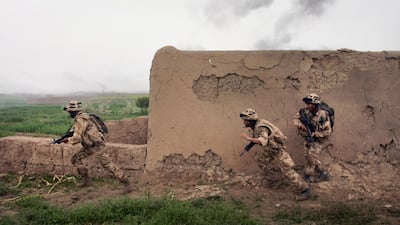
    British Marines run under fire from the Taliban during a morning operation on March 18, 2007 near Kajaki in the Afghan province of Helmand. Getty Images
  • Afghan Army troops prepare to board a British chinook helicopter from their base at Shorabak on March 12, 2007 in Southern Helmand province, Afghanistan. Getty Images
    Afghan Army troops prepare to board a British chinook helicopter from their base at Shorabak on March 12, 2007 in Southern Helmand province, Afghanistan. Getty Images
  • British Marine Joe Harvey from Stafford, England (R), watches as British forces come under fire by Taliban insurgents on March 18, 2007 near Kajaki in the Afghan province of Helmand. Getty Images
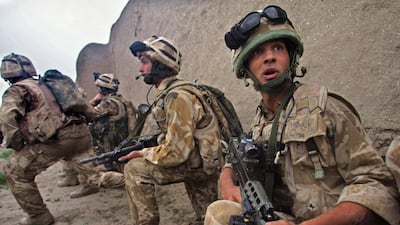
    British Marine Joe Harvey from Stafford, England (R), watches as British forces come under fire by Taliban insurgents on March 18, 2007 near Kajaki in the Afghan province of Helmand. Getty Images
  • U.S. Army 101st Airborne 3-187 "Bravo" company soliders pass through a corn field while conducting a sensitive site exploitation (SSE) mission July 23, 2002 near the town of Narizah in Southeastern Afghanistan. Getty Images
    U.S. Army 101st Airborne 3-187 "Bravo" company soliders pass through a corn field while conducting a sensitive site exploitation (SSE) mission July 23, 2002 near the town of Narizah in Southeastern Afghanistan. Getty Images
  • Scouts from 2nd Battalion, 503rd Infantry Regiment (Airborne), pull overwatch during Operation Destined Strike while 2nd Platoon, Able Company searches a village below the Chowkay Valley in Kunar Province, Afghanistan on August 22, 2006. US Army
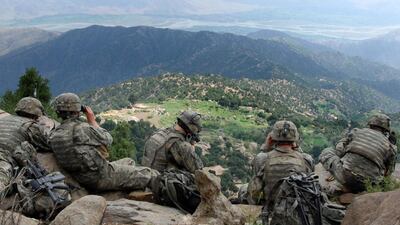
    Scouts from 2nd Battalion, 503rd Infantry Regiment (Airborne), pull overwatch during Operation Destined Strike while 2nd Platoon, Able Company searches a village below the Chowkay Valley in Kunar Province, Afghanistan on August 22, 2006. US Army

Taliban

Taliban chief Hibatullah Akhundzada says all male and female compatriots will be given their 'due rights' and calls on all Taliban fighters to abide by the agreement with the US.

Taliban lead negotiator Abdul Ghani Baradar said he hopes countries including Pakistan, Indonesia, China, Russia will take part in the future rebuilding of Afghanistan, and said he wants an Islamic system.

Nato

Nato Secretary General Jen Stoltenberg says, "We went in together in 2001, we are going to adjust [troop levels] together and when the time is right, we are going to leave together, but we are only going to leave when conditions are right."

In a statement, the organisation adds: "Recent progress on peace has ushered in a reduction of violence and paved the way for intra-Afghan negotiations between a fully inclusive Afghan national team and the Taliban to reach a comprehensive peace agreement. We call on the Taliban to embrace this opportunity for peace."

United Nations

The United Nations urges the continuation of reduced violence in Afghanistan, welcomes intra-Afghan negotiations and says it is ready to support an Afghan-led peace process that is inclusive of women, minorities and the youth.

UN Assistance Mission in Afghanistan says, "The United Nations welcomes the commitment expressed by the parties to intra-Afghan negotiations; and urges them to move ahead expeditiously with their preparations to start the negotiations, including through forming a truly representative negotiation team."

United Kingdom

UK Foreign Secretary Dominic Raab said that "meaningful negotiations between the Afghan leadership and the Taliban" will be the real prize. "I hope this opportunity will be seized," he said. "The only way to achieve lasting peace in Afghanistan is through a political solution."

Pakistan 

Pakistani Foreign Minister Shah Mahmood Qureshi says, "Pakistan had fulfilled its part of the responsibility in terms of facilitating this Peace Agreement. Pakistan will continue to support a peaceful, stable, united, democratic and prosperous Afghanistan, at peace with itself and with its neighbours."

Afghans react to the deal

Esmat, 24, Helmand province, says: "I lost a leg in the clashes between the Taliban and security forces. My father was a tribal elder and six years ago when he was travelling with my 10-year-old brother the Taliban attacked them. Both of them were killed. I listen to the radio every day to find out how far the peace talks have progressed. I support this process and pray daily that the war will end and that peace comes to my country. I really hate the war."

Zarmina, 27, in the Ghazni province town of Tehsang, says: "It was midnight when clashes between the Taliban and security forces began. I didn't know if it was a bomb or a rocket that hit my house. My husband and three daughters were killed. I saw my husband's head blown off. Two of my daughters are alive but all of us suffer from mental problems now. Yes, I am optimistic about peace talks. ... I do not know if peace will be achieved, but it is enough to just end the war."

Wahida, 19, in the Nangarhar province village of Nadir Khil, lost 12 members of her family in an air strike. She says, "I lost two brothers, eight sisters, and my parents. I was also seriously injured and not able to walk anymore. Can I forget that incident? When your family dies in front of your eyes and you hear their painful noises and are not able to help them, can you imagine how it feels? If peace comes and the agreement between the Taliban and the Afghan government is done, it will not change my life and bring me back my loved ones. But yes this will change other people's lives. They will not lose their loved ones and this matters a lot."

Hujat Ezat, 22, in Kabul, who lost his brother in an ambulance bomb in Kabul in 2018, says: "My brother Ahmad was 24 years old and it was his last year of university. He was going to the university when the explosion took place. We found only one of his feet. We were waiting for spring to celebrate his wedding, but instead of the wedding we held his funeral ... Our pain will not be cured by peace, but if peace comes at least the rest of the people will not lose their loved ones."

Analysts react to the US-Taliban deal 

President of Crisis Group Robert Malley tells The National: "No agreement is perfect, and the US-Taliban deal is no exception… But it represents the most hopeful step to end a war that has lasted two decades and taken countless American and especially Afghan lives. It ought to be celebrated, bolstered and built upon to reach a genuine intra-Afghan peace."

Kate Clark, co-director, Afghanistan Analysts Network, says, "This is not yet a peace deal it's a withdrawal deal."

"You can't help hoping for something like a momentum being created by this reduction in violence but it didn't happen after the Eid ceasefire (in 2018)… There are many hopes and many fears and many unknowns. Is the Taliban acting in good faith in terms of wanting to seriously negotiate a political settlement to the war with power sharing? Do they see the Afghan government and other Afghans as equals as negotiating partners? Because they haven't done so far. Will the Kabul side be able to get together a negotiating team and a coherent line? What does a U.S. troop withdrawal mean?"

Michael Kugelman, Asia Program deputy director, Wilson Centre, says: "The US-Taliban deal is a major achievement, given how long and fraught the negotiations were. But as tough as it was to get to the finish line, the hardest work is yet to come. An intra-Afghan dialogue will be even more complex and take much more time."