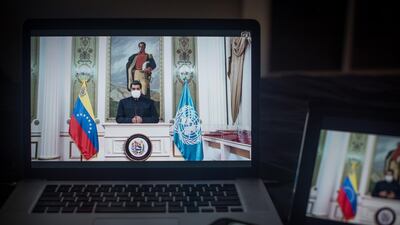

The UN General Assembly is, in normal years, held amid tight security for fear of terrorist strikes.
This year, the biggest threat is a microscopic virus, which has upended New York’s annual diplomatic jamboree.
Gone is the parade of world leaders, their motorcades, vast entourages and checkpoints manned by police wearing body armour and toting assault rifles.
The din of chanting protesters does not drift between the skyscrapers of Midtown East.
Instead, the occasional cyclist pedals along a desolate First Avenue.
Inside the General Assembly hall, diplomats wearing face masks sit two metres apart, watching pre-recorded speeches from leaders on screens and clapping politely.
For UN veterans, the 2020 assembly is more manageable than in years past.
But the lack of face-to-face diplomacy may cost a world that is increasingly riven by feuding between the US, China and others.
Ian Williams, an author, journalist and former president of the UN Correspondents Association, said coronavirus had kept leaders in their capitals but they still suffered from "oratorical incompetence".
"For 30 years I ran the gauntlet of New York police, secret service and UN security to hear mostly boring speeches," Williams told The National.
“This year I can lie in bed and watch them from my laptop.”
The highlight of any UN assembly is the General Debate, when presidents, prime ministers and kings ascend the 193-nation assembly hall’s marble dais.
This year, US President Donald Trump criticised Beijing for the “China virus” and Venezuelan leader Nicolas Maduro said Washington threatened “peace in this world”.
-
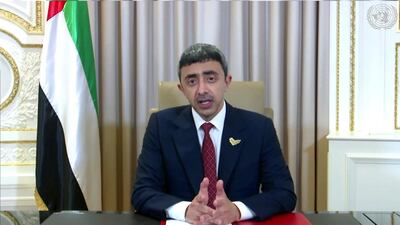
Sheikh Abdullah bin Zayed, UAE Minister of Foreign Affairs and International Cooperation, speaks in a pre-recorded message which was played during the 75th session of the United Nations General Assembly. UNTV via AP -
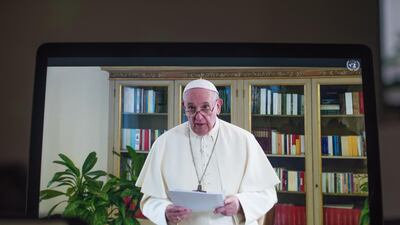
Pope Francis speaks during the United Nations General Assembly seen on a laptop computer in Hastings on the Hudson, New York, US. Bloomberg -
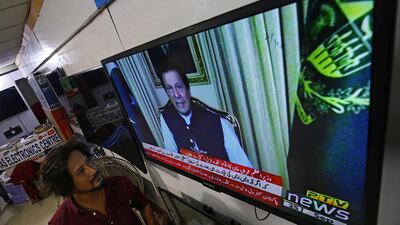
A man watches the televised speech of Pakistan's Prime Minister Imran Khan. EPA -
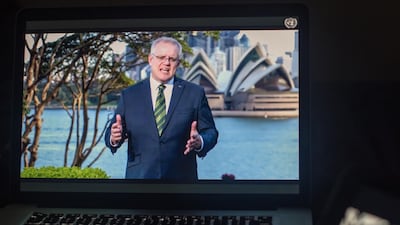
Scott Morrison, Australia's prime minister, speaks during the United Nations General Assembly. Bloomberg -
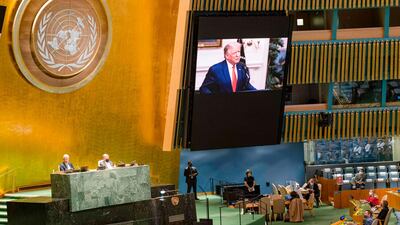
US President Donald Trump (on screen), as he addresses the general debate of the seventy-fifth session of the United Nations General Assembly. AFP -
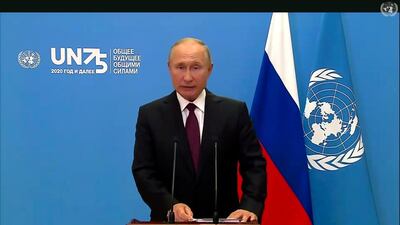
Russian President Vladimir Putin, speaks in a pre-recorded message which was played during the 75th session of the United Nations General Assembly. UNTV via AP -
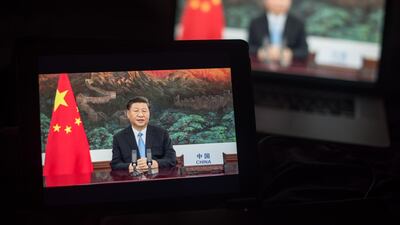
Xi Jinping, China's president, speaks during the United Nations General Assembly seen on a laptop computer. Bloomberg -
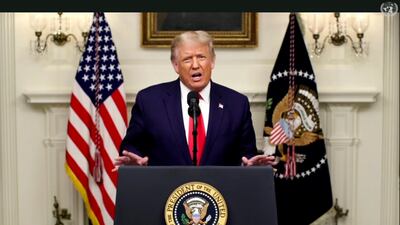
United States President Donald Trump speaks in a pre-recorded message which was played during the 75th session of the United Nations General Assembly. UNTV via AP -
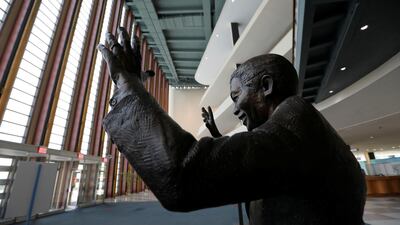
A statue of former South African President Nelson Mandela is seen in the empty arrivals hall at United Nations headquarters during the 75th annual UN General Assembly high level debate. Reuters -
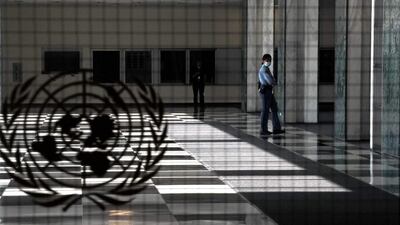
A UN police officer stands at an empty entrance at the United Nations. AFP -

Dian Triansyah Djani, left, permanent representative of Indonesia to the UN, takes a photo with Kairat Umarov, centre, permanent representative of Kazakhstan and Tijjani Muhammad-Bande former president of the General Assembly. UN via AP -
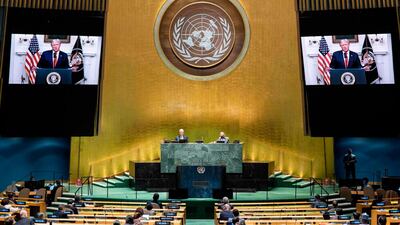
US President Donald Trump (on screen), as he addresses the general debate. AFP -
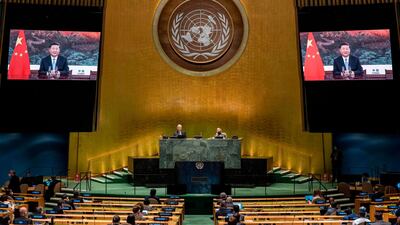
President of the People's Republic of China, Xi Jinping (on screen), as he addresses the general debate. AFP -
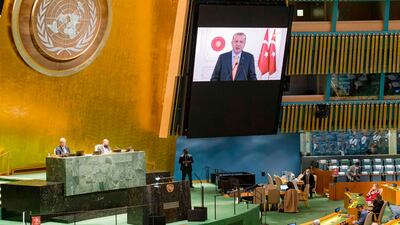
President of of Turkey, Recep Tayyip Erdogan (on screen), as he addresses the general debate. AFP -
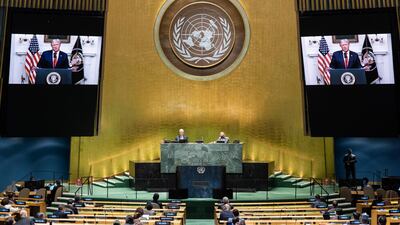
Donald Trump, president of the United States, speaks in a pre-recorded message. UN via AP -
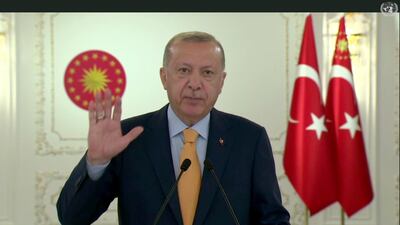
Recep Tayyip Erdogan, president of Turkey, speaks in a pre-recorded message which was played during the 75th session of the United Nations General Assembly. UNTV via AP -
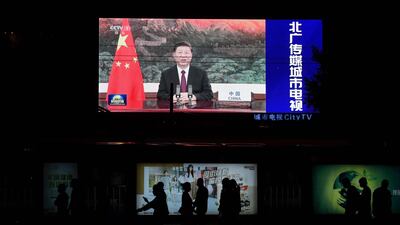
Chinese President Xi Jinping appearing by video link at the United Nations 75th anniversary is seen on an outdoor screen as pedestrians walk past below in Beijing on September 22, 2020. AFP -
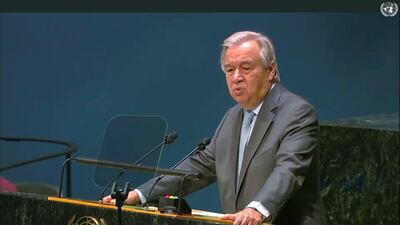
United Nations Secretary-General Antonio Guterres speaks during the 75th session of the United Nations General Assembly. UNTV Via AP -
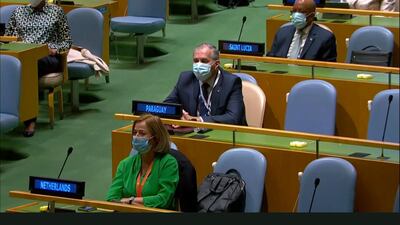
Representatives of different countries listen to speakers during the 75th session of the United Nations General Assembly. UNTV via AP -

Brazilian President Jair Bolsonaro speaks in a pre-recorded message. UNTV via AP -
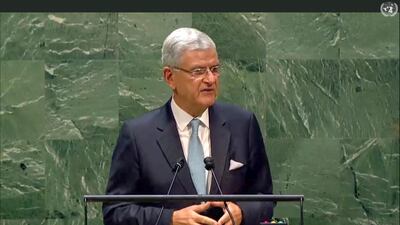
United Nations General Assembly President Volkan Bozkir, of Turkey, speaks during the 75th session of the United Nations General Assembly. UNTV via AP -
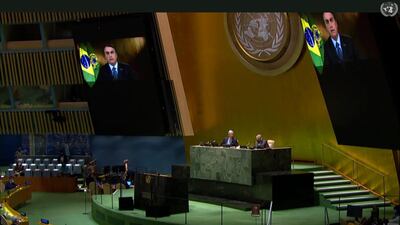
Brazilian President Jair Bolsonaro, top, speaks in a pre-recorded message being played during the 75th session of the United Nations General Assembly. UNTV via AP


But those speeches were recorded days ago. The UN’s technicians simply pressed the play button and emailed texts of the speeches to journalists.
For this reason, critics dubbed the virtual UN summit the “world’s worst Zoom meeting”.
While the broadcast was mostly seamless, the opening address by Brazilian President Jair Bolsonaro had to be restarted after an embarrassing glitch with the automatic translation for on-screen subtitles.
Speaking in Portuguese, Mr Bolsonaro railed against fake news of Amazon rainforest wildfires.
For those following the English text below, however, the populist was spouting gibberish about a “cocoa hidden danger”.
One upside, even just logistically for the UN staffers keeping the parade of important global figures on schedule, was that the recorded speeches meant leaders kept largely to their allotted time.
No one tried to challenge VK Krishna Menon's more than eight-hour address in 1957, nor did anyone come close to Fidel Castro’s 269-minute opus in 1960 or Muammar Qaddafi’s 96-minute haranguing in 2009.
The UN broadcast speeches on its YouTube channel, offering the viewing public an opportunity to add their thoughts in the comments stream – a bewildering array of emojis, slogans and slurs.
Some viewers issued political demands, such as “save the Amazon”; others conveyed yawning frustration with “Zzzzzzzzz”.
Amid the stream of leaders, one viewer even declared: "Wakanda forever", although the fictional African utopia from the 2018 Black Panther movie is not known to be seeking UN membership.
The online format did not kill all diplomatic theatre.
When Turkish President Recep Tayyip Erdogan took a swipe at Israel’s “dirty hand” on Tuesday, Israel’s ambassador Gilad Erdan walked out of the assembly hall, complaining of anti-Semitism.
Mr Erdan had more luck on Wednesday, when he sat down for the first time with UAE ambassador Lana Nusseibeh, cementing a normalisation accord signed between the two nations on the White House lawn this month.
That was one of this year’s few UN bilateral sit-downs, which are the lifeblood of UN diplomacy.
Usually, a floor of the headquarters building is filled with dozens of booths for diplomats to press the flesh and cut deals.
These are not just for bigwigs such as Mr Trump and Saudi King Salman. They are where a foreign minister from Palau can meet officials from faraway Barbados and share thoughts on rising tides and global warming.
For Volkan Bozkir, the Turkish diplomat who was recently appointed President of the General Assembly, this marked a big loss amid fighting in Libya, Yemen, Syria and Afghanistan, and cross-border tensions between India and China.
The “leaders of our nations are not personally present” when the “need for deliberation is higher than ever”, Mr Bozkir said on Tuesday.
“Rarely has the whole of humanity faced such an eminent and common threat."
The UN parley in normal years draws about 10,000 people from around the world.
But that was unthinkable at a time when countries imposed strict entrance requirements to halt the spread of Covid-19, which has claimed about 984,000 lives.

