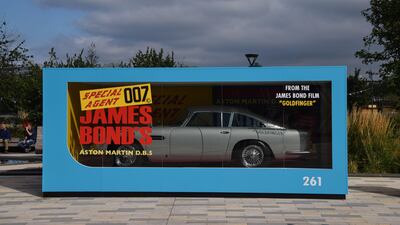
Aston Martin has announced plans to phase out combustion engine-only models by 2026 and focus on electric and hybrid cars.
Chairman Lawrence Stroll said after 2026 there will still be the option of a combustion engine vehicle, but only as a hybrid.
He was speaking as a number of rivals, including Lamborghini and Bentley, have announced their visions for a green future.
“By 2026 we will be fully electrified,” Mr Stroll said. “I can’t tell you that 100 per cent of Aston Martin customers want an electric vehicle.
“People still want the smell, the noise [of combustion engine cars]. We’re gradually going to get to full EV, but we will continue offering both [electric and hybrid].
“There will still be an electrification component, but if someone wants an internal combustion engine in 2028, that will happen.”
Carmakers across the board are looking to bring in greener cars as climate change becomes a growing concern.
At the super car end of the market, there is the added hurdle that buyers often want the noise that comes with most powerful, most finely-tuned combustion engines.
“By 2025 or 2026, even though we will have every model electrified, front engine, mid-engine, SUV, we will still continue to offer for sale, as long as there’s customer demand, hybrid versions,” Mr Stroll said.
He was speaking at the unveiling of the upgraded DBX SUV that the company hopes will grab the attention of buyers considering Lamborghini’s Uru.
Luxury Italian carmaker Lamborghini is developing its first fully electric model for the end of the decade.
“Over the past few years Lamborghini, has stabilised and consolidated thanks to Urus,’ chief executive Stephan Winkelmann said in January.
“With the hybridisation of the current range, we keep the promise of making our cars even more performing and reducing CO2 by over 50 per cent. The fourth Lamborghini model will arrive around 2028, joining the Urus, Huracan and Aventador.”
He said the electric car would still provide plenty of power and will be recognisably a Lamborghini.
Bentley said last week that its first all-electric vehicle will be ready by 2025.
It plans to offer only plug-in hybrid and electric cars by 2026 and switch its entire line-up to fully battery-powered vehicles by the end of the decade.

Results:
First Test: New Zealand 30 British & Irish Lions 15
Second Test: New Zealand 21 British & Irish Lions 24
Third Test: New Zealand 15 British & Irish Lions 15
Ferrari 12Cilindri specs
Engine: naturally aspirated 6.5-liter V12
Power: 819hp
Torque: 678Nm at 7,250rpm
Price: From Dh1,700,000
Available: Now
BMW M5 specs
Engine: 4.4-litre twin-turbo V-8 petrol enging with additional electric motor
Power: 727hp
Torque: 1,000Nm
Transmission: 8-speed auto
Fuel consumption: 10.6L/100km
On sale: Now
Price: From Dh650,000
Results:
First Test: New Zealand 30 British & Irish Lions 15
Second Test: New Zealand 21 British & Irish Lions 24
Third Test: New Zealand 15 British & Irish Lions 15
The major Hashd factions linked to Iran:
Badr Organisation: Seen as the most militarily capable faction in the Hashd. Iraqi Shiite exiles opposed to Saddam Hussein set up the group in Tehran in the early 1980s as the Badr Corps under the supervision of the Iran Revolutionary Guards Corps (IRGC). The militia exalts Iran’s Supreme Leader Ali Khamenei but intermittently cooperated with the US military.
Saraya Al Salam (Peace Brigade): Comprised of former members of the officially defunct Mahdi Army, a militia that was commanded by Iraqi cleric Moqtada Al Sadr and fought US and Iraqi government and other forces between 2004 and 2008. As part of a political overhaul aimed as casting Mr Al Sadr as a more nationalist and less sectarian figure, the cleric formed Saraya Al Salam in 2014. The group’s relations with Iran has been volatile.
Kataeb Hezbollah: The group, which is fighting on behalf of the Bashar Al Assad government in Syria, traces its origins to attacks on US forces in Iraq in 2004 and adopts a tough stance against Washington, calling the United States “the enemy of humanity”.
Asaeb Ahl Al Haq: An offshoot of the Mahdi Army active in Syria. Asaeb Ahl Al Haq’s leader Qais al Khazali was a student of Mr Al Moqtada’s late father Mohammed Sadeq Al Sadr, a prominent Shiite cleric who was killed during Saddam Hussein’s rule.
Harakat Hezbollah Al Nujaba: Formed in 2013 to fight alongside Mr Al Assad’s loyalists in Syria before joining the Hashd. The group is seen as among the most ideological and sectarian-driven Hashd militias in Syria and is the major recruiter of foreign fighters to Syria.
Saraya Al Khorasani: The ICRG formed Saraya Al Khorasani in the mid-1990s and the group is seen as the most ideologically attached to Iran among Tehran’s satellites in Iraq.
(Source: The Wilson Centre, the International Centre for the Study of Radicalisation)
