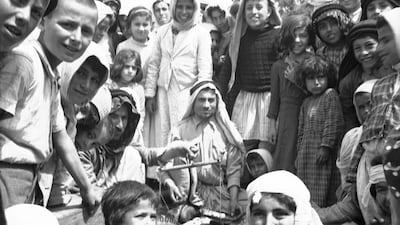
Alawites celebrate a festival in the coastal Syrian town of Baniyas during the Second World War. Alamy

Syrian tycoon scandal strikes at the heart of ruling Alawite sect


Khaled Yacoub Oweis
  • English
  • Arabic

When Hafez Al Assad died in 2000 after three decades of iron-fisted rule, he set a model of communal behaviour upended by a political and business scandal shaking his minority Alawite sect to the core.

Assad’s funeral in his home village of Qardaha in the Alawite Mountains near the Mediterranean coast was entirely Sunni, without a hint of the esoteric faith to which he belonged.

A protege cleric from Damascus, who had spent his life preaching obedience to the Assads, presided over the ceremony.

Nowhere in the televised funeral was an Alawite rite detected or an Alawite accent heard, although the sect had dominated the state and the security apparatus since mostly Alawite officers took power in a 1963 coup.

So it was highly unusual when Rami Makhlouf, Syria’s richest man and Bashar Al Assad’s cousin, partly spoke with an Alawite accent in viral Facebook videos over the past week. As a staunch backer of the Alawites, his fall from grace and apparent threat to his power base in Syria strikes at the very heart of the ruling sect.

Hafez Al Assad in Damascus in 1972. AFP

Breaking a taboo by using the sect’s religious terms in a public broadcast, Mr Makhlouf signalled that the security apparatus was moving against him because he had expanded his efforts to help fellow Alawites without permission from the top.

Mr Makhlouf made clear that in the past eight years he has been plugging perceived neglect of ordinary Alawites by supporting families who had lost members defending the regime. Before the 2011 revolt against the Assad family’s rule, the sect comprised about 10 per cent of Syria’s population, which then was 20 to 22 million.

Regional bankers who dealt with Mr Makhlouf said he has also been financing Alawite clerics the Assads had traditionally treated with suspicion because some of them had baulked at showing total obedience to the ruling family.

The tycoon’s fortune came largely from monopolies the Assads had awarded him and his father over much of the economy.

Mr Makhlouf is also widely seen as a frontman for Mr Assad and his brother Maher Al Assad, who oversees the Alawite praetorian units entrusted with defending the core of the regime.

The funeral procession of Hafez Al Assad in Damascus on June 13, 2000, before his body was flown to his home village of Qardaha for burial. AFP

Alawites have comprised most of the officer class for decades, partly as a result of their promotion in the military by the French colonialists of Syria in the 1930s and 1940s.

Still, the Assads assigned sensitive military hardware, such as artillery units within reach of the presidential palace in Damascus, only to members of Alawite clans regarded as ultra-loyalists.

Mr Makhlouf is now believed to be out of sight in the Alawite Mountains near Qardaha, the same rugged region where Hafez Al Assad’s Soviet-style mausoleum stands.

The late dictator feared being buried, as is customary among Sunni inhabitants of Damascus, as he did not trust his grave would be left unmolested in perpetuity.

In 2013 rebel groups, some linked to Al Qaeda, came close to Qardaha before being repelled, but not after overrunning several villages and killing more than 100 Alawites, as well as taking at least a similar number hostage.

Syrian tycoon Rami Makhlouf has revealed that he has a web of offshore front companies to help President Bashar Al Assad evade Western sanctions.

Many in the opposition, even secular figures, regarded the offensive as partial retribution for the hundreds of thousands of Sunni civilians who regime forces killed or disappeared since the 2011 revolt and the ensuing civil war.

But the inter-communal settling of scores has also been a hallmark of the Alawite Mountains, and members of the sect traditionally fled there when they felt their existence was at stake.

When Hafez Al Assad died in July 2000, many Alawite families left Damascus to their original mountain enclaves, fearing Sunni retribution if the succession did not work.

Mohammad Makhlouf, Rami’s father, played a central role behind the scenes in ensuring the transfer went smoothly, as did his sister Anissa, Hafez Al Assad’s late widow and Bashar Al Assad’s mother.

Syrian writer Michel Kilo in Paris on October 11, 2011. A former political prisoner, Mr Kilo was jailed for three years in the 2000s after he wrote about societal changes in his home city of Latakia prompted by a 1963 coup that ushered Alawite domination of the state. AFP

Hafez Al Assad had surrounded Bashar with Sunni figures who introduced him to Sunni urban merchant families and helped him adapt his mannerisms to fit the Sunni mainstream. Bashar married from the Al Akhrases, a Sunni family from Homs who had business dealings with the regime.

Bashar Al Assad and Rami Makhlouf were close friends before Assad became president.

But Mr Makhlouf was not liked by the two powerful brothers of Bashar: Bassel, the former heir apparent who died in a car accident in 1994, and Maher, who leads the elite Fourth Mechanised Division of the Syrian military and has expanded his business network in the past eight years.

The death of Hafez Al Assad set Mr Makhlouf on a course to become a member of an Alawite triumvirate — Bashar, Maher and himself. Some of the spoils also went to the senior Alawites who disproportionately occupied the top echelons of the army, security and the state, as well as their Sunni business associates and informants.

Syrian human rights lawyer Anwar al-Bunni poses in his office in Berlin on April 9, 2020. - When Anwar al-Bunni crossed paths with fellow Syrian Anwar Raslan in a DIY store in Germany five years ago, he recognised him as the man who had thrown him into prison around a decade earlier. On Thursday, April 23, 2020 the two men will face each other in a German court, where Raslan will be one of two alleged former Syrian intelligence officers in the dock accused of carrying out crimes against humanity for Bashar al-Assad's regime. (Photo by John MACDOUGALL / AFP)

The Alawite rise from the fringes of Syria to absolute control of the country’s resources for the past 57 years resulted in steep societal changes, compounded by the spoils of a de facto takeover of large parts of Lebanon from 1976 to 2005 and the war economy since 2012.

While researching a book on Syria in the late 1990s, Palestinian scholar Hanna Batatu sat next to a group of Alawite intelligence operatives at a bar in a state-owned hotel in Damascus.

He approached the group and started asking about their peasant backgrounds, only to be grabbed and thrown in jail. Eventually he published the work, about Syria’s peasantry, the descendants of its lesser rural notables and their politics.

A Sunni academic living in the UAE recalled that his family had an Alawite maid in their house when he was growing up in Damascus. The maid married an intelligence operative and quit in the late 1960s.

“She came a couple of years after with an armed guard in a black Mercedes, knocked on our door and ordered my mother to kiss her feet, although we had treated her as a member of our family,” he said.

His mother did as she was told. Others who challenged what they described as the Alawisation of the state were jailed.

Veteran Syrian economist Aref Dalila in Damascus in 2012. Mr Dalila was jailed fom 2001 to 2008 after he criticised the regime for awarding monopolies to Rami Makhlouf. AFP

Among them was prominent writer Michel Kilo, a Christian imprisoned in 2006 for three years after writing about officers’ tombstones in his home town of Latakia on which he observed mostly Alawite names.

The coastal city was overwhelmingly Sunni and Christian until preferential treatment attracted Alawites from the mountains to state security jobs. Latakia’s Bauhaus and Marseilles-style architecture gave way to a skyline of bland residential towers and fortress-like compounds for myriad secret police organisations.

While conducting research on the make-up of the manager class in the bureaucracy, also in 2006, Syrian human rights lawyer Anwar Al Bunni was arrested and spent five years incarcerated as a political prisoner. After his release, Mr Bunni said data he had collected indicated that the manager ranks were almost exclusively Alawite.

The regime has had few qualms about punishing Alawite dissidents. Aref Dalila, a former dean of economics at Damascus University, criticised monopolies awarded to Mr Makhlouf and was gravely ill when the regime released him in 2008 after seven years in jail on the assumption he would soon die. Against the odds, Mr Dalila survived a huge lung operation in Damascus and is now in exile in Dubai.

Abdel Aziz Al Khayyer, a friend of Mr Dalila from Qardaha, remained in Syria despite his opposition to the regime. Security forces abducted Mr Al Khayyer in 2012 and he disappeared.

But Mr Makhlouf is a casualty of the system of repression he championed. His quest for survival has exposed socio-economic rifts within the Alawites, challenging the regime’s narrative that the community is monolithic in its support for the Assads.

A European lawyer who has had close dealings with Mr Makhlouf told The National the tycoon retains support among a significant proportion of Alawites who regard the Assads as having treated them as cannon fodder, and among a long-neglected Alawite clerical establishment.

“Makhlouf’s message has been that Assad lost Lebanon and then large parts of Syria, and now he is going to sink the Alawites by targeting the only financial trustee who has been helping the community,” the lawyer said.


What to watch out for:

Algae, waste coffee grounds and orange peels will be used in the pavilion's walls and gangways

The hulls of three ships will be used for the roof

The hulls will painted to make the largest Italian tricolour in the country’s history

Several pillars more than 20 metres high will support the structure

Roughly 15 tonnes of steel will be used

Ruwais timeline

1971 Abu Dhabi National Oil Company established

1980 Ruwais Housing Complex built, located 10 kilometres away from industrial plants

1982 120,000 bpd capacity Ruwais refinery complex officially inaugurated by the founder of the UAE Sheikh Zayed

1984 Second phase of Ruwais Housing Complex built. Today the 7,000-unit complex houses some 24,000 people.  

1985 The refinery is expanded with the commissioning of a 27,000 b/d hydro cracker complex

2009 Plans announced to build $1.2 billion fertilizer plant in Ruwais, producing urea

2010 Adnoc awards $10bn contracts for expansion of Ruwais refinery, to double capacity from 415,000 bpd

2014 Ruwais 261-outlet shopping mall opens

2014 Production starts at newly expanded Ruwais refinery, providing jet fuel and diesel and allowing the UAE to be self-sufficient for petrol supplies

2014 Etihad Rail begins transportation of sulphur from Shah and Habshan to Ruwais for export

2017 Aldar Academies to operate Adnoc’s schools including in Ruwais from September. Eight schools operate in total within the housing complex.

2018 Adnoc announces plans to invest $3.1 billion on upgrading its Ruwais refinery 

2018 NMC Healthcare selected to manage operations of Ruwais Hospital

2018 Adnoc announces new downstream strategy at event in Abu Dhabi on May 13

Source: The National

Biog

Mr Kandhari is legally authorised to conduct marriages in the gurdwara

He has officiated weddings of Sikhs and people of different faiths from Malaysia, Sri Lanka, Russia, the US and Canada

Father of two sons, grandfather of six

Plays golf once a week

Enjoys trying new holiday destinations with his wife and family

Walks for an hour every morning

Completed a Bachelor of Commerce degree in Loyola College, Chennai, India

2019 is a milestone because he completes 50 years in business


GAC GS8 Specs

Engine: 2.0-litre 4cyl turbo

Power: 248hp at 5,200rpm

Torque: 400Nm at 1,750-4,000rpm

Transmission: 8-speed auto

Fuel consumption: 9.1L/100km

On sale: Now

Price: From Dh149,900

It

Director: Andres Muschietti

Starring: Bill Skarsgard, Jaeden Lieberher, Sophia Lillis, Chosen Jacobs, Jeremy Ray Taylor

Three stars

World record transfers

1. Kylian Mbappe - to Real Madrid in 2017/18 - €180 million (Dh770.4m - if a deal goes through)
2. Paul Pogba - to Manchester United in 2016/17 - €105m
3. Gareth Bale - to Real Madrid in 2013/14 - €101m
4. Cristiano Ronaldo - to Real Madrid in 2009/10 - €94m
5. Gonzalo Higuain - to Juventus in 2016/17 - €90m
6. Neymar - to Barcelona in 2013/14 - €88.2m
7. Romelu Lukaku - to Manchester United in 2017/18 - €84.7m
8. Luis Suarez - to Barcelona in 2014/15 - €81.72m
9. Angel di Maria - to Manchester United in 2014/15 - €75m
10. James Rodriguez - to Real Madrid in 2014/15 - €75m

Tamkeen's offering
  • Option 1: 70% in year 1, 50% in year 2, 30% in year 3
  • Option 2: 50% across three years
  • Option 3: 30% across five years 
Sam Smith

Where: du Arena, Abu Dhabi

When: Saturday November 24

Rating: 4/5

Company%20profile
%3Cp%3EDate%20started%3A%20January%202022%3Cbr%3EFounders%3A%20Omar%20Abu%20Innab%2C%20Silvia%20Eldawi%2C%20Walid%20Shihabi%3Cbr%3EBased%3A%20Dubai%3Cbr%3ESector%3A%20PropTech%20%2F%20investment%3Cbr%3EEmployees%3A%2040%3Cbr%3EStage%3A%20Seed%3Cbr%3EInvestors%3A%20Multiple%3C%2Fp%3E%0A
MOUNTAINHEAD REVIEW

Starring: Ramy Youssef, Steve Carell, Jason Schwartzman

Director: Jesse Armstrong

Rating: 3.5/5

Real estate tokenisation project

Dubai launched the pilot phase of its real estate tokenisation project last month.

The initiative focuses on converting real estate assets into digital tokens recorded on blockchain technology and helps in streamlining the process of buying, selling and investing, the Dubai Land Department said.

Dubai’s real estate tokenisation market is projected to reach Dh60 billion ($16.33 billion) by 2033, representing 7 per cent of the emirate’s total property transactions, according to the DLD.

CONCRETE COWBOY

Directed by: Ricky Staub

Starring: Idris Elba, Caleb McLaughlin, Jharrel Jerome

3.5/5 stars

The%20specs
%3Cp%3E%3Cstrong%3EPowertrain%3A%20%3C%2Fstrong%3ESingle%20electric%20motor%0D%3Cbr%3E%3Cstrong%3EPower%3A%20%3C%2Fstrong%3E201hp%0D%3Cbr%3E%3Cstrong%3ETorque%3A%20%3C%2Fstrong%3E310Nm%0D%3Cbr%3E%3Cstrong%3ETransmission%3A%20%3C%2Fstrong%3ESingle-speed%20auto%0D%3Cbr%3E%3Cstrong%3EBattery%3A%20%3C%2Fstrong%3E53kWh%20lithium-ion%20battery%20pack%20(GS%20base%20model)%3B%2070kWh%20battery%20pack%20(GF)%0D%3Cbr%3E%3Cstrong%3ETouring%20range%3A%20%3C%2Fstrong%3E350km%20(GS)%3B%20480km%20(GF)%0D%3Cbr%3E%3Cstrong%3EPrice%3A%20%3C%2Fstrong%3EFrom%20Dh129%2C900%20(GS)%3B%20Dh149%2C000%20(GF)%0D%3Cbr%3E%3Cstrong%3EOn%20sale%3A%3C%2Fstrong%3E%20Now%3C%2Fp%3E%0A
The specs
Engine: 2.0-litre turbo 4-cyl

Transmission: eight-speed auto

Power: 190bhp

Torque: 300Nm

Price: Dh169,900

On sale: now 

Who's who in Yemen conflict

Houthis: Iran-backed rebels who occupy Sanaa and run unrecognised government

Yemeni government: Exiled government in Aden led by eight-member Presidential Leadership Council

Southern Transitional Council: Faction in Yemeni government that seeks autonomy for the south

Habrish 'rebels': Tribal-backed forces feuding with STC over control of oil in government territory

Scoreline

Syria 1-1 Australia

Syria Al Somah 85'

Australia Kruse 40'

New schools in Dubai
Bio

Age: 25

Town: Al Diqdaqah – Ras Al Khaimah

Education: Bachelors degree in mechanical engineering

Favourite colour: White

Favourite place in the UAE: Downtown Dubai

Favourite book: A Life in Administration by Ghazi Al Gosaibi.

First owned baking book: How to Be a Domestic Goddess by Nigella Lawson.