
US forces in Syria are focused on fighting the remnants of ISIS and are not guarding oilfields as previously ordered by ex-president Donald Trump, a US defence official said Monday.
Since a US firm entered a contract last year with the Kurds in northern Syria, to help exploit oil reserves in the north-east, US troops are not involved, said Pentagon spokesman John Kirby.
The 900 US military personnel and contractors in the region "are not authorised to provide assistance to any other private company, including its employees or agents, seeking to develop oil resources in Syria," Kirby said .
The only exception is when US troops in Syria are operating under existing authorisations to protect civilians, he said, which could explain the continuing presence of US forces around the area of the oilfields.
"It's important to remember that our mission there remains to enable the enduring defeat of ISIS," he said.
The shift is more a change in tone by the new US President Joe Biden from Trump's policy for the decade-old Syrian civil war.
The main oilfields are in territory in the country's north-east, a region where the US-allied Kurdish Syrian Democratic Forces hold sway and depend on the oil for income.
-

A US military convoy patrols near the Rumaylan oil fields in Syria's Kurdish-controlled north-eastern Hassakeh province on September 17, 2020, a day before the US said it was sending more troops and vehicles to north-east Syria. AFP -
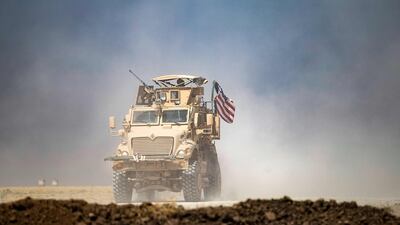
A US military vehicle patrols near the Rumaylan oil fields in Syria's Hassakeh province. AFP -
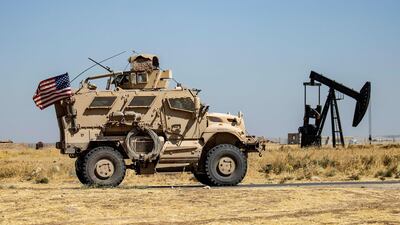
A US military vehicle passes a pumpjack in the Rumaylan oil field in north-east Syria. The major oil field, located near a US airbase, has been among the Syrian Kurds' most prized assets since regime forces withdrew early on in the Syrian civil war. AFP -
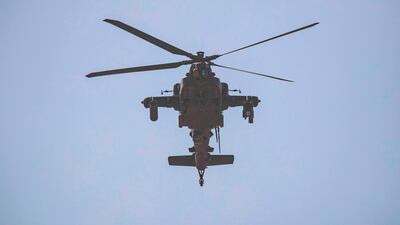
A US Apache attack helicopter flies over a field near the town of Tal Haddad in the countryside of Syria's Hassakeh province on September 15, 2020. AFP -
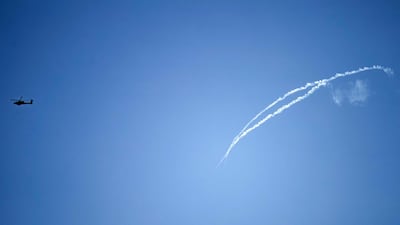
A US helicopter deploys flares as it flies over the Rumaylan oilfields in Hassakeh province on September 17, 2020. AFP -
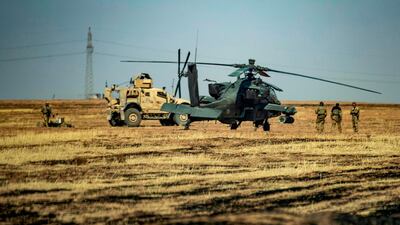
US soldiers and military vehicles stand next to an attack helicopter near the town of Tal Haddad in Syria's Hassakeh province. AFP -
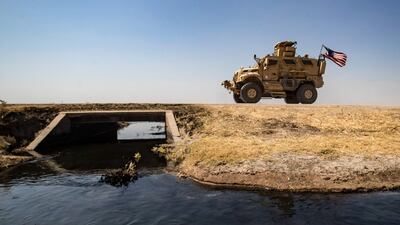
A US military vehicle patrols near the Rumaylan oil fields in Hassakeh province. AFP


In 2019, after the Syria-Iraq ISIS "caliphate" was crushed by US and allied forces, Trump declared that US troops would mostly withdraw from the country, leaving behind a residual force to "protect" the oil.
US officials said at the time that they were there to prevent the oilfields from falling into the hands of extremists.
The next year a previously unknown US oil company, Delta Crescent Energy, signed a deal with the Kurds to exploit the oil deposits.

