

Russia will leave the International Space Station programme in 2025 and concentrate on building its own space station, Deputy Prime Minister Yuri Borisov said on Sunday.
Mr Borisov, who oversees Russia’s space industry, announced the move during a television appearance to discuss the government’s plans to build a new space station with international partners.
Although many of its modules were designed to last only 15 years, the ISS is expected to remain in orbit until at least 2030.
Its first module was launched in 1998 and the first ISS crew arrived in 2000.
Russia’s space agency Roscosmos said on Sunday that the decision to leave the programme was not yet final, Russia’s Interfax news agency reported. Roscosmos has said previously that it was open to extending its participation in the project beyond 2024.
-
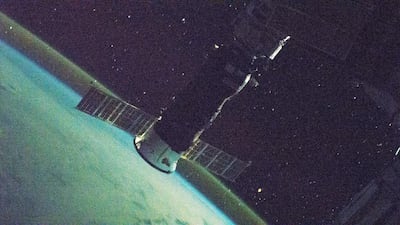
The International Space Station, pictured with Russia's ISS Progress 77 cargo craft attached to the Pirs docking compartment, orbits into a sunset 270 miles above the South Pacific on February 21, 2021. Nasa -

The ISS Progress 76 resupply ship backs away from the International Space Station after it had undocked moments earlier from the Pirs docking compartment on February 9, 2021. In the foreground is the Soyuz MS-17 crew ship docked to the Rassvet module. Nasa -
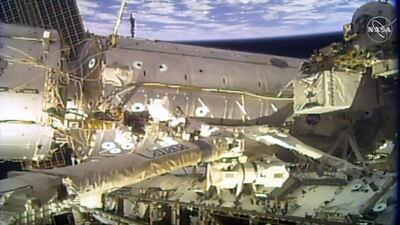
Astronauts Mike Hopkins and Victor Glover, Jr. finish a four-year effort to upgrade the International Space Station’s power system during a spacewalk on February 1, 2021. AFP -

The SpaceX Crew Dragon, centre right, the Japanese H-II Transfer Vehicle-9 resupply ship, centre bottom, and Europe's Columbus laboratory module as they figure prominently in this photograph taken during a spacewalk conducted by astronauts Bob Behnken and Chris Cassidy on July 1, 2020. Nasa -

The Cygnus resupply ship, with its prominent cymbal-shaped UltraFlex solar arrays, from Northrop Grumman pictured on March 28, 2021 attached to the International Space Station's Unity module. AFP -
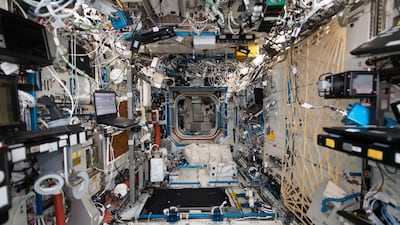
A View of the Destiny US Laboratory aboard the International Space Station. The US Laboratory Module, called Destiny, is the primary research laboratory for US payloads, supporting a wide range of experiments and studies contributing to health, safety, and quality of life for people all over the world. Nasa


“The decision will be made based on the technical condition of the station modules, which have mostly expired their service life, as well as our plans to deploy a new national orbital service station," the space agency said.
"When we make a decision, then we will start negotiations with our partners on the conditions and forms of interaction after 2024."

Russia's President Vladimir Putin said last week that the country must "retain its status as a nuclear and space power" as it marked the 60th anniversary of the pioneering space flight that saw Yuri Gagarin become the first person to reach orbit and made him a national hero.
"We will analyse what needs to be done to strengthen our position in this strategic industry," Mr Putin said.
The Russian leader called for a review of major projects and a new space development strategy over at least 10 years.
Russia's Soyuz rockets have allowed it to remain a key player in space exploration.
For nearly 10 years after the final flight of the US space shuttle programme, Soyuz rockets were the only ones certified to carry astronauts to the ISS.
The first Emirati astronaut, Hazza Al Mansouri, blasted off to the space station aboard a Soyuz rocket in 2019.
But Elon Musk's SpaceX last year delivered the first astronauts to the ISS as part of Nasa's Commercial Crew Programme, seeing off rival Boeing and ending Russia's monopoly on manned launches to the station.
A second crewed SpaceX mission to the ISS is due to take off later this week.
Russia last month marked the 20th anniversary of the de-orbit of the Soviet Union’s last national space station, Mir, which burned up in the Earth’s atmosphere at the end of a trailblazing 15-year programme.

Many of the lessons learned on board Mir fed directly into the ISS programme.
Two cosmonauts, Vladimir Titov and Musa Manarov, became the first people to spend a whole year in space on board the station during 1988.
Cosmonaut Valeri Polyakov spent 437 consecutive days aboard Mir between January 1994 and March 1995. It remains the longest-ever human space flight.
Missions like those have played a significant role in studies of the effects of long-term space flight on humans, helping protect astronauts living on the ISS.
As space agencies begin to look toward the Moon and Mars, the vital lessons will no doubt continue to protect future astronauts.

Mir also paved the way for a period of renewed co-operation in space between the US and Russia.
Roscosmos head Dmitry Rogozin has set a series of ambitious goals for the space programme in recent years, despite funding cuts.
Speaking on the anniversary of the Gagarin flight, he said Russia was "on the cusp of very important changes" that will lead to next-generation spacecraft and lunar missions.

