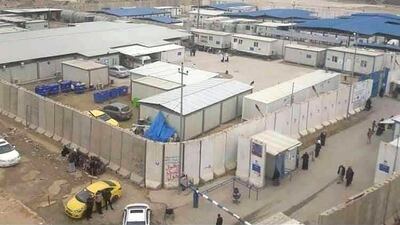
Al Batool Hospital in Mosul, where many war-damaged medical facilities are operating out of caravans. Courtesy: Facebook

‘We’re treating patients in caravans’: corruption and neglect intensify Mosul’s coronavirus crisis


  • English
  • Arabic

The doctor stood in his green scrubs and watched as a civilian frantically pumped at the lifeless man’s chest in the hospital forecourt. As bystanders gesticulated at the medic, he walked away from the stretcher. They gave chase, and the first to reach him lunged with a kick, a punch and a push.

The assault at eastern Mosul’s Shifaa Hospital in July, captured on CCTV, is just one of a series of attacks on medics in the northern Iraqi city since the Covid-19 outbreak began.

At the Ibn Sina hospital in the city’s west, the coronavirus attacks the patients and, when they succumb to it, their relatives attack the medics who tried to save them with minimal resources.

“We are used to the fights and people shouting,” said Fayez Ibrahim, the hospital’s general manager. “This is done to show their families that they’ve done something to help save their lives.”

Ibn Sina’s emergency department has just 30 beds but has been receiving up to 300 patients a day, Mr Ibrahim said. Those admitted are usually at the most critical stage of the disease, leaving the medics helpless to save them and facing the wrath of patients' families.

A photo purportedly showing patients sleeping in the corridors of Ibn Sina hospital in Mosul, which was shared widely on social media by Muslawis and provided to The National by activists and doctors in the Iraqi city.

At least 12 doctors and activists from Iraq's second city interviewed by The National, many who asked not to be identified for fear of government or militia reprisals, say this anger is misplaced.

They speak of an underreported crisis of great proportions, one spiralling out of control because of a shortfall of equipment, support and services. They say the lack of medical facilities has been exacerbated by a four-year occupation by ISIS militants, state corruption and neglect by local and national authorities.

Heavy bombardment during the battle to wrest Mosul from ISIS, which ended in December 2017, left the city’s medical facilities in tatters. Medical workers faced up to the threat of attacks at hospitals throughout the campaign, especially women, and Red Crescent ambulances were routinely looted.

Now the city’s medics are having to use ill-equipped, makeshift facilities to cope with the demand for treatment of Covid-19 patients. The national art gallery of Nineveh, the province in which Mosul lies, has been converted into a quarantine site and at least two medical facilities are now operating out of caravans.

We are now in 2020 and we don't have proper hospitals, we are treating patients in caravans

Health workers have the capacity to conduct only 200 tests a day, according to activists and medics, meaning Mosul’s coronavirus crisis could be much worse than reported. Mr Ibrahim said bed space has fallen from 1,800 before the ISIS occupation in 2014 to less than 1,000 at present.

“The main problem we are facing is working in a hospital that has the right facilities to cater to a patient's needs: in Mosul, we don’t have that option,” said Okba Al Obeidi, a cardiovascular surgeon.

“We are now in 2020 and we don’t have proper hospitals, we are treating patients in caravans.”

The flood of Covid-19 cases has led to patients lying in hospital corridors or outside, activists say. Medics say they are unable to treat illnesses such as cancer, diabetes or leukaemia.

Iraq has recorded at least 467,000 cases of Covid-19, including 10,815 deaths. Precise numbers in Mosul are harder to come by but those interviewed said hundreds of cases were being reported daily.

NGOs warn the situation will only get worsen unless the Iraqi government acts.

“The health sector in Mosul is affected by years of conflicts and violence, it is hard to cope with the increasing numbers of Covid-19 cases in the city, especially since most health facilities are still damaged,” said Sahar Tawfeeq, spokesperson for the International Committee of the Red Cross, which has helped to repair some health facilities and is providing protective equipment to medics in the city.

But the medics and activists say another obstacle stands in the way of Mosul reaching the capacity required: rampant corruption.

Muslawis point the finger at the highest levels of government as well as local officials, accusing them of striking deals that line their pockets and risk the health of the residents. The former governor of Nineveh, Nawfal Akoub, was arrested last month along with officials close to him for allegedly embezzling $64 million of public funds.

The money had been designated for the reconstruction of Mosul, including the rebuilding of two hospitals and support for those who lost their homes in the war against ISIS. Mosul mayor Zuhair Al Araji has had several charges of corruption levelled against him by various Iraqi officials, but remains in power. The National was not able to reach Mr Al Araji for comment on the matter.

“Corruption is rife in the health sector, we don’t know where the money is going. We are not aware of what humanitarian organisations are doing in the city and there is no co-ordination between the local health sector and medical organisations,” said Abdul Wahid Al Jubouri, resident doctor at Ibn Sina hospital.

“Most of the projects are filled with corrupt deals that are being done at the expense of poor and innocent people.”

Abdul Wahid Al Jubouri, resident doctor at Ibn Sina hospital in Mosul. Courtesy of Dr Al Jubouri

Another doctor, a woman, said: “The government has allocated money to us but we don’t know where it's going or how it’s been spent, we’ve not seen any development since the fall of ISIS.”

Others suggested that the international community provide aid by circumventing local and national authorities to ensure that Mosul’s health system receives the funds it needs. “Money is being given but we are not seeing the results on the ground,” a male medic said.

A common feeling among Mosul’s majority-Sunni population, which stood at two million before the ISIS occupation in June 2014, accuse the Shiite-dominated government of neglecting the city after its liberation, sanctioning financial and health resources to Baghdad and other southern cities instead.

Responding to claims that the Iraqi government is not doing enough for Mosul in the pandemic, Dr Jassim Al Falhy, Iraq’s deputy health and environment minister, said the city’s health infrastructure was not functioning properly because of the “destruction in the city caused by ISIS”.

The militant group used at least one major Mosul hospital as a base for two years, and occupied several other medical facilities in the city, according to Human Rights Watch, putting staff and patients at risk.

“The health ministry in Baghdad has increased its efforts since the liberation of Mosul to help rehabilitate the city’s health care system and infrastructure, despite the lack of funding it currently faces,” Dr Al Falhy said, pointing to makeshift facilities, or caravans, built by the government in the city to increase medical capacity.

“Of course, Covid-19 has played a heavy toll on the city’s healthcare system following years of wars and conflict, lack of security and stability and the great challenges it faces from terrorism,” he said. “The ministry has done everything it can to rehabilitate a number of health and medical centres as well as hospitals that existed in the city.”

Dr Al Falhy did not respond to a request for comment about the claims of rampant corruption in Mosul’s health system and the effect it may have had in exacerbating the city’s coronavirus crisis.

A photo circulated on social media and given to The National by activists and doctors in Mosul purportedly shows patients sleeping on the floor at Ibn Sina hospital.

Coupled with the city’s dilapidated facilities, a deeper societal issue has promoted exposure to the coronavirus, medics say. Because of the stigma attached to becoming infected, people including doctors and nurses refuse to reveal it when they test positive for the virus.

“No one will ever say that they are sick, that’s the primary problem. Even the doctors won’t say they have the virus,” said one Muslawi doctor.

At least 20 per cent of the city’s medics have tested positive for coronavirus, according to Dr Al Obeidi, who said that figure would rise to 30 per cent if testing increased.

“Doctors are being infected because their clinics are not prepared to tackle the virus, they don’t know what to do to avoid getting the disease,” said another Muslawi doctor.

“If you had animals or pets in these clinics, they could not stand being there.”

Despite the array of problems facing the city, it is Mosul's own communities that are leading the way in helping health officials to cope with the pandemic.

A mosque in the centre of the city, Al Rahma, has been collecting donations to buy medicine and oxygen tanks. Those who have no income are told to go to the mosque to receive the right treatment so they can self-isolate at home, according to one Muslawi activist.

Families who can afford an oxygen tank are buying their own and staying at home, preparing for the worst in the knowledge they will not be able to receive adequate treatment from a hospital. The price of an oxygen tank has risen from 60,000 Iraqi dinars ($50) to 250,000 Iraqi dinars since the pandemic began, according to Omar Mohammed, the founder of Mosul Eye, a blog focused on the city. It is a sum that many in the war-wracked city do not have. To refill a tank costs 6,000 Iraqi dinars.

Although some doctors have returned to Mosul to help, the city is still suffering from a brain drain, with many of top professionals fleeing to better conditions elsewhere, including in Iraqi Kurdistan.

It is a hard choice for doctors: leave your hometown, or stay and risk death? Several years ago, it was the prospect of being killed by ISIS, now it is the threat of the coronavirus.

Dr Al Obeidi and his colleagues are calling on the government to prioritise Mosul once again.

“We have suffered in unimaginable ways. We hope that the central government and the international community will help us. We need action to offer the right treatment to the public and to do our jobs,” he said.

“Our message, as doctors and residents, is that the process of rebuilding the city and its medical facilities, clinics and hospitals must be implemented as soon as possible.”

For Mr Ibrahim, the head of one of Mosul’s only functioning facilities, the city can no longer rely on hope and prayer alone.

“God has protected and guided us through this pandemic,” he said, “but we need more support.”

AIR
%3Cp%3E%3Cstrong%3EDirector%3A%20%3C%2Fstrong%3EBen%20Affleck%3Cbr%3E%3Cbr%3E%3Cstrong%3EStars%3A%20%3C%2Fstrong%3EMatt%20Damon%2C%20Jason%20Bateman%2C%20Ben%20Affleck%2C%20Viola%20Davis%3Cbr%3E%3Cbr%3E%3Cstrong%3ERating%3A%3C%2Fstrong%3E%204%2F5%3C%2Fp%3E%0A
HEADLINE HERE
  • I would recommend writing out the text in the body 
  • And then copy into this box
  • It can be as long as you link
  • But I recommend you use the bullet point function (see red square)
  • Or try to keep the word count down
  • Be wary of other embeds lengthy fact boxes could crash into 
  • That's about it
Evacuations to France hit by controversy
  • Over 500 Gazans have been evacuated to France since November 2023
  • Evacuations were paused after a student already in France posted anti-Semitic content and was subsequently expelled to Qatar
  • The Foreign Ministry launched a review to determine how authorities failed to detect the posts before her entry
  • Artists and researchers fall under a programme called Pause that began in 2017
  • It has benefited more than 700 people from 44 countries, including Syria, Turkey, Iran, and Sudan
  • Since the start of the Gaza war, it has also included 45 Gazan beneficiaries
  • Unlike students, they are allowed to bring their families to France
The%20Mother%20
%3Cp%3E%3Cstrong%3EDirector%3A%3C%2Fstrong%3E%20Niki%20Caro%26nbsp%3B%3C%2Fp%3E%0A%3Cp%3E%3Cstrong%3EStars%3A%3C%2Fstrong%3E%20Jennifer%20Lopez%2C%20Joseph%20Fiennes%2C%20Gael%20Garcia%20Bernal%2C%20Omari%20Hardwick%20and%20Lucy%20Paez%3C%2Fp%3E%0A%3Cp%3E%3Cstrong%3ERating%3A%3C%2Fstrong%3E%203%2F5%3C%2Fp%3E%0A
Lexus LX700h specs

Engine: 3.4-litre twin-turbo V6 plus supplementary electric motor

Power: 464hp at 5,200rpm

Torque: 790Nm from 2,000-3,600rpm

Transmission: 10-speed auto

Fuel consumption: 11.7L/100km

On sale: Now

Price: From Dh590,000

Mercer, the investment consulting arm of US services company Marsh & McLennan, expects its wealth division to at least double its assets under management (AUM) in the Middle East as wealth in the region continues to grow despite economic headwinds, a company official said.

Mercer Wealth, which globally has $160 billion in AUM, plans to boost its AUM in the region to $2-$3bn in the next 2-3 years from the present $1bn, said Yasir AbuShaban, a Dubai-based principal with Mercer Wealth.

Within the next two to three years, we are looking at reaching $2 to $3 billion as a conservative estimate and we do see an opportunity to do so,” said Mr AbuShaban.

Mercer does not directly make investments, but allocates clients’ money they have discretion to, to professional asset managers. They also provide advice to clients.

“We have buying power. We can negotiate on their (client’s) behalf with asset managers to provide them lower fees than they otherwise would have to get on their own,” he added.

Mercer Wealth’s clients include sovereign wealth funds, family offices, and insurance companies among others.

From its office in Dubai, Mercer also looks after Africa, India and Turkey, where they also see opportunity for growth.

Wealth creation in Middle East and Africa (MEA) grew 8.5 per cent to $8.1 trillion last year from $7.5tn in 2015, higher than last year’s global average of 6 per cent and the second-highest growth in a region after Asia-Pacific which grew 9.9 per cent, according to consultancy Boston Consulting Group (BCG). In the region, where wealth grew just 1.9 per cent in 2015 compared with 2014, a pickup in oil prices has helped in wealth generation.

BCG is forecasting MEA wealth will rise to $12tn by 2021, growing at an annual average of 8 per cent.

Drivers of wealth generation in the region will be split evenly between new wealth creation and growth of performance of existing assets, according to BCG.

Another general trend in the region is clients’ looking for a comprehensive approach to investing, according to Mr AbuShaban.

“Institutional investors or some of the families are seeing a slowdown in the available capital they have to invest and in that sense they are looking at optimizing the way they manage their portfolios and making sure they are not investing haphazardly and different parts of their investment are working together,” said Mr AbuShaban.

Some clients also have a higher appetite for risk, given the low interest-rate environment that does not provide enough yield for some institutional investors. These clients are keen to invest in illiquid assets, such as private equity and infrastructure.

“What we have seen is a desire for higher returns in what has been a low-return environment specifically in various fixed income or bonds,” he said.

“In this environment, we have seen a de facto increase in the risk that clients are taking in things like illiquid investments, private equity investments, infrastructure and private debt, those kind of investments were higher illiquidity results in incrementally higher returns.”

The Abu Dhabi Investment Authority, one of the largest sovereign wealth funds, said in its 2016 report that has gradually increased its exposure in direct private equity and private credit transactions, mainly in Asian markets and especially in China and India. The authority’s private equity department focused on structured equities owing to “their defensive characteristics.”

In%20the%20Land%20of%20Saints%20and%20Sinners
%3Cp%3E%3Cstrong%3EDirector%3A%20%3C%2Fstrong%3ERobert%20Lorenz%3C%2Fp%3E%0A%3Cp%3E%3Cstrong%3EStarring%3A%3C%2Fstrong%3E%20Liam%20Neeson%2C%20Kerry%20Condon%2C%20Jack%20Gleeson%2C%20Ciaran%20Hinds%3C%2Fp%3E%0A%3Cp%3E%3Cstrong%3ERating%3A%20%3C%2Fstrong%3E2%2F5%3C%2Fp%3E%0A
NO OTHER LAND

Director: Basel Adra, Yuval Abraham, Rachel Szor, Hamdan Ballal

Stars: Basel Adra, Yuval Abraham

Rating: 3.5/5

The specs

Engine: 5.0-litre supercharged V8

Transmission: Eight-speed auto

Power: 575bhp

Torque: 700Nm

Price: Dh554,000

On sale: now

The specs

Engine: Turbocharged four-cylinder 2.7-litre

Power: 325hp

Torque: 500Nm

Transmission: 10-speed automatic

Price: From Dh189,700

On sale: now

Email sent to Uber team from chief executive Dara Khosrowshahi

From: Dara

To: Team@

Date: March 25, 2019 at 11:45pm PT

Subj: Accelerating in the Middle East

Five years ago, Uber launched in the Middle East. It was the start of an incredible journey, with millions of riders and drivers finding new ways to move and work in a dynamic region that’s become so important to Uber. Now Pakistan is one of our fastest-growing markets in the world, women are driving with Uber across Saudi Arabia, and we chose Cairo to launch our first Uber Bus product late last year.

Today we are taking the next step in this journey—well, it’s more like a leap, and a big one: in a few minutes, we’ll announce that we’ve agreed to acquire Careem. Importantly, we intend to operate Careem independently, under the leadership of co-founder and current CEO Mudassir Sheikha. I’ve gotten to know both co-founders, Mudassir and Magnus Olsson, and what they have built is truly extraordinary. They are first-class entrepreneurs who share our platform vision and, like us, have launched a wide range of products—from digital payments to food delivery—to serve consumers.

I expect many of you will ask how we arrived at this structure, meaning allowing Careem to maintain an independent brand and operate separately. After careful consideration, we decided that this framework has the advantage of letting us build new products and try new ideas across not one, but two, strong brands, with strong operators within each. Over time, by integrating parts of our networks, we can operate more efficiently, achieve even lower wait times, expand new products like high-capacity vehicles and payments, and quicken the already remarkable pace of innovation in the region.

This acquisition is subject to regulatory approval in various countries, which we don’t expect before Q1 2020. Until then, nothing changes. And since both companies will continue to largely operate separately after the acquisition, very little will change in either teams’ day-to-day operations post-close. Today’s news is a testament to the incredible business our team has worked so hard to build.

It’s a great day for the Middle East, for the region’s thriving tech sector, for Careem, and for Uber.

Uber on,

Dara

The%C2%A0specs%20
%3Cp%3E%3Cstrong%3EEngine%3A%3C%2Fstrong%3E%204-cylinder%202.0L%20TSI%0D%3Cbr%3E%3Cstrong%3ETransmission%3A%3C%2Fstrong%3E%20Dual%20clutch%207-speed%0D%3Cbr%3E%3Cstrong%3EPower%3A%3C%2Fstrong%3E%20320HP%20%2F%20235kW%0D%3Cbr%3E%3Cstrong%3ETorque%3A%3C%2Fstrong%3E%20400Nm%0D%3Cbr%3E%3Cstrong%3EPrice%3A%20%3C%2Fstrong%3Efrom%20%2449%2C709%20%0D%3Cbr%3E%3Cstrong%3EOn%20sale%3A%3C%2Fstrong%3E%20now%3C%2Fp%3E%0A
Key findings of Jenkins report
  • Founder of the Muslim Brotherhood, Hassan al Banna, "accepted the political utility of violence"
  • Views of key Muslim Brotherhood ideologue, Sayyid Qutb, have “consistently been understood” as permitting “the use of extreme violence in the pursuit of the perfect Islamic society” and “never been institutionally disowned” by the movement.
  • Muslim Brotherhood at all levels has repeatedly defended Hamas attacks against Israel, including the use of suicide bombers and the killing of civilians.
  • Laying out the report in the House of Commons, David Cameron told MPs: "The main findings of the review support the conclusion that membership of, association with, or influence by the Muslim Brotherhood should be considered as a possible indicator of extremism."
UAE v Gibraltar

What: International friendly

When: 7pm kick off

Where: Rugby Park, Dubai Sports City

Admission: Free

Online: The match will be broadcast live on Dubai Exiles’ Facebook page

UAE squad: Lucas Waddington (Dubai Exiles), Gio Fourie (Exiles), Craig Nutt (Abu Dhabi Harlequins), Phil Brady (Harlequins), Daniel Perry (Dubai Hurricanes), Esekaia Dranibota (Harlequins), Matt Mills (Exiles), Jaen Botes (Exiles), Kristian Stinson (Exiles), Murray Reason (Abu Dhabi Saracens), Dave Knight (Hurricanes), Ross Samson (Jebel Ali Dragons), DuRandt Gerber (Exiles), Saki Naisau (Dragons), Andrew Powell (Hurricanes), Emosi Vacanau (Harlequins), Niko Volavola (Dragons), Matt Richards (Dragons), Luke Stevenson (Harlequins), Josh Ives (Dubai Sports City Eagles), Sean Stevens (Saracens), Thinus Steyn (Exiles)

Tips for newlyweds to better manage finances

All couples are unique and have to create a financial blueprint that is most suitable for their relationship, says Vijay Valecha, chief investment officer at Century Financial. He offers his top five tips for couples to better manage their finances.

Discuss your assets and debts: When married, it’s important to understand each other’s personal financial situation. It’s necessary to know upfront what each party brings to the table, as debts and assets affect spending habits and joint loan qualifications. Discussing all aspects of their finances as a couple prevents anyone from being blindsided later.

Decide on the financial/saving goals: Spouses should independently list their top goals and share their lists with one another to shape a joint plan. Writing down clear goals will help them determine how much to save each month, how much to put aside for short-term goals, and how they will reach their long-term financial goals.

Set a budget: A budget can keep the couple be mindful of their income and expenses. With a monthly budget, couples will know exactly how much they can spend in a category each month, how much they have to work with and what spending areas need to be evaluated.

Decide who manages what: When it comes to handling finances, it’s a good idea to decide who manages what. For example, one person might take on the day-to-day bills, while the other tackles long-term investments and retirement plans.

Money date nights: Talking about money should be a healthy, ongoing conversation and couples should not wait for something to go wrong. They should set time aside every month to talk about future financial decisions and see the progress they’ve made together towards accomplishing their goals.

'The Sky is Everywhere'

Director:Josephine Decker

Stars:Grace Kaufman, Pico Alexander, Jacques Colimon

Rating:2/5

'Gold'

Director:Anthony Hayes

Stars:Zaf Efron, Anthony Hayes

Rating:3/5

Boston%20Strangler
%3Cp%3E%3Cstrong%3EDirector%3A%3C%2Fstrong%3E%20Matt%20Ruskin%3Cbr%3E%3Cstrong%3EStarring%3A%20%3C%2Fstrong%3EKeira%20Knightley%2C%20Carrie%20Coon%2C%20Alessandro%20Nivola%3Cbr%3E%3Cstrong%3ERating%3A%3C%2Fstrong%3E%203%2F5%3Cbr%3E%3C%2Fp%3E%0A
MATCH RESULT

Liverpool 4 Brighton and Hove Albion 0
Liverpool: 
Salah (26'), Lovren (40'), Solanke (53'), Robertson (85')    

Overall standings

1. Christopher Froome (GBR/Sky) 68hr 18min 36sec,

2. Fabio Aru (ITA/AST) at 0:18.

3. Romain Bardet (FRA/ALM) 0:23.

4. Rigoberto Uran (COL/CAN) 0:29.

5. Mikel Landa (ESP/SKY) 1:17.

Veil (Object Lessons)
Rafia Zakaria
​​​​​​​Bloomsbury Academic

Fast%20X
%3Cp%3E%3Cstrong%3EDirector%3A%3C%2Fstrong%3E%20Louis%20Leterrier%3C%2Fp%3E%0A%3Cp%3E%3Cstrong%3EStars%3A%3C%2Fstrong%3E%20Vin%20Diesel%2C%20Michelle%20Rodriguez%2C%20Jason%20Statham%2C%20Tyrese%20Gibson%2C%20Ludacris%2C%20Jason%20Momoa%2C%20John%20Cena%2C%20Jordana%20Brewster%2C%20Nathalie%20Emmanuel%2C%20Sung%20Kang%2C%20Brie%20Larson%2C%20Helen%20Mirren%20and%20Charlize%20Theron%3C%2Fp%3E%0A%3Cp%3E%3Cstrong%3ERating%3A%3C%2Fstrong%3E%203%2F5%3C%2Fp%3E%0A
Profile

Company: Libra Project

Based: Masdar City, ADGM, London and Delaware

Launch year: 2017

Size: A team of 12 with six employed full-time

Sector: Renewable energy

Funding: $500,000 in Series A funding from family and friends in 2018. A Series B round looking to raise $1.5m is now live.

Gulf Under 19s final

Dubai College A 50-12 Dubai College B

World record transfers

1. Kylian Mbappe - to Real Madrid in 2017/18 - €180 million (Dh770.4m - if a deal goes through)
2. Paul Pogba - to Manchester United in 2016/17 - €105m
3. Gareth Bale - to Real Madrid in 2013/14 - €101m
4. Cristiano Ronaldo - to Real Madrid in 2009/10 - €94m
5. Gonzalo Higuain - to Juventus in 2016/17 - €90m
6. Neymar - to Barcelona in 2013/14 - €88.2m
7. Romelu Lukaku - to Manchester United in 2017/18 - €84.7m
8. Luis Suarez - to Barcelona in 2014/15 - €81.72m
9. Angel di Maria - to Manchester United in 2014/15 - €75m
10. James Rodriguez - to Real Madrid in 2014/15 - €75m

How%20champions%20are%20made
%3Cp%3E%0D%3Cstrong%3EDiet%3C%2Fstrong%3E%20%0D%3Cbr%3E7am%20-%20Protein%20shake%20with%20oats%20and%20fruits%0D%3Cbr%3E10am%20-%205-6%20egg%20whites%0D%3Cbr%3E1pm%20-%20White%20rice%20or%20chapati%20(Indian%20bread)%20with%20chicken%0D%3Cbr%3E4pm%20-%20Dry%20fruits%20%0D%3Cbr%3E7.30pm%20-%20Pre%20workout%20meal%20%E2%80%93%20grilled%20fish%20or%20chicken%20with%20veggies%20and%20fruits%0D%3Cbr%3E8.30pm%20to%20midnight%20workout%0D%3Cbr%3E12.30am%20%E2%80%93%20Protein%20shake%20%0D%3Cbr%3E%3Cstrong%3ETotal%20intake%3A%3C%2Fstrong%3E%204000-4500%20calories%20%0D%3Cbr%3E%3Cstrong%3ESaidu%E2%80%99s%20weight%3A%3C%2Fstrong%3E%20110%20kg%0D%3Cbr%3E%3Cstrong%3EStats%3A%3C%2Fstrong%3E%20Biceps%2019%20inches.%20Forearms%2018%20inches%3C%2Fp%3E%0A
